Absorption of beta particles by lead

Click For Summary

Discussion Overview

The discussion revolves around the absorption of beta particles emitted from a strontium-90 source by varying thicknesses of lead. Participants explore the experimental results, questioning the expected behavior of beta particles and the implications of the observed count rates.

Discussion Character

  • Exploratory, Technical explanation, Debate/contested, Experimental/applied

Main Points Raised

  • The initial experiment showed unexpected count rates with increasing lead thickness, leading to questions about the absorption characteristics of beta particles from strontium-90.
  • Some participants suggest that the count rates might be influenced by background radiation, questioning the validity of the measurements with lead.
  • There is a suspicion of typographical errors in the reported count rates, particularly regarding the relationship between lead thickness and count rate.
  • Bremsstrahlung radiation is mentioned, with some arguing that it would not be significantly attenuated by a few millimeters of lead.
  • Discussion includes the potential decay of strontium-90 into yttrium-90, which has a different emission profile and could affect the observed results.
  • Participants emphasize the importance of experimental setup details, such as geometry and detector sensitivity, in interpreting the results.

Areas of Agreement / Disagreement

Participants express disagreement regarding the interpretation of the count rates and the expected behavior of beta particles. There is no consensus on the reasons for the observed data or the validity of the measurements.

Contextual Notes

Participants note the potential for background radiation affecting measurements, the need for accurate reporting of data, and the complexities introduced by the decay of strontium-90 into yttrium-90. The discussion highlights uncertainties in the experimental setup and the interpretation of results.

Who May Find This Useful

Individuals interested in experimental physics, radiation detection, and the behavior of beta particles in shielding materials may find this discussion relevant.

Elbow_Patches
Messages
4
Reaction score
0
TL;DR
What thickness of lead would you expect a strontium-90 beta source to penetrate?
Hello everyone,

We conducted an experiment with a strontium-90 source and some different thicknesses of lead.
With 2.1mm of lead the count rate (corrected for the background) was 0.69 counts per second,
3.0mm 19.7cps
6.8mm 15.4cps
13.8mm 10.0 cps

This would indicate that the thicker the lead, the more the absorption, the lower the count. Which makes sense, but shouldn't the 2.1mm have been thick enough to stop all beta particles from passing through? According to some data I've found (figure 1) for a beta particle to penetrate 1mm of lead would require an energy of about 1-2 MeV, when you'd expect an Sr-90 source to emit them with about 0.5MeV.

So, what do you think? Are these results normal and to be expected (not the opinion of others in my department)? Has the strontium decayed into something that emits gamma? Has the strontium decayed into yttrium which then emits gamma with about 2.3MeV (so according to figure 1 it would penetrate through 1-2mm of lead)? Is the beta striking the lead and producing bremsstrahlung radiation? Something else I haven't thought of?

Any help, suggestions or musings are welcome. :)
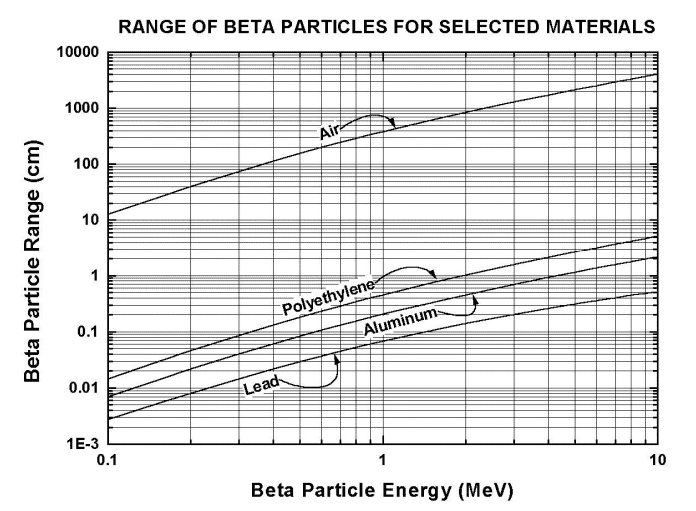
1583424742323.png
 
Physics news on Phys.org
Perhaps all of the lead thicknesses stopped all of the beta particles and all of your measurements are just background. What was the count rate with no lead?
 
  • Like
Likes   Reactions: jim mcnamara
Elbow_Patches said:
Summary:: What thickness of lead would you expect a strontium-90 beta source to penetrate?

With 2.1mm of lead the count rate (corrected for the background) was 0.69 counts per second,
3.0mm 19.7cps
I suspect a typographical error here. Surely increasing the thickness of lead by nearly 50% doesn’t increase the count rate by more than 20x. :))
 
  • Like
Likes   Reactions: Vanadium 50
Bremsstrahlung doesn't get far in lead.

Y-90 has a half life of just 64 hours, if your source isn't brand new then it will be in equilibrium and you get one Y-90 decay per Sr-90 decay. It is mainly a beta emitter at up to 2.3 MeV (to the stable Zr-90), the emission of a photon is very rare.

Something went wrong with your count rates if the weakest shielding produced by far the lowest count rate.
 
Bremsstrahlung? A few mm of lead will not attenuate 0.5 to 2 MeV Brems radiation very much. The attenuation of 0.5 MeV x-rays of 1mm Pb is only about 0.8. There even might be some characteristic x-rays too in the range 70 -90 KeV.

As with any attenuation measurement the geometry of the setup, source to attenuator distance, collimation of the beam and attenuator to detector distance, is important as well as the detector sensitivity to various types of radiation.
 
jtbell said:
Surely increasing the thickness of lead by nearly 50% doesn’t increase the count rate by more than 20x.

I think we should suspend speculation until the OP posts the correct numbers. Explaining the wrong thing may be more confusing than helpful.
 

Similar threads

  • · Replies 1 ·
Replies
1
Views
2K
  • · Replies 7 ·
Replies
7
Views
3K
  • · Replies 3 ·
Replies
3
Views
3K
  • · Replies 9 ·
Replies
9
Views
4K
Replies
1
Views
3K
  • · Replies 10 ·
Replies
10
Views
3K
  • · Replies 3 ·
Replies
3
Views
3K
  • · Replies 152 ·
6
Replies
152
Views
11K
  • · Replies 11 ·
Replies
11
Views
5K