Ac coupling and offset voltage in amplifier

Click For Summary
SUMMARY

The discussion centers on the effects of offset voltage and AC coupling in non-inverting amplifiers using operational amplifiers (op-amps). A specific example is provided where an op-amp has a closed-loop gain of 1000 and an input offset voltage of 5 mV, with output saturation levels of ±13V. The maximum input sine wave amplitude without capacitive coupling is determined to be 8 mV, while with coupling, it is 13 mV. The conversation also highlights the limitations imposed by DC offsets on amplifier performance and the complexities involved in offset cancellation.

PREREQUISITES
  • Understanding of operational amplifier (op-amp) configurations
  • Knowledge of AC coupling and its effects on signal processing
  • Familiarity with input offset voltage and its implications in amplifiers
  • Basic principles of feedback in amplifier circuits
NEXT STEPS
  • Study the impact of input offset voltage on op-amp performance
  • Learn about AC coupling techniques in amplifier design
  • Explore methods for offset voltage cancellation in op-amps
  • Investigate the role of bias currents in operational amplifier circuits
USEFUL FOR

Electronics engineers, students studying amplifier design, and anyone involved in signal processing and operational amplifier applications will benefit from this discussion.

sandy.bridge
Messages
797
Reaction score
1
Hey all,

Just a question concerning the image I have provided. If I have an offset of 0.1 mV at the non inverting input, how exactly does coupling take effect in this set up? If I input an ac signal, it will pass through the cap, but will the op-amp not still experience the offset voltage?
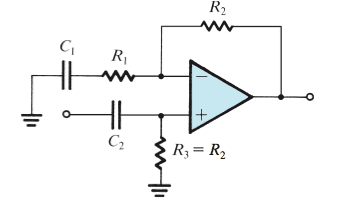
smOvE.png
 
Engineering news on Phys.org
Ignoring input bias current for the moment, a 0.1V offset at the - input means there is a 0.1mv output. That dc offset will always be there. A signal input through C2 will have that DC signal imposed on it.

Think of it this way. The opamp will output whatever is required to maintain 0.1V between + and -. Input bias currents cause a voltage drop across R2, but the effect is the same.
 
Is it not possible to utilize bypass capacitors such that the offset does not offset the input ac signal?
 
No bypass caps don't work that way. meBigGuy is right. Another way to think of it is you have a 0.1mV DC voltage source in front of one of your op amp inputs. How is a bypass cap going to do anything about that?
 
That's what I figured. There is an example in my book, however, that neglects the offset voltage that is inherent to that particular op-amp. For example, they had a nominal gain of 1000, an offset voltage of 0.03 V, and they asked the maximum input signal that would result in an ouput of 10V peak amplitude. They answered with 0.01V, which does not accout for the dc offset. I found this odd considering the dc offset was given at the beginning of the example. Just thought I would ask in case I was missing something. Thanks.
 
No worries. Offsets typically set the real-world limit to the gain you can get out of a closed-loop voltage amplifier. You can do things to cancel them but that adds complexity, of course.
 
Perfect, thanks again!
 
sandy.bridge said:
For example, they had a nominal gain of 1000, an offset voltage of 0.03 V, and they asked the maximum input signal that would result in an ouput of 10V peak amplitude. They answered with 0.01V, which does not accout for the dc offset.
Maybe the OP-AMP was powered by rails of ± 45V?
 
Here, I will display the question at hand word for word. "A non-inverting amplifier with a closed-loop gain of 1000 is designed using an op-amp having an input offset voltage of 5 mV and output saturation levels of +/-13V. What is the maximum amplitude of the sine wave that can be applied at the input without capacitive coupling and with it?" The figure with capacitive coupling was provided above already.

The answers provided by both the textbook and my professor were 8 mV without coupling, 13 mV with it.

Another question regarding the output voltage due to bias currents for the integrator with feedback resistor R_f: my textbook states that the output voltage due to the bias currents is v_o=R_fI_{OS}, however, if non-inverting input is grounded, the only current contributing to the output voltage is the bias current entering the inverting node. Hence, v_o=R_fI_{B^-}. What exactly am I missing here?
 
Last edited:

Similar threads

  • · Replies 3 ·
Replies
3
Views
3K
Replies
2
Views
2K
  • · Replies 10 ·
Replies
10
Views
2K
  • · Replies 7 ·
Replies
7
Views
2K
Replies
8
Views
2K
Replies
13
Views
3K
  • · Replies 3 ·
Replies
3
Views
2K
  • · Replies 6 ·
Replies
6
Views
2K
  • · Replies 3 ·
Replies
3
Views
4K
  • · Replies 3 ·
Replies
3
Views
1K