Acceleration and distance using derivatives.

Join the discussion
Registration is free. Ask a follow-up in this thread, or start your own.
8 replies · 3K views
Bman900
Messages
12
Reaction score
0
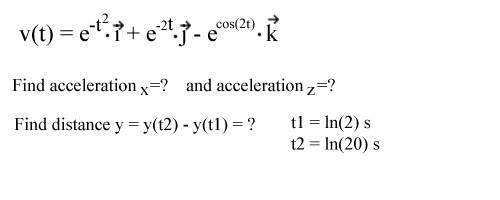
Now I understand the basic concept that if one derivative's velocity you get acceleration and if you integrate velocity you will get the distance. But what about in this case?

Homework Statement


problem1.jpg

Homework Equations


The Attempt at a Solution


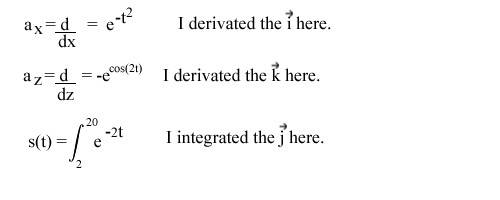
attemptedsolution-1.jpg
 
Physics news on Phys.org
You didn't differentiate properly. You need the chain rule(s).

So, I'm thinking you probably didn't integrate correctly, either.

But, we don't know, as you didn't post your results.
 
Well I didn't get to that yet because I was not sure that is the correct way of finding the answers. So am I at least derivating the right parts of the equation?
 
For what the problem is asking, yes - that's the correct approach.
 
Ok so I derivated but I could not integrate because I have only know e^x. Am looking into to solving that but please tell me if the answers so far are correct?

attemptedsolution-2.jpg
 
The a_x is correct, but not a_z. What is the derivative of cos?

And for the integration, set -2t to u, so that you integrate e^u. Don't forget that you are now integrating with respect to u!
 
Oh its -sin so the negative signs cancel out! Thanks. Am am about solve the integral here soon as I have to learn a bit more about the substitution method.