Adding Two Waveforms to find the final Phasor

Click For Summary
The discussion revolves around adding two waveforms to find the final phasor, specifically v(t) = 2cos(8t+180) + 10cos(8t+30). The phasors are converted to rectangular form for addition, resulting in a sum of 6.66 + i*5, from which the magnitude and angle are calculated. There is frustration regarding grading algorithms that require exact values for angles rather than decimal approximations, as well as confusion over the acceptable precision for answers. The importance of maintaining accuracy in phasor calculations is emphasized, especially near the zeros of the waveform, which can significantly affect the outcome. Suggestions are made to try different forms of the phasor to avoid potential grading issues.
rudy
Messages
45
Reaction score
9
Homework Statement
Find the phasor which corresponds to v(t), which is the sum of two waveforms:

v(t) = 2cos(8t+180) + 10cos(8t+30) volts

find phasor "V" for the above waveform

phase angles are given in degrees
answers are to be given in radians for exp. form, or rectangular form.
Relevant Equations
r ∠⦵ = r*e^(i*⦵) (polar to exponential notation)
rcos(wt+⦵) = r∠⦵
basic trig formulas, vector addition
v(t) = 2cos(8t+180) + 10cos(8t+30) volts
polar form
= 2∠180 + 10∠30

convert to rectangular to add vectors
= (2cos180 + i*2sin180) + (10cos30 + i*10sin30)
= (-2 + i*0) + (8.66 + i*5) = 6.66 + i*5

find ⦵ and r of sum of vectors
⦵ = arctan(5/6.66) = 0.64
r = sqrt(5^2 + 6.66^2) = 8.33

V = 8.33*e^(i*0.64) ("incorrect answer")

note: I successfully answered another phasor question using this exact entry format. For this question I have tried entering the phasor in exponential (radians and degrees just to check) as well as rectangular.

For a previous question I was graded incorrect for not using the constant "pi" in my answer, could I be missing something like that here or is there a problem with my calculation?
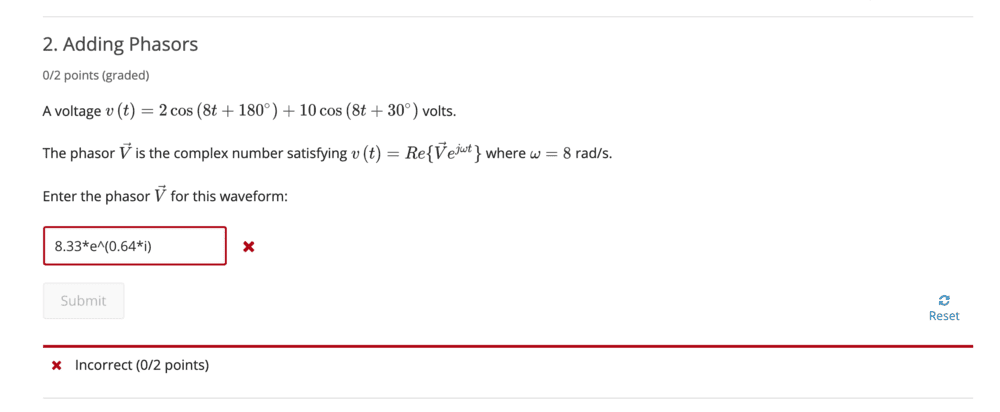
242082
 
Last edited:
Physics news on Phys.org
So I think I figured it out.

Since all the angles are nice angles like 30, 60, 180 etc. they expect you to enter answer as exact numbers (i.e. cos45 = "sqrt(2)/2" instead of "0.71"). Really frustrating that they won't accept both, especially since the instructions include a line saying "answers must be correct to 1%". I assumed that means two decimal places is acceptable.

Anyways, consider this one solved.
 
  • Like
Likes berkeman
Your answer looks close to what I got. Sometimes these "type in the box" homework/test problems can be stubborn. Have you tried degrees, or maybe more digits of precision?
Note that 1% does not necessarily mean 2 digits. Suppose the angle is pi/6 radians (30 degrees)
pi/6 in decimal is 0.5235987756 and 1% of that is .005235987756

When you get values much smaller than this, you could run into where just giving 2 digits will be more than 1% away from the true answer.
 
  • Like
Likes berkeman
Good point about the 1%. I will try more decimals for some of the others because I am still having some entry problems.
 
rudy said:
Since all the angles are nice angles like 30°, 60°, 180° etc. they expect you to enter answer as exact numbers (i.e. cos45° = "sqrt(2)/2" instead of "0.71"). Really frustrating that they won't accept both, especially since the instructions include a line saying "answers must be correct to 1%". I assumed that means two decimal places is acceptable.
Right you are.

It's difficult to know the details of how the percent error is determined (by the grading algorithm).

If all that was checked were the phasor amplitude and angle, then you would be fine. Each of your answers for those is within ±1% .

However, if there is any error in the phasor angle, then the relative error in the resulting waveform will be huge for some values of ##t## . This is particularly true at those values of ##t## near the zeros of the given waveform, v(t). I tried a few values for ##t## using your phasor values. At ##t=0## you have less than 0.3% error. For all values of ##t## between ##t=0.110## and ##t=0.122## the (absolute value of the) relative error is greater than 8%. The given waveform has a zero about mid-way between those values.

I have no idea how the grading algorithm might be constructed.

Here's an idea ...
Is it required that your answer for the phasor, ##\vec V ##, actually be in "polar" form? If not, try something like ##\vec V = (6.66 + 5i)##. (Try it anyway.)
Although that form has a small amount of rounding error, it's extremely small.
 
Last edited:

Similar threads

  • · Replies 2 ·
Replies
2
Views
4K
  • · Replies 11 ·
Replies
11
Views
8K
  • · Replies 2 ·
Replies
2
Views
2K
  • · Replies 1 ·
Replies
1
Views
5K
  • · Replies 6 ·
Replies
6
Views
4K
  • · Replies 3 ·
Replies
3
Views
2K
  • · Replies 26 ·
Replies
26
Views
3K
  • · Replies 17 ·
Replies
17
Views
2K
  • · Replies 1 ·
Replies
1
Views
7K
  • · Replies 3 ·
Replies
3
Views
3K