Aerodynamic Forces on 6' x 3' plate at 45 degrees - 70 MPH?

Click For Summary

Discussion Overview

The discussion centers around the aerodynamic forces experienced by a 6-foot wide, 3-foot long plate angled at 45 degrees in the wind at speeds up to 70 mph. Participants explore theoretical and practical aspects of lift, drag, and vertical forces, aiming for a general understanding rather than precise calculations.

Discussion Character

  • Exploratory
  • Technical explanation
  • Debate/contested

Main Points Raised

  • One participant requests ballpark estimates of horizontal, vertical, and down-force or lift forces on the plate, comparing it to the force of a football tackle.
  • Another participant references Hoerner's work on fluid dynamics, suggesting it may provide relevant insights into drag and lift.
  • Concerns are raised about the placement of an air dam on an SUV, with one participant suggesting it may not be effective for airflow over a trailer.
  • Another participant argues that the vertical load placement is critical for maintaining vehicle stability while towing, sharing personal experiences with load distribution.
  • A participant expresses frustration at their inability to solve what they perceive as a simple problem, reflecting on past academic experiences with similar calculations.
  • One participant expresses a desire to analyze the design of the air diverter without promoting it, indicating a shift in their understanding of the forces involved.
  • Another participant suggests using a taut tarp to improve airflow around the SUV and trailer combination, aiming to mitigate aerodynamic hindrances.

Areas of Agreement / Disagreement

Participants express differing views on the effectiveness of the air dam and its placement, as well as the complexity of the forces involved. There is no consensus on the best approach or solution to the aerodynamic challenges presented.

Contextual Notes

Participants acknowledge the limitations of their analyses, including the need for more detailed airflow studies and the complexity of the forces at play, which may not be reducible to simple calculations.

kach22i
Messages
51
Reaction score
0
Thread for context this question came up in:
http://ecomodder.com/forum/showthre...l-economy-tonneau-cover-124-6.html#post535358
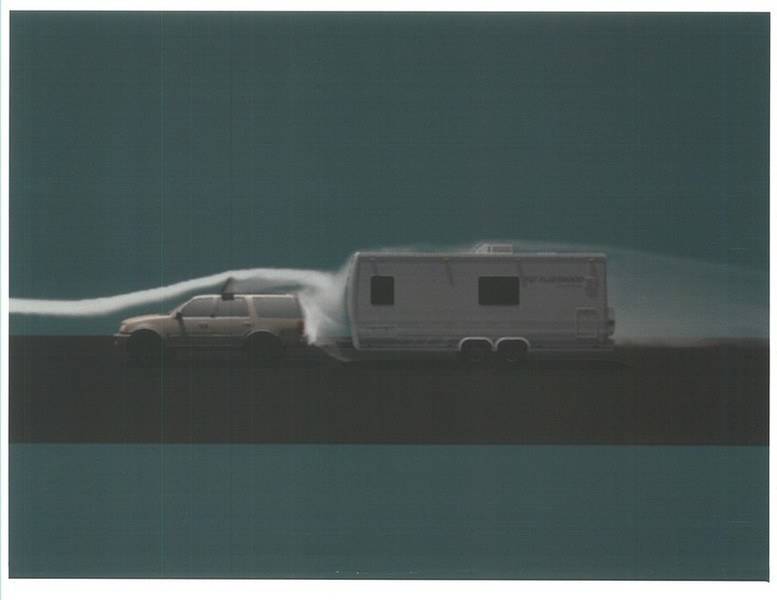
Untitled8_10.jpg


Does anyone have any idea of what kind of forces a 6 foot wide, 3 foot long wing would see angled up into the wind at say a 45 degree angle or more at say up to 70 mpH?

I'm guessing we will want the answer in pounds, perhaps FT/Pounds.

Ballpark numbers on horizontal, vertical and or down-force and or lift.

Just need a general idea for discussion purposes if you can please. Comparisons in laymen terms would be very useful.

My guess is that such a plane would experiences forces similar to a football tackle between some 120 lb kids. Not very useful, very subjective but it gets an image across hopefully.

Let's put it this way, if you have ever built something and sat on it, pulled on it, or jumped on it to test it before mounting, then you know what I mean. We are talking backyard engineering where one can just throw more parts and material on something until it feels right. Just short of the "hold my beer and watch this" approach.
 
Last edited:
Physics news on Phys.org
Check out Hoerner's classic work on fluid dynamic drag and lift. Much of that was based on experimental work done in Germany in the 1930s, but it was good science.
 
@kach22i -- That air dam on the SUV doesn't look like it's placed correctly. It sure doesn't seem to be doing much with the airflow over the trailer. Shouldn't it be placed at the back of the SUV, more in line with how the air dams on tractor-trailers work?

http://www.truck-drivers-money-saving-tips.com/image-files/air-resistance-drag-dsc09127.jpg
air-resistance-drag-dsc09127.jpg
 
  • Like
Likes   Reactions: Nidum
Berkeman, I think they placed it correctly load wise, which is perhaps in conflict with aerodynamic needs.

In other words, the vertical force is downward and mid-way in the wheelbase of the tow vehicle.

If the vertical load is aft of the center of gravity it will lift the front wheels and steering gets light - way too light.

I've towed my hovercraft around a bit, once I tried loading it backwards with most of the weight on the tongue - that was a disaster in the making.

I think the rule of thumb with the sub 1,000 lb load I had was about 50 lbs on the tow hitch ball/tongue. I always like a little more weight because I was afraid of it lifting off the ball.

The double axle of the trailer/camper in the photo far above will still want to see-saw a bit, best to have your tow vehicle as sure footed as possible.
 
Dr. D......back when I was in college 30 years ago I'm pretty sure I could have done this simple problem in 15 minutes.

I figured out earthquake and wind loads on multi-story buildings in my structural courses, I just didn't want to dust off my books and take the time.

This should be a simple problem for a smart person, I'm just not that smart anymore. I hire engineers to do my heavy lifting these days.
 
kach22i said:
Berkeman, I think they placed it correctly load wise, which is perhaps in conflict with aerodynamic needs.

In other words, the vertical force is downward and mid-way in the wheelbase of the tow vehicle.

If the vertical load is aft of the center of gravity it will lift the front wheels and steering gets light - way too light.
Well, as it's placed right now, it looks like it is of no aerodynamic benefit to the trailer, and a significant aerodynamic hindrance to the SUV. I hope nobody pays any money for something like that.

To avoid the loading and downforce issues on the SUV, and help streamline the SUV+trailer pair, just run a taut tarp from the back of the SUV to the top/sides of the trailer. Make it so that it can flex for turning, but is taut enough to re-direct the airflow in straight-line high-speed driving so the front of the trailer is protected.
 
I'm not here to argue the merits or efficiency of the design posted as I feel it's a distraction from the original goal stated.

I am more than willing to analyze it however in a effort to understand it.

I stated earlier that I thought the diverter plane was mid-point of the wheelbase or center of mass/gravity, this turns out not to be quite true (unlike the Tractor Trailer design). And as a result I'm starting to really not like it, although without a smoke flow image without the air diverter to compare to I'm hesitant to condemn it completely as of yet.

To make it clear, I'm not attempting to design or promote anything, just curious about the scale of forces involved.

It seems to me now that there could be more lot going on than I first thought, and this is not a simple vector of forces with equal reaction math problem. I mean it could be simple, not asking for axle loads or anything, right?

EDIT:
Untitled8_10.jpg

I found a sister image to the opening image - I think.

https://www.rv.net/forum/index.cfm/fuseaction/thread/tid/28963857/print/true.cfm
80-airflow_00207_f9d713c1ed92285e2dec0a3eba89274d9ae58277.jpg
 

Attachments

  • STUDY.jpg
    STUDY.jpg
    34.3 KB · Views: 605
Last edited:

Similar threads

  • · Replies 35 ·
2
Replies
35
Views
9K
Replies
3
Views
4K
  • · Replies 3 ·
Replies
3
Views
3K
Replies
6
Views
8K
  • · Replies 2 ·
Replies
2
Views
4K
  • · Replies 12 ·
Replies
12
Views
6K
  • · Replies 5 ·
Replies
5
Views
12K
  • · Replies 8 ·
Replies
8
Views
5K
  • · Replies 4 ·
Replies
4
Views
3K
  • · Replies 2 ·
Replies
2
Views
3K