Alternative way to calculate the area of a right angled triangle

  • Thread starter Thread starter kenneth_G
  • Start date Start date
  • Tags Tags
    Area Triangle
Click For Summary
SUMMARY

The discussion centers on an alternative method for calculating the area of a right-angled triangle, specifically using the formula Area = ¼ c²sin(2A) = ¼ c²sin(2B). The original poster verified this formula against the standard Area = ½ab and found consistent results. A participant noted that while the formula may not have a specific name or practical application, it illustrates that the maximum area occurs when angles A and B are both 45 degrees. This exploration emphasizes the importance of engaging with mathematical concepts beyond rote memorization.

PREREQUISITES
  • Understanding of trigonometric functions, specifically sine and cosine.
  • Familiarity with the area formula for triangles, particularly Area = ½ab.
  • Basic knowledge of right-angled triangles and their properties.
  • Concept of angle relationships in triangles, including angle doubling.
NEXT STEPS
  • Research the derivation of the area of a triangle using the formula Area = ½ side * side * sin(angle between).
  • Explore the properties of sine and cosine functions in relation to triangle geometry.
  • Study the implications of angle relationships in maximizing area within geometric figures.
  • Investigate the concept of reflections in geometry and their applications in proofs.
USEFUL FOR

Students of mathematics, educators looking for innovative teaching methods, and anyone interested in exploring geometric proofs and trigonometric applications.

kenneth_G
Messages
1
Reaction score
0
Hello all!

New to the forums, and I have a question for you. In my classes, we have been dealing a lot with proofs lately, so when I was working on an assignment, I figured I would try and find my own proof for something, just for the hell of it. I decided to tacle the area of a right angled triangle, because I was using it in one of my assignments, and I wanted to skip some of the legwork I had to do to find the area. On my third try of finding a proof, I finally arrived at something useful.
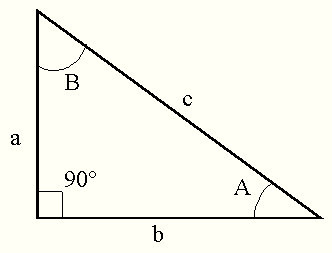
triangle02.gif

Starting with Area=½ab, I ended up with:
Area=¼ c^{2}sin(2A)=¼ c^{2}cos(2B)​

I verified my findings by comparing the results with the ½ab version, and they match. I also wanted to doube check it with some trusted source (and that I wasn't just getting lucky), so I searched around on the web, but can't find it listed anywhere.

So now the question: Has anyone seen this before? And where?
 
Mathematics news on Phys.org
welcome to pf!

hello kenneth! welcome to pf! :smile:

(actually, it's ¼ c^{2}sin(2A)=¼ c^{2}sin(2B) :wink:)

i don't think it has a name, since it's not particularly useful

but if you double the triangle, by adding a reflection to itself, making a triangle with angles 2A B and B, then it's the well-known formula for the area of a triangle, 1/2 side*side*sin(anglebetween) = 1/2 c*c*sin2A :smile:
 
Your result shows one (slightly) interesting thing. For a fixed length of c, the maximum area is when sin(2A) = 1, or A = B = 45 degrees.

You can see that a different way, if you know that the right angle always lies on the circle with c as the diameter. If you use the formula "base x height / 2" with c as the base, so you can see where the right angle must be to get the maximum area.

Don't worry about the fact that we don't find this incredibly exciting, or useful. You will learn a lot more by getting the habit of "playing around" with math, rather than just "remembering the right formula" to solve problems.
 

Similar threads

  • · Replies 3 ·
Replies
3
Views
2K
  • · Replies 20 ·
Replies
20
Views
4K
Replies
4
Views
2K
Replies
2
Views
1K
Replies
2
Views
2K
  • · Replies 7 ·
Replies
7
Views
5K
  • · Replies 1 ·
Replies
1
Views
2K
Replies
1
Views
2K
  • · Replies 1 ·
Replies
1
Views
1K
  • · Replies 1 ·
Replies
1
Views
1K