Alternator Field Winding Question

Click For Summary
SUMMARY

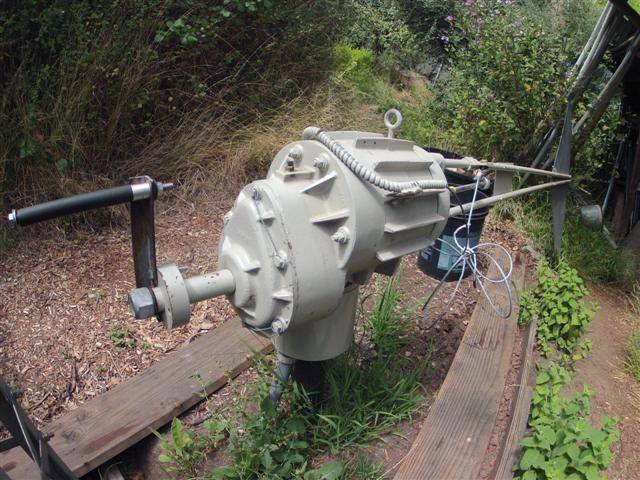
The discussion centers on the operation of a 1979 Sencenbaugh wind generator equipped with a 3-phase alternator that requires field winding excitation. The user calculated that to achieve the maximum 60 watts to the field winding at 13.5 volts, 4.4 amps are needed; however, the measured resistance of 6.5 Ohms limits the output to 30 watts. Suggestions include using a manual switch to disconnect the field winding from the battery when not in use and considering a car regulator to manage the field current effectively.

PREREQUISITES
  • Understanding of electrical concepts such as Ohm's Law
  • Familiarity with 3-phase alternator operation
  • Knowledge of battery charging systems
  • Basic skills in electrical wiring and circuit design
NEXT STEPS
  • Research how to calculate field current for alternators
  • Learn about car voltage regulators and their application in wind generators
  • Explore methods for increasing wattage to field windings
  • Investigate the impact of varying field current on generator output
USEFUL FOR

Individuals interested in renewable energy systems, particularly those working with wind generators, electrical engineers, and hobbyists seeking to optimize alternator performance.

doubledipsoon
Messages
2
Reaction score
0
I
GOPR0229 (Small).JPG
have an older 12 volt battery-charging 1979 Sencenbaugh wind generator that I am testing. It has an 3 phase alternator with a field winding that must be excited, as opposed to the newer "permanent magnet" alternators. The manual says that 60 watts maximum should go to the field winding. According to theory, amps= watts over volts, so the amps to the field winding should be 60watts (the desired wattage to the field winding)/13.5 volts (battery bank at full charge). So the amps comes out to 4.4 amps. I just measured the Ohms off of the 2 field winding wires, and it came out to 6.5 Ohms, which allows only 30 watts to the field windings. So the big question is, how can I deliver 60 watts to my field winding? By the way, I won't be regulating the wattage to the field winding- I intend to keep 60 watts continually hooked up to the winding. I'm not an electrical engineer, I am self-taught, so I hope I'm thinking this out correctly. Thanks.
 
Engineering news on Phys.org
doubledipsoon said:
The manual says that 60 watts maximum should go to the field winding.
The key word in that specification is maximum. Generator output is typically controlled by varying the field current. If you can get the desired output power at a lower field current you are ahead of the game. Go for it.

Out of curiousity, you state:
doubledipsoon said:
I intend to keep 60 watts continually hooked up to the winding.
Where are those watts coming from? Why not just use them to charge the battery directly?

Cheers,
Tom
 
Hi Tom, the watts are coming from a battery bank that the wind generator alternator will be charging...Since the measured ohms off the field winding is 6.60, the watts delivered to the field windings is about 30 watts (watts = amps x ohms). So increasing the wattage isn't possible because of the resistance (ohms) in the wiring of the field winding won't allow any wattage above 30 watts- this is what I've concluded...I went ahead and hooked up the field winding to my 12 volt battery bank (13.5 volts), hooked up the 3 phase alternator to a DC rectifier, spun the alternator, and the volt meter registered 1, 2, 3...10 volts with increasing rpm (I could only spin it at about 120 rpm This alternator puts out 14 volts max at about 275 rpm. I think it's working fine, right? PS: At this point, I'm not going to regulate the field winding, but am willing to figure out how)
 
I agree it seems to be working OK.
I suggest at least a manual switch to disconnect the field from the battery bank when not in use.
An appropriate regulator would be one one from a car. And they disconnect from the battery until the alternator exceed the battery voltage. They are readily available, even at a junkyard if there is one close by.

Have Fun! (You will certainly get a workout cranking that thing.)
Tom
 
I am trying to understand how transferring electric from the powerplant to my house is more effective using high voltage. The suggested explanation that the current is equal to the power supply divided by the voltage, and hence higher voltage leads to lower current and as a result to a lower power loss on the conductives is very confusing me. I know that the current is determined by the voltage and the resistance, and not by a power capability - which defines a limit to the allowable...

Similar threads

  • · Replies 9 ·
Replies
9
Views
3K
  • · Replies 6 ·
Replies
6
Views
5K
Replies
1
Views
3K
  • · Replies 7 ·
Replies
7
Views
2K
  • · Replies 18 ·
Replies
18
Views
2K
  • · Replies 2 ·
Replies
2
Views
8K
  • · Replies 16 ·
Replies
16
Views
3K
  • · Replies 12 ·
Replies
12
Views
2K
  • · Replies 9 ·
Replies
9
Views
4K
  • · Replies 14 ·
Replies
14
Views
84K