Project: Charging devices with Eolic (Wind) Energy

Click For Summary

Discussion Overview

The discussion revolves around the feasibility of using a computer fan as a wind turbine to charge smartphones or tablets. Participants explore the technical aspects of converting wind energy into electrical energy, including the specifications of the fan, voltage requirements, and the need for voltage regulation.

Discussion Character

  • Exploratory
  • Technical explanation
  • Debate/contested

Main Points Raised

  • One participant suggests that a computer fan can be used in reverse as a generator, although it may not be efficient for this purpose.
  • Another participant points out that the fan likely uses a brush-less DC motor, which may not generate power without modifications.
  • Some participants propose that using a rechargeable battery could store energy generated by the fan, allowing for charging even when wind is not present.
  • There is a discussion about the possibility of redirecting different voltages to a smartphone and a secondary battery, depending on the output from the fan.
  • Concerns are raised about the variability of wind speed affecting voltage output and the need for voltage regulation to protect devices from damage.
  • Participants mention that not all motors can be used as generators without significant modifications, and some types may not work at all.
  • There is confusion regarding the differences between motors and generators, with some participants seeking clarification on how to identify them.
  • Examples from videos are cited, showing varying voltages produced by similar setups, leading to further confusion about the reliability of using a fan as a generator.

Areas of Agreement / Disagreement

Participants generally agree that the fan may not be suitable for use as a generator without modifications, but there is no consensus on the best approach to take or the feasibility of using a fan for this purpose. Multiple competing views remain regarding the effectiveness of different types of motors and generators.

Contextual Notes

Participants express uncertainty about the efficiency of using a computer fan as a generator and the necessary modifications required. There are also unresolved questions about the voltage output and the implications of varying wind speeds on the charging process.

Nexo
Messages
5
Reaction score
0
Good evening, everybody, I'm new here so if I made any mistake, I apologize in advance.

I've been thinking in a project from a while now and I want to share it with you seeking for your help and wisdom.

Basically, I want to build a small wind turbine in order to charge a smartphone or a tablet and so far I have the following:

1. I found a rather big computer fan and these are its specifications:

Name: Yate Loon D14BH-12
More: 2-pin, 12V, 0.7A @ 2800RPM, 140CFM, 48.5dBA

Here is a photo:
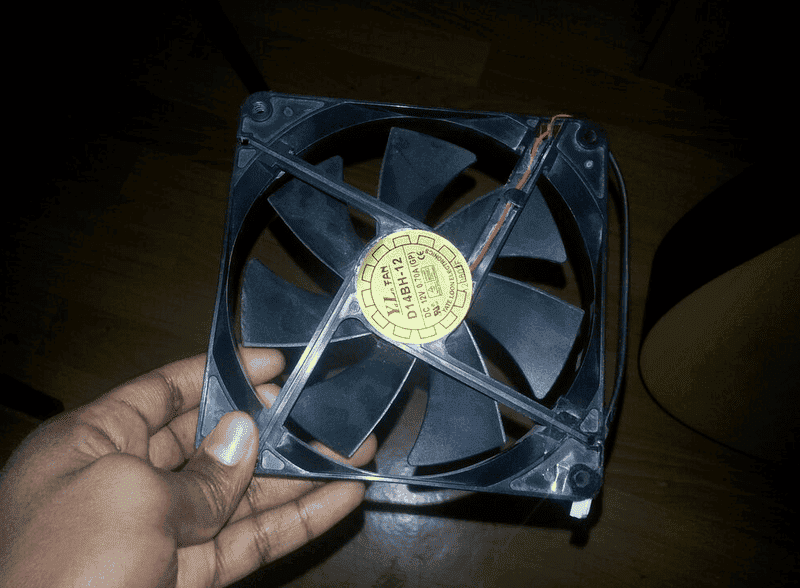
2gVRy6w.png


So my question is:

- If this fan needs 12V in order to work and it's RPM is 2800, could I use it the other way around? I mean, Use the wind in order to create energy.

Note: I made a small test connecting a small LED and I made the fan spin and it turned on a little bit for a little while (about 2-3 seconds) and it's obviously because of the poor spin I created.

I live in a pretty windy city and I wanted to know what would happen if I'm able to reproduce those 2800 RPM? Would that create 12 volts?

- If so, how can I know the amperage? Because the smartphone needs ~2.1 amps and 5 Volts DC to charge.

- So, If I get those 12 volts, would it be necessary to reduce them to 5 volts? or can I send 5 volts to the smartphone and 7 volts to a secondary battery that I could use later on in order to charge the smartphone when there is no wind?

Note: I could use a smaller fan in order to get those 5 volts.

- Another question is: The wind is not going to be constant, a moment it can have a high velocity and a few seconds later it may not be windy at all so the fan will produce different voltage, Am I right? If so, How can I regulate the output of voltage and amperage in order to not blow my smartphone?

This is by far the main questions I have.

I apologize for my English.
Hope you can help me, guys. Thanks in advance.
 
Engineering news on Phys.org
Yes you can run an electric motor in reverse and have it act as a generator.
It won't be particularly efficient since it isn't designed for the purpose but it should work.
In addition to the 'generator' (the fan), it will help to add a rechargeable battery which can store the output continuously (until it's fully charged).
Now you can charge the phone from the stored energy collected in the battery even when there is no wind!
A voltage regulator circuit could be added to improve efficiency further but that is not necessarily needed.
 
That type of fan typically uses a brush-less DC motor. This type of motor is a multi-phase electrically commutated device. You will not get any power out of it unless you replace the circuit.

BoB
 
  • Like
Likes   Reactions: davenn
agree with Bob on that one ... no it won't work with that type of motor
 
I've never tried it but an n-phase bridge hooked up correctly would give you something. I just checked a broken one I have here. It has a rather weak vinyl magnet in it. I doubt much power would be created even if you modified it.

You also want lots more swept area to get any usable amount of power. If you want to use broken computers for power your best bet is to use the magnets out of several hard drives. You might be able to get a reasonable amount of magnet wire out of the power supply too.

BoB
 
Thank you very much for your response.
I've heard that before (the efficiency part). There is no way to buy the fan with the generator integrated? Just as the on I have but instead of being a motor, it would be a generator.

I don't quite understand the difference, the motor can create energy as well as the generator, right?

I'm thinking about adding that additional rechargeable battery and my question is: If this motor generates 12V of output, can I redirect 5V to the smartphone/tablet and the other 7V to the rechargeable battery? If not, I can use a smaller fan, right?

I was thinking about the voltage regulator for the following: The wind is not going to be constant, a moment it can have a high velocity and a few seconds later it may not be windy at all so the fan will produce different voltage, Am I right? If so, How can I regulate the output of voltage and amperage in order to not damage the smartphone/tablet?

Thanks again.
 
Thank you all for your responses.

So, is settle, the motor is not an option. Therefore, I ask the following question: There is no way to buy the fan with the generator integrated? Just as the on I have but instead of being a motor, it would be a generator.
 
If you get a large fan with a standard induction motor you could use that but it is not as simple as cutting the cord off and plugging it into your cell phone.

The motor needs to be rewired and an excitation current is necessary to start it all up. That gets you ac power. Then you need to convert that into 5V DC to charge your phone.

None of this is particularly difficult. You would learn a lot doing it. It is similar to the alternator in a car.

BoB
 
1. As the other guys said, some kind of motors can easily be made to work backwards as generators, others kinds are not worth the effort.
2. Yes of course you can purchase small scale wind power generators, but since the power requirement to charge a mobile device is so very little, I doubt it makes economic sense.
 
  • #10
How can I differentiate between a DC motor and a generator?
 
  • #11
A permanent magnet mechanically commutated DC motor can be used as a generator without modification. Most other types need some added circuity to be used as a generator. There may be some types that will not work at all as a generator.

The application as a phone charger will need some voltage conversion no matter what. It is unlikely that you will get exactly 5V out of any kind of generator.

BoB
 
  • #12
I've seen a video in Spanish in which the kid uses a similar fan to mine (although smaller) and it generates up to 13 V.


And in a second video (also in Spanish) the guy changes the motor of the computer's fan for a generator and this only generates 2 V.


This is so confusing :confused:
 
  • #13
Both of those videos use permanent magnet mechanically commutated DC motor for the generator. The PC fan is just used for the fan blades. The two motors likely have different numbers of windings on the armature and are spun at different speeds so they produce different voltages.

BoB
 

Similar threads

  • · Replies 3 ·
Replies
3
Views
2K
  • · Replies 6 ·
Replies
6
Views
5K
  • · Replies 15 ·
Replies
15
Views
2K
  • · Replies 2 ·
Replies
2
Views
2K
Replies
5
Views
3K
  • · Replies 11 ·
Replies
11
Views
33K
Replies
5
Views
4K
Replies
1
Views
2K
Replies
12
Views
3K
Replies
1
Views
2K