Am I overthinking this? (Noise cancelling headphones for airplane noise)

Click For Summary
SUMMARY

The discussion centers on the mathematical principles of wave shifting in the context of noise-cancelling headphones for airplane noise. Participants clarify that shifting a wave by 2π does not alter its appearance, while a shift by π or π/2 can effectively create a phase difference. The conversation emphasizes the importance of visualizing the wave functions, specifically s(t) and shead(t), to understand their interactions. A key takeaway is that the phase shift can be represented mathematically as ##\sin(\theta)=-\sin(\theta+\phi)##, where φ corresponds to the phase difference.

PREREQUISITES
  • Understanding of wave functions and their properties
  • Familiarity with phase shifts in trigonometric functions
  • Basic knowledge of sine and cosine functions
  • Ability to graph functions and interpret their intersections
NEXT STEPS
  • Explore the concept of phase shifts in trigonometric functions
  • Learn about the mathematical representation of sound waves
  • Study the effects of wave interference in noise-cancelling technology
  • Investigate the application of Fourier transforms in wave analysis
USEFUL FOR

Students in physics or engineering, audio engineers, and anyone interested in the mathematical foundations of sound wave manipulation and noise cancellation techniques.

Thickmax
Messages
31
Reaction score
8
Homework Statement
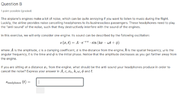
Am I over thinking this question
Relevant Equations
See below (shown in the question)
1625957474706.png
Can I just shift the wave over by 2Pi to get the opposite wave?
 

Attachments

  • 1625957380536.png
    1625957380536.png
    32.4 KB · Views: 149
Physics news on Phys.org
Thickmax said:
Homework Statement:: Am I over thinking this question
Relevant Equations:: See below (shown in the question)

Can I just shift the wave over by 2Pi to get the opposite wave?
How will a shift of 2pi give you anything different from the original wave?
 
  • Like
Likes   Reactions: Delta2 and Thickmax
haruspex said:
How will a shift of 2pi give you anything different from the original wave?
Shift it by 1pi then?
 
Thickmax said:
Shift it by 1pi then?
Pi/2?
 
I'd suggest drawing s(t), sheadphones and their sum.
 
Thickmax said:
Shift it by 1pi then?

Thickmax said:
Pi/2?
Don't just guess. Figure it out.
 
  • Like
Likes   Reactions: phinds
the answer is negative the same equation...start points and end points will be the same?

Shifting the wave will move the start and end points by either (2pi, pi or pi/2)
 
I repeat my original hint: draw s(t) and shead(t) (3, 4 of them?) and add. One of them should be close to zero.
 
  • Like
Likes   Reactions: Thickmax
Thickmax said:
the answer is negative the same equation
Right, so that is a valid answer to the question.
Thickmax said:
Shifting the wave will move the start and end points by either (2pi, pi or pi/2)
Not sure what you mean by that. The equation does not have endpoints. It expresses the amplitude for all times and all locations.
If you mean shifting the entire wave, yes, there is a phase shift that is exactly equivalent to negating the expression: ##\sin(\theta)=-\sin(\theta+\phi)## for some ##\phi##. You really should be able to say immediately what that value is! Consider the sines of 0°, 90°, 180°, 270°, 360°.

There is one other error in your attempt in post #1. It tells you which variables are allowed in the answer, but you have used one not in the list.
 
  • Like
Likes   Reactions: Thickmax

Similar threads

  • · Replies 7 ·
Replies
7
Views
3K
Replies
3
Views
1K
Replies
1
Views
2K
Replies
4
Views
1K
  • · Replies 11 ·
Replies
11
Views
2K
  • · Replies 9 ·
Replies
9
Views
3K
  • · Replies 8 ·
Replies
8
Views
2K
  • · Replies 0 ·
Replies
0
Views
2K
  • · Replies 49 ·
2
Replies
49
Views
10K
  • · Replies 0 ·
Replies
0
Views
849