An elementary equation manipulation in CFT

5 replies · 2K views · last reply
Lapidus
Messages
344
Reaction score
12
A presumably basic introductory equation manipulation in 2-d conformal field theory. How does from
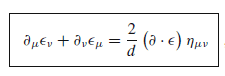
Equation: ∂μεν + ∂νεμ = (2/d)(∂·ε)ημν, a boxed tensor identity relating symmetrized derivatives of a vector field ε to its divergence and the metric.


(when the metric is Euclidean) follow

Two equations side by side: ∂0 ε0 = +∂1 ε1 on the left and ∂0 ε1 = −∂1 ε0 on the right, with a comma after each.


The right equation is clear (the metric is zero for different indices). But how do i get to the first equation on the left?

thank you
 
fresh_42 said:
set μ = ν = 0 and calculate, then μ = ν = 1 and compare the results

Thanks for the reply! But I don't understand what you mean. If I set zero or one, then RHS and LHS do not add up, in either case.

∂0ε0 + ∂0ε0 = ∂0ε0

??
 
I do not know for sure how ##η## is defined. Since you did not explain it and I'm too lazy to search what you might have meant, I supposed ##η## to be the Kronecker symbol according to your calculation above.
If I then first compute ##δ_0 ε_0 = ...## and next ##δ_1 ε_1 = ...## then I get the same result, i.e. they are equal.
 
Lapidus said:
Thanks for the reply! But I don't understand what you mean. If I set zero or one, then RHS and LHS do not add up, in either case.

∂0ε0 + ∂0ε0 = ∂0ε0

??

Since presumably ##\partial\cdot \epsilon = \partial_0 \epsilon_0+\partial_1 \epsilon_1## in your conventions, you should have found ##2\partial_0 \epsilon_0 = \partial_0 \epsilon_0+\partial_1 \epsilon_1## for the 00 component.
 
  • Like
Likes   Reactions: Lapidus
Ahaa. I did not understand that ∂⋅ε is a sum. (or an inner product)

Thanks everybody!