An integral relation in soil physics

Click For Summary

Discussion Overview

The discussion revolves around the relationship between suction head, soil water content, and hydraulic conductivity in soil physics. Participants explore methods for deriving soil water content from known hydraulic conductivity, focusing on integral relations and iterative approaches.

Discussion Character

  • Exploratory
  • Technical explanation
  • Mathematical reasoning

Main Points Raised

  • Mohammad poses a question about deriving soil water content, S, from the hydraulic conductivity, K, given the relationship between suction head, h, and S.
  • One participant suggests using an iterative approach, calculating the left-hand side (LHS) and right-hand side (RHS) of the equation for different values of S until a satisfactory approximation is found.
  • Another participant emphasizes the challenge of not having a known relation between h and x, which complicates the calculation of integrals necessary for the reverse procedure.
  • It is proposed that if h is known as a function over a specific interval, one can compute an integral I(S) and solve for S numerically, but this relies on knowing h(x) for all x in the domain.
  • Further mathematical manipulation is introduced, including a differential equation involving the derivative of K with respect to h, but uncertainty remains about handling the integral of 1/h(x) over the interval.

Areas of Agreement / Disagreement

Participants express differing views on the feasibility of calculating S from K, with some proposing iterative methods while others highlight the limitations due to unknown relationships between variables. The discussion remains unresolved regarding the best approach to take.

Contextual Notes

Participants note the importance of knowing the function h(x) to perform necessary calculations, indicating that without this knowledge, certain integrals cannot be computed, which limits the ability to derive S from K.

re444
Messages
14
Reaction score
0
Hi every one,

Here is my question: In soil physics, knowing the relation between suction head, h, and the soil water content, S, one can derive the hydraulic conductivity, K, of that soil using a formula like:
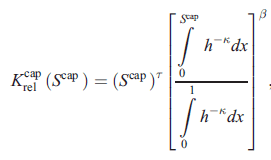
1znpn6f.png


(ignore the superscripts "cap")
where in my problem, τ=0.5, κ=1, β=2.

Now what if we need the reverse procedure? If I have the relation between h and K, and want to calculate S, how it is possible?


Thanks in advance,
Mohammad
 
Physics news on Phys.org
Iteration is one way.

You know K on the LHS of the equation, and you have h as a function of x, along with the constants tau, kappa, and beta. The integral in the denominator seems to be a fixed quantity, but the value of the integral in the numerator depends on the value of S for the upper limit.

The engineering approach, would be to assume different values of the parameter S and calculate the LHS and the RHS of the equation, or re-write the equation as LHS - RHS = 0. Then you can iterate until a particular value of S makes this relation arbitrarily close to zero.

You could probably put together a spreadsheet to calculate the value of the expression for various input values of S.
 
  • Like
Likes   Reactions: 1 person
SteamKing said:
Iteration is one way.

You know K on the LHS of the equation, and you have h as a function of x, along with the constants tau, kappa, and beta. The integral in the denominator seems to be a fixed quantity, but the value of the integral in the numerator depends on the value of S for the upper limit.

The engineering approach, would be to assume different values of the parameter S and calculate the LHS and the RHS of the equation, or re-write the equation as LHS - RHS = 0. Then you can iterate until a particular value of S makes this relation arbitrarily close to zero.

You could probably put together a spreadsheet to calculate the value of the expression for various input values of S.

The issue here is in the reverse procedure we don't have any knowledge about the relation between h and x (or in fact h and S), so the integrals could not be calculated. How about this?
 
If I have the relation between h and K, and want to calculate S, how it is possible?

If you know h : [0,1] \to \mathbb{R}, \beta, \kappa, \tau and K, then you can calculate <br /> I(S) = \left(\frac{\int_0^S h^{-\kappa}\,dx}{\int_0^1 h^{-\kappa}\,dx}\right)^{\beta} for any 0 \leq S \leq 1 and from that you can solve <br /> K = S^\beta I(S) numerically for S. (I'm assuming here that only values of S between 0 and 1 inclusive make physical sense.)

re444 said:
The issue here is in the reverse procedure we don't have any knowledge about the relation between h and x (or in fact h and S), so the integrals could not be calculated. How about this?

h is a function of a real variable. If you can't determine h(x) for every x in the domain then there is no sense in which you know h. Thus you can't calculate I(S) for any S other than the trivial I(0) = 0 (if \beta &gt; 0) and I(1) = 1. If you can't calculate I(S) you have no hope of solving K = S^{\tau}I(S) for S.
 
  • Like
Likes   Reactions: 1 person
pasmith said:
If you know h : [0,1] \to \mathbb{R}, \beta, \kappa, \tau and K, then you can calculate <br /> I(S) = \left(\frac{\int_0^S h^{-\kappa}\,dx}{\int_0^1 h^{-\kappa}\,dx}\right)^{\beta} for any 0 \leq S \leq 1 and from that you can solve <br /> K = S^\beta I(S) numerically for S. (I'm assuming here that only values of S between 0 and 1 inclusive make physical sense.)


h is a function of a real variable. If you can't determine h(x) for every x in the domain then there is no sense in which you know h. Thus you can't calculate I(S) for any S other than the trivial I(0) = 0 (if \beta &gt; 0) and I(1) = 1. If you can't calculate I(S) you have no hope of solving K = S^{\tau}I(S) for S.


In h(x), x is a dummy variable of integration (in calculating K , when the known relation h(S) is available, S is replaced by x in the integrands. So h(x) or h(S) is exactly what we are looking for.
 
I've gone a bit further to get this: (assuming τ=0.5, κ=1, β=2)

\frac{\mathrm{d} }{\mathrm{d} S} \int_{0}^{S}\frac{1}{h(x))}dx=\int_{0}^{1}\frac{1}{h(x))}dx \cdot \frac{\mathrm{d} }{\mathrm{d} S} \left ( \sqrt{\frac{K_{r}}{\sqrt{S}}} \right )

\Rightarrow <br /> <br /> \frac{1}{h(S))}=\int_{0}^{1}\frac{1}{h(x))}dx \cdot \frac{\sqrt{S}\frac{dK}{dh}\cdot \frac{dh}{dS}-\frac{K}{2\sqrt{S}}}{2\sqrt{\frac{K}{\sqrt{S}}}}

now knowing the K and \frac{dK}{dh}, the last equation seems to be an ODE but in this stage I don't know what to do with the \int_{0}^{1}\frac{1}{h(x))}dx ?

Can I in someway handle that?
 

Similar threads

  • · Replies 1 ·
Replies
1
Views
1K
  • · Replies 3 ·
Replies
3
Views
2K
  • · Replies 2 ·
Replies
2
Views
2K
  • · Replies 1 ·
Replies
1
Views
2K
  • · Replies 11 ·
Replies
11
Views
3K
Replies
5
Views
26K
  • · Replies 40 ·
2
Replies
40
Views
5K
  • · Replies 2 ·
Replies
2
Views
2K
  • · Replies 1 ·
Replies
1
Views
1K
  • · Replies 1 ·
Replies
1
Views
3K