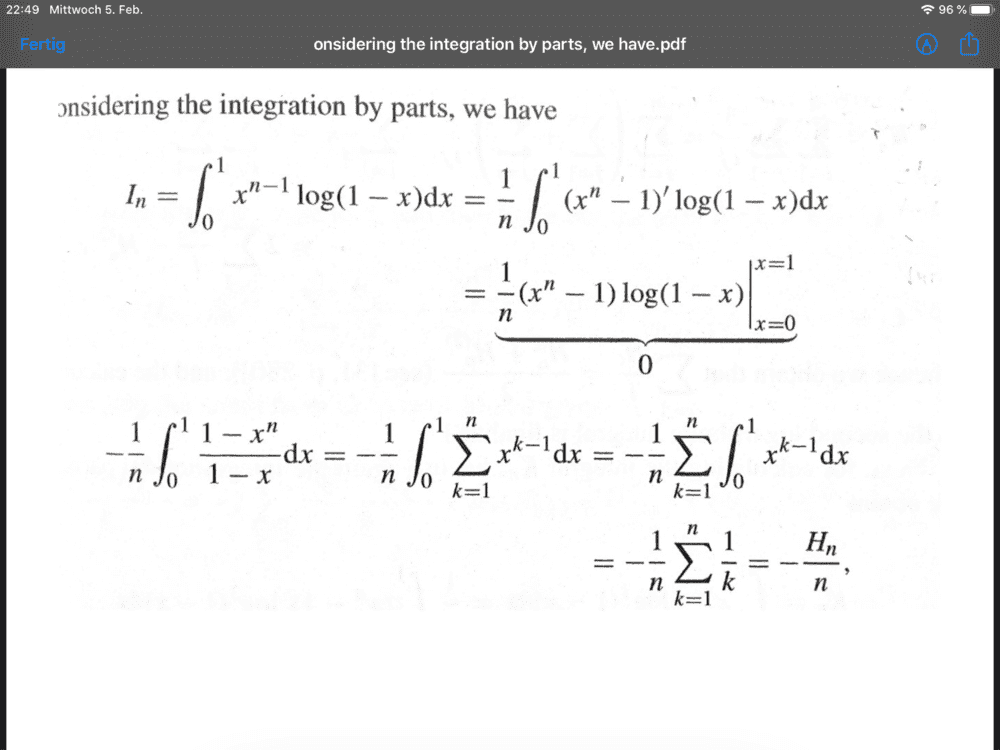
An integral rewritten (from “Almost impossible integrals“, p.59 in Valean)

Click For Summary
SUMMARY

The discussion focuses on the mathematical manipulation involving the integral of the expression related to the harmonic series. The -1 in the right-hand side (RHS) term arises from rewriting the expression as ##\frac{1}{n}(x^n - C)'##, where C is a constant. This manipulation is a legal trick in calculus, as the derivative of this expression yields ##x^{n-1}##, allowing for flexibility in choosing constants without affecting the equality. The choice of C as 1 simplifies the subsequent calculations, demonstrating the importance of strategic constant selection in integral calculus.

PREREQUISITES
  • Understanding of integral calculus and derivatives
  • Familiarity with the harmonic series and its properties
  • Knowledge of mathematical notation, particularly derivatives and integrals
  • Experience with algebraic manipulation of expressions
NEXT STEPS
  • Explore the concept of integration by parts in calculus
  • Study the properties and applications of the harmonic series
  • Learn about the role of constants in integration and differentiation
  • Investigate advanced techniques in integral calculus, such as substitution methods
USEFUL FOR

Mathematicians, calculus students, educators, and anyone interested in advanced integral manipulation and the properties of the harmonic series.
Pnin
Messages
20
Reaction score
1
I want to understand where the minus 1 in the first line in the RHS term comes from.
I assume the little apostrophe means taking a derivative. But the antiderivative of x^(n-1) is (1/n)x^n. Why the -1?

thank you

36B76220-096E-4F9A-94C1-A0DBA5C10085.png
 
Physics news on Phys.org
It has ##(1-x^n)## in the numerator while the previous expression has ##(x^n-1)'##.
 
This I understand. But I do not understand the first line.

How does the -1 come up in the RHS giving the LHS in the first line?
 
It's a trick. The -1 vanishes upon differentiation. You could have written any number there instead.
 
SchroedingersLion said:
It's a trick. The -1 vanishes upon differentiation. You could have written any number there instead.

Ok. I never saw that trick before. But if I had written another number I would not have gotten the desired result, the harmonic series. So is that really a legal trick which allows you getting different values from a definite integral?
 
Pnin said:
Ok. I never saw that trick before. But if I had written another number I would not have gotten the desired result, the harmonic series. So is that really a legal trick which allows you getting different values from a definite integral?
Well, me neither, but this is what happens. From the first integral to the second integral, they simply rewrite ##x^{n-1}## as ##\frac 1 n (x^n - C)'## with ##C## as a constant (i.e. 1 in your case). If you take the derivative of ##\frac 1 n (x^n - C)## you obtain ##x^{n-1}## for any constant ##C##, so the RHS and LHS of your first line are equal. They are choosing a particular ##C##, i.e. 1, because it helps in the following steps. As an exercise, try to do it with another constant, then you might see why there was just one logical choice that simplifies the calculation.
 
  • Like
Likes   Reactions: Pnin

Similar threads

  • · Replies 8 ·
Replies
8
Views
2K
  • · Replies 8 ·
Replies
8
Views
3K
  • · Replies 2 ·
Replies
2
Views
1K
  • · Replies 3 ·
Replies
3
Views
2K
  • · Replies 2 ·
Replies
2
Views
2K
  • · Replies 1 ·
Replies
1
Views
3K
  • · Replies 9 ·
Replies
9
Views
3K
  • · Replies 1 ·
Replies
1
Views
1K
  • · Replies 8 ·
Replies
8
Views
2K
  • · Replies 11 ·
Replies
11
Views
2K