Analysing a ##C_M## graph (pitching moment data)

Click For Summary
SUMMARY

This discussion focuses on analyzing pitching moment coefficient (CM) data for airfoils with various serrations on the trailing edge. Key insights include the understanding that a CM of 0 indicates a symmetric airfoil, while negative values signify a nose-down moment. The participants emphasize the importance of comparing CM results across different trailing edges, noting that more negative pitching moments can indicate a disadvantage due to the increased downward torque required from the tail. The graphs presented in the discussion reveal unexpected behavior, suggesting a need for further investigation into the data trends.

PREREQUISITES
  • Understanding of pitching moment coefficient (CM) in aerodynamics
  • Familiarity with angles of attack (AOA) and their effects on airfoil performance
  • Knowledge of aerodynamic center concepts
  • Experience with analyzing aerodynamic data and interpreting graphs
NEXT STEPS
  • Research the impact of trailing edge serrations on pitching moment coefficients
  • Study the relationship between pitching moment and aerodynamic center location
  • Explore methods for graphing and interpreting aerodynamic data trends
  • Investigate the stability implications of negative pitching moments in aircraft design
USEFUL FOR

Aerospace engineering students, aerodynamicists, and researchers focused on airfoil performance and stability analysis will benefit from this discussion.

SymNeric
Messages
1
Reaction score
0
TL;DR
I need advice on how to compare pitching moment data
Hi guys, I hope everyone is safe and well.

I'm currently nearing the end of my third year dissertation, and I'm looking at analysing pitching moment coefficient (CM) data over a full range of angles of attack for airfoils with different serrations on the trailing edge. What are things to look for and what would, for instance, a lower value mean? I am aware that a CM of 0 is a symmetric airfoil and that negative is a nose-down moment etc. but I am unsure how to compare the results from different trailing edges to each other? Attached is one set of data, as an example.

Any and all help/insight is appreciated.
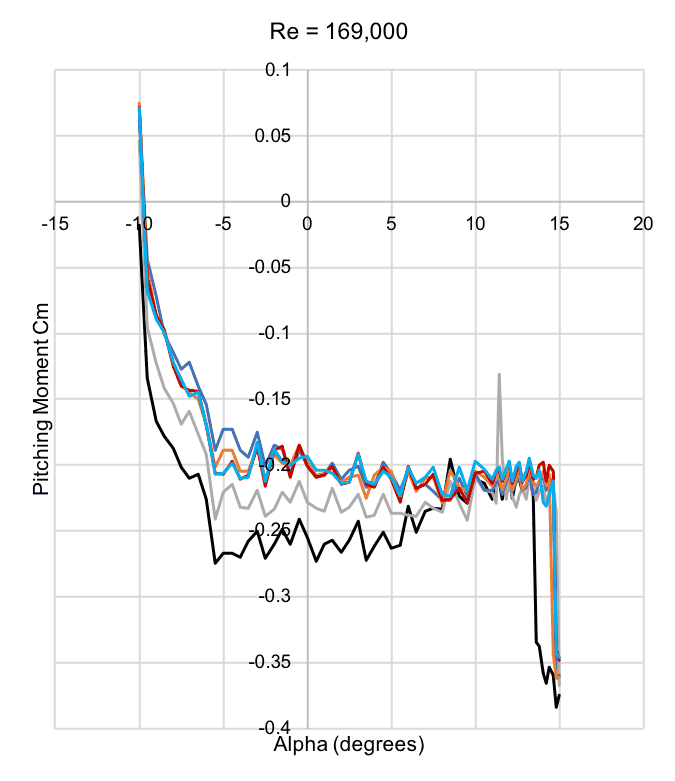
CM_Re3.png
 
Last edited by a moderator:
Physics news on Phys.org
  • Like
Likes   Reactions: FactChecker
Just a simple comparison, supposing that the lifts are equal, would say that the more negative pitching moment is a disadvantage since it would require more downward torque from the tail. The graphs you show seem strange to me. They change a lot at both AOA extremes and are flat or slightly increasing over most of the AOA range. That doesn't seem right. I would have expected a more linear, smooth downward slope.
 

Similar threads

Replies
1
Views
2K
  • · Replies 7 ·
Replies
7
Views
5K
  • · Replies 3 ·
Replies
3
Views
17K
Replies
6
Views
2K
  • · Replies 3 ·
Replies
3
Views
3K
  • · Replies 1 ·
Replies
1
Views
7K
  • · Replies 8 ·
Replies
8
Views
2K
  • · Replies 6 ·
Replies
6
Views
6K
  • · Replies 2 ·
Replies
2
Views
3K
  • · Replies 2 ·
Replies
2
Views
3K