Angle of Deflection of Laser Given Tilted Mirror

Click For Summary

Homework Help Overview

The discussion revolves around a physics problem related to the deflection of a laser beam when it strikes a tilted mirror. The original poster attempts to prove that the angle of deflection is twice the angle of rotation of the mirror, specifically that if a laser beam is incident on a mirror rotated by an angle θ, the beam is deflected by an angle 2θ. Participants are exploring geometric relationships and the properties of angles involved in reflection.

Discussion Character

  • Exploratory, Conceptual clarification, Mathematical reasoning, Assumption checking

Approaches and Questions Raised

  • Participants discuss geometric proofs and relationships between angles of incidence and reflection. There are attempts to clarify the relationship between the angles involved, particularly questioning the equality of β and γ and the implications for the angle of deflection.

Discussion Status

The discussion is active with participants questioning assumptions and clarifying definitions. Some guidance has been offered regarding the relationships between the angles, but there is no explicit consensus on the proof itself. The exploration of potential typos in the problem statement indicates a productive direction in the conversation.

Contextual Notes

There is an ongoing examination of the geometric setup and the relationships between the angles, with some participants expressing uncertainty about the definitions and implications of the angles involved. The original problem statement is referenced multiple times, suggesting that clarity on the definitions is crucial for understanding.

Kumo
Messages
22
Reaction score
1
Hi Everyone,

A question in my latest Physics I lab wishes for a proof showing that if a laser beam is incident on a mirror that is then rotated an angle θ the beam is deflected an angle 2θ.

I attempted to prove this geometrically below. In the diagram the angle γ, is the angle of deflection, and β is the incident angle. I was able to show that if the mirror was rotated θ degrees to the vertical, that β = θ. However,I haven't been able to show that γ = 2θ from the below diagram, as I am unable to determine the top right/bottom left angles of the parallelogram, or any additional angles of the triangles that exist in side of it.

Any assistance or guidance would be very much appreciated.

1. Homework Statement


If a laser beam is incident on a mirror, and the mirror is rotated θ degrees, prove that the angle by which the beam is deflected is equal to 2θ.

Homework Equations


[/B]
- Elementary geometric equations (e.g. sum of the interior angles of a triangle, properties of a parallelogram)
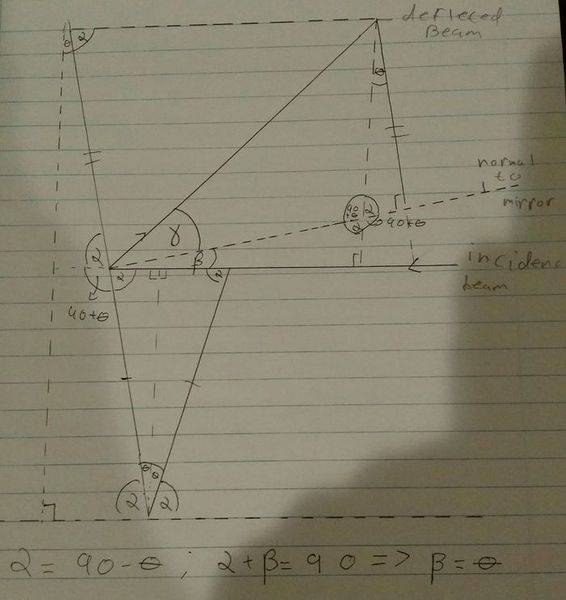
The Attempt at a Solution


YWlu2hN.jpg
 
Physics news on Phys.org
Kumo said:
Hi Everyone,

A question in my latest Physics I lab wishes for a proof showing that if a laser beam is incident on a mirror that is then rotated an angle θ the beam is deflected an angle 2θ.

I attempted to prove this geometrically below. In the diagram the angle γ, is the angle of deflection, and β is the incident angle. I was able to show that if the mirror was rotated θ degrees to the vertical, that β = θ. However,I haven't been able to show that γ = 2θ from the below diagram, as I am unable to determine the top right/bottom left angles of the parallelogram, or any additional angles of the triangles that exist in side of it.

Any assistance or guidance would be very much appreciated.

1. Homework Statement


If a laser beam is incident on a mirror, and the mirror is rotated θ degrees, prove that the angle by which the beam is deflected is equal to 2θ.

Homework Equations


[/B]
- Elementary geometric equations (e.g. sum of the interior angles of a triangle, properties of a parallelogram)

The Attempt at a Solution


YWlu2hN.jpg
How are the angles of incidence and reflection related?
 
SammyS said:
How are the angles of incidence and reflection related?

The angle of incidence is equal to the angle of reflection.
 
Kumo said:
The angle of incidence is equal to the angle of reflection.
Did you use that anywhere?

β = γ
 
SammyS said:
Did you use that anywhere?

β = γ


I see. That is what I initially thought, but then why is β ≠ θ when geometrically they seem to be equal when accounting for the isosceles triangle at the bottom of the diagram?
 
Kumo said:
I see. That is what I initially thought, but then why is β ≠ θ when geometrically they seem to be equal when accounting for the isosceles triangle at the bottom of the diagram?
β does equal θ
 
SammyS said:
β does equal θ

I see. Then given that β = γ = θ ≠ 2θ would that then mean that the angle of deflection is in fact not equal to twice the angle through which the mirror is rotated? Could it be a typo perhaps?
 
Kumo said:
I see. Then given that β = γ = θ ≠ 2θ would that then mean that the angle of deflection is in fact not equal to twice the angle through which the mirror is rotated? Could it be a typo perhaps?
What are you calling the angle of deflection?
 
SammyS said:
What are you calling the angle of deflection?
γ
 
  • #10
Kumo said:
γ
No.

What is the angle between the incident ray and the reflected ray ?
 
  • #11
SammyS said:
No.

What is the angle between the incident ray and the reflected ray ?

Uh, I see. This makes sense -- the reflected angle = β + γ. Given that θ = β = γ, the deflected angle = 2β = 2θ. Thank you very much for your help!
 

Similar threads

  • · Replies 8 ·
Replies
8
Views
8K
  • · Replies 6 ·
Replies
6
Views
3K
  • · Replies 4 ·
Replies
4
Views
2K
  • · Replies 2 ·
Replies
2
Views
2K
  • · Replies 12 ·
Replies
12
Views
2K
  • · Replies 3 ·
Replies
3
Views
8K
Replies
2
Views
6K
Replies
1
Views
4K
  • · Replies 5 ·
Replies
5
Views
5K
  • · Replies 1 ·
Replies
1
Views
4K