tanaygupta2000
- 208
- 14
- Homework Statement
- Protons of kinetic energy 10^12 eV are injected into a uniform magnetic field of strength
10 Tesla. The magnetic field exists only inside a cylindrical region of diameter 50 cm
and is parallel to the axis of the cylinder. At the point of injection, the proton beam is
directed towards the axis of the cylinder and is perpendicular to it. By the time the beam
exits the magnetic field, it changes its direction by
[Hints: (i) The protons in the beam are ultrarelativistic, i.e., v = c.
(ii) Use the relativistic expressions for energy and momentum
(iii) F = dp/dt]
(a) 2.2e-3 radian
(b) 2.4e-4 radian
(c) 1.0e-2 radian
(d) 1.5e-3 radian
(e) 9.0e-4 radian
- Relevant Equations
- Relativistic energy equation, E^2 = p^2c^2 + mo^2c^4
Radius of revolution in a perpendicular magnetic field, r = mv/qB
The beam of protons are directed towards the axis of the cylinder, perpendicular to the direction of the field.
While traveling through the cross-section of the cylinder, the proton beam experiences a magnetic force, which tends to move the beam in a circular orbit of the radius given by:
r = mv/qB = (E/c)/qB (Since in E^2 = p^2c^2 + mo^2c^4, given v = c, so rest massmo = 0)
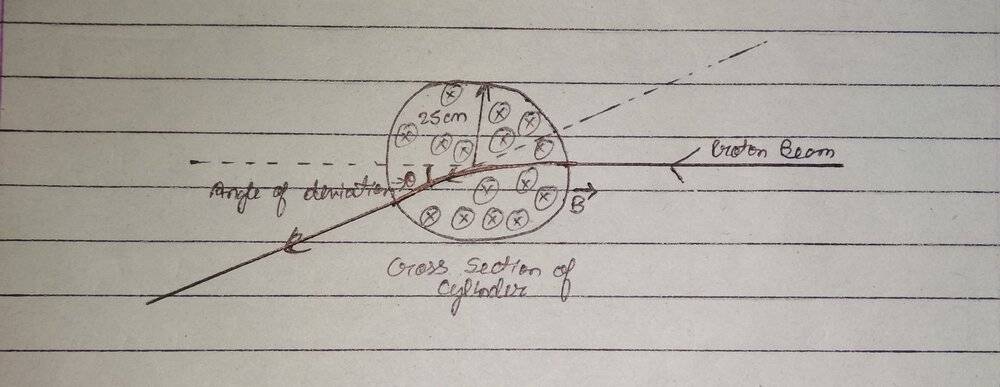
After leaving the field region, the beam will move tangentially from the point of leaving, as I've made in the diagram, causing a deviation θ from the initial incident direction. The question requires to find the value of θ.
Now I think that mathematically, the angle θ subtanded by the tangent to the arc in the diagram with the initial direction will be the same as the angle θ subtanded by the same arc at the center.
And knowing the value of radius of the arc, r = mv/qB = (E/c)/qB (>>> 25cm), I'm having trouble finding the relation between the length of this arc and the radius of the circle in which this arc is present to get the required value of θ.
Please help !
While traveling through the cross-section of the cylinder, the proton beam experiences a magnetic force, which tends to move the beam in a circular orbit of the radius given by:
r = mv/qB = (E/c)/qB (Since in E^2 = p^2c^2 + mo^2c^4, given v = c, so rest massmo = 0)
After leaving the field region, the beam will move tangentially from the point of leaving, as I've made in the diagram, causing a deviation θ from the initial incident direction. The question requires to find the value of θ.
Now I think that mathematically, the angle θ subtanded by the tangent to the arc in the diagram with the initial direction will be the same as the angle θ subtanded by the same arc at the center.
And knowing the value of radius of the arc, r = mv/qB = (E/c)/qB (>>> 25cm), I'm having trouble finding the relation between the length of this arc and the radius of the circle in which this arc is present to get the required value of θ.
Please help !