Angular impulse of rolling ball

Click For Summary

Homework Help Overview

The discussion revolves around the angular impulse of a rolling ball, specifically focusing on the transition from sliding to pure rolling motion when friction is introduced. Participants are analyzing the conditions under which this transition occurs and the implications of various assumptions in the problem setup.

Discussion Character

  • Conceptual clarification, Assumption checking, Problem interpretation

Approaches and Questions Raised

  • Participants are attempting to derive an expression for velocity at the onset of pure rolling using angular impulse. There are questions regarding the correctness of initial assumptions and the relationships between linear and angular quantities. Some participants are also addressing potential typographical errors in the problem statement.

Discussion Status

The discussion is ongoing, with participants providing insights and questioning each other's reasoning. There is a mix of interpretations regarding the initial conditions and the implications of the angular impulse method. No consensus has been reached, but various perspectives are being explored.

Contextual Notes

There are indications of confusion regarding the notation used for initial and final velocities, as well as the definitions of variables in the problem. Some participants express uncertainty about the implications of certain values being larger than others in the context of the problem.

serverxeon
Messages
100
Reaction score
0
In the following, we have a sliding sphere, when it meets a floor with friction.

I want to use the angular impulse method to find an expression of the v when pure rolling starts.
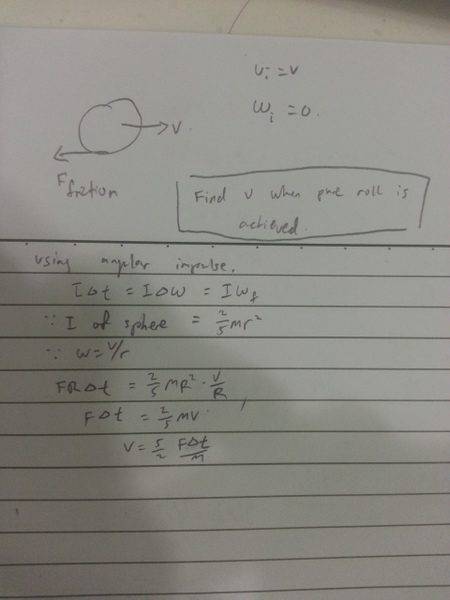
5wmn8z.jpg


[sorry I have no idea how to type in latex.]

This is obviously incorrect.
But I can't find out what's wrong. anyone?
 
Physics news on Phys.org
Why is that obviously wrong? I at least could follow it. (Small note: you changed from r to R in the problem. Also I think Vi should equal Vi not Vi=V because if Vi=V that's like Vi=Vf, but that's more of a typo.)
 
Last edited:
it's wrong cos it states that mv is larger tahn the impulse given.
 
?? Kind of following. Why does that matter? The value of mv can be bigger than the linear impulse in this problem. (Note: where mv=mVfinal)
 
It might become clearer if you properly distinguish initial and final linear speeds (u, v perhaps) and get the relationship between them.
 

Similar threads

Replies
14
Views
3K
Replies
6
Views
1K
  • · Replies 60 ·
3
Replies
60
Views
5K
Replies
4
Views
3K
  • · Replies 9 ·
Replies
9
Views
2K
  • · Replies 32 ·
2
Replies
32
Views
4K
  • · Replies 4 ·
Replies
4
Views
5K
  • · Replies 9 ·
Replies
9
Views
2K
Replies
4
Views
2K
  • · Replies 14 ·
Replies
14
Views
2K