JWA
- 1
- 0
Hi there,
A friend of mine is creating a physics engine in java (mostly as a challenge I believe).
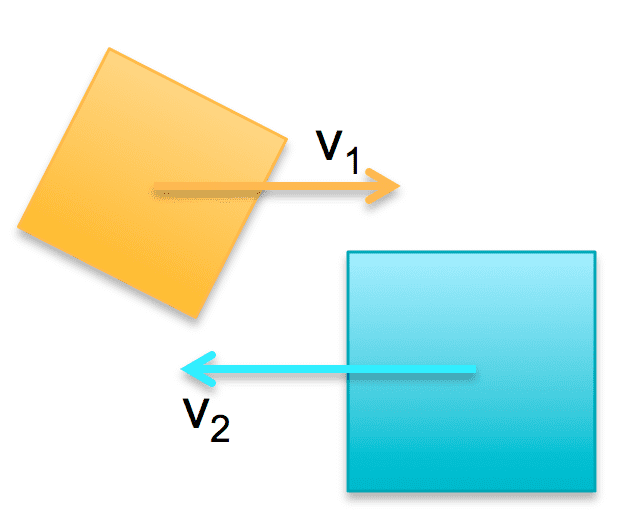
Today he asked me a question about the results of collisions between objects. For example, imagine that these 2 objects collide:
The results of such a collusion would be something like this:
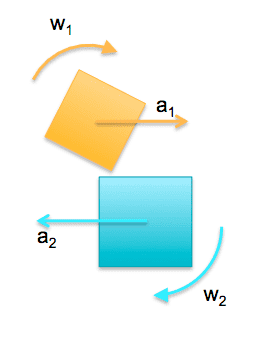
where w_1 and w_2 are angular velocities, a_1 and a_2 are final velocities in the x,y plane.
The question really is, how do you calculate the values of a_1, a_2, w_1 and w_2?
Then does the method/answer change when you have initial angular velocities as well?
I would love to have a method for finding these values, but from what I've searched online, I can't find anything...
P.S. I would assume this is graduate level physics. I did a degree in physics and have honestly no clue but that might also be because I was never much good with physics :P
Thanks,
~jwa
A friend of mine is creating a physics engine in java (mostly as a challenge I believe).
Today he asked me a question about the results of collisions between objects. For example, imagine that these 2 objects collide:
The results of such a collusion would be something like this:
where w_1 and w_2 are angular velocities, a_1 and a_2 are final velocities in the x,y plane.
The question really is, how do you calculate the values of a_1, a_2, w_1 and w_2?
Then does the method/answer change when you have initial angular velocities as well?
I would love to have a method for finding these values, but from what I've searched online, I can't find anything...
P.S. I would assume this is graduate level physics. I did a degree in physics and have honestly no clue but that might also be because I was never much good with physics :P
Thanks,
~jwa