Angular magnification what is angle subtended?

Click For Summary
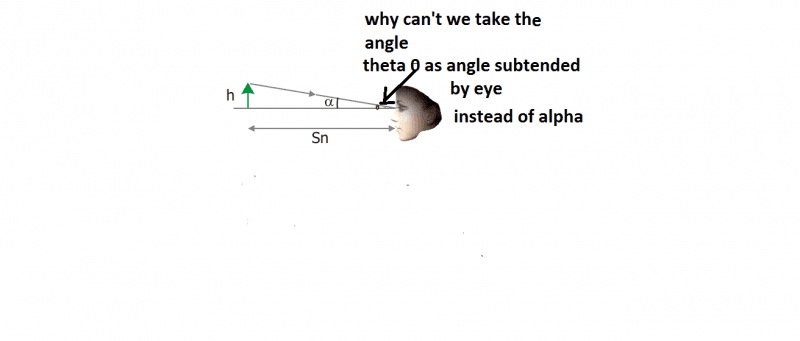
Angular magnification in a simple microscope is defined as the ratio of the angle subtended at the eye with the instrument to the angle without it. The discussion revolves around understanding how to measure this subtended angle, particularly questioning the relevance of angles θ and α. Participants clarify that there is no significant difference between these angles, emphasizing that both represent the same concept of angle measure. The conversation highlights the confusion regarding measuring angles at different distances from the vertex. Ultimately, the discussion enhances the understanding of angular magnification and its measurement in microscopy.
gracy
Messages
2,486
Reaction score
83
In case of simple microscope .we take angular magnification
I know The angular magnification of an instrument is the ratio of the angle subtended at the eye when using the instrument divided by the angular size without the instrument
But what I am not getting is how this subtended angle is taken?
For example in the image below
angel subtended.png

Is it because this angle theta is negligible (nearly zero)
 
Last edited:
Mathematics news on Phys.org
In your picture you ask "why can't we take the angle \theta as the angle subtended rather than \alpha?". But I see NO difference between "\theta" and "\alpha". You also say "Is it because this angle theta is negligible (nearly 0)".<br /> <br /> Are you possibly thinking that the angle, measured farther out, is larger than the angle measured close to the vertex? If so, then you do not what "angle measure" <b>means</b>!
 
HallsofIvy said:
Are you possibly thinking that the angle, measured farther out, is larger than the angle measured close to the vertex?
Yes.
 
HallsofIvy said:
"angle measure" means!
Hmm... I got you point.This picture greatly explains that there is n difference between difference between "θ" and ",alpha
 

Attachments

  • angle measure.png
    angle measure.png
    12.3 KB · Views: 529
Here is a little puzzle from the book 100 Geometric Games by Pierre Berloquin. The side of a small square is one meter long and the side of a larger square one and a half meters long. One vertex of the large square is at the center of the small square. The side of the large square cuts two sides of the small square into one- third parts and two-thirds parts. What is the area where the squares overlap?

Similar threads

  • · Replies 7 ·
Replies
7
Views
2K
  • · Replies 5 ·
Replies
5
Views
2K
  • · Replies 6 ·
Replies
6
Views
3K
Replies
2
Views
2K
Replies
8
Views
10K
  • · Replies 5 ·
Replies
5
Views
8K
  • · Replies 14 ·
Replies
14
Views
3K
  • · Replies 12 ·
Replies
12
Views
3K
  • · Replies 2 ·
Replies
2
Views
3K
  • · Replies 5 ·
Replies
5
Views
8K