Angular motion with constant acceleration
Join the discussion
Registration is free. Ask a follow-up in this thread, or start your own.
2 replies · 3K views
kyin01
Messages
47
Reaction score
0
[SOLVED] Angular motion with constant acceleration

Homework Statement


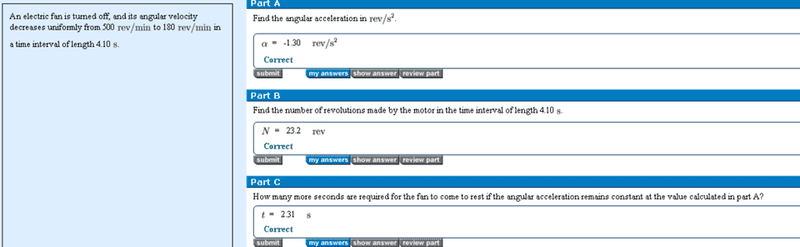
1-13.png


Homework Equations


[tex]\varpi[/tex]= [tex]\varpi[/tex](inital) + [tex]\alpha[/tex]t


The Attempt at a Solution


I understood part A and Part b,
What I don't understand is how to do Part C.
What I did was divide the average angular velocity with acceleration. But I don't get why or a more understanding method to do this problem
 
Physics news on Phys.org
The angular acceleration is a measure of the rate of change of angular velocity, in other words, provided that the angular acceleration is constant it is the change in angular velocity divided by the time taken. Mathematically, for constant acceleration ([itex]\alpha[/itex]),

[tex]\alpha = \frac{\Delta \omega}{\Delta t}[/tex]

Which can be rearranged,

[tex]\Rightarrow \Delta t = \frac{\Delta \omega}{\alpha}[/tex]

or,

[tex]\Delta t = \frac{\omega_\text{final} - \omega_\text{initial}}{\alpha}[/tex]

In the case of part (c) you want to know how long it takes for the fan to come to rest, i.e. the final angular velocity is zero. Hence,

[tex]\Delta t = \frac{- \omega_\text{initial}}{\alpha}[/tex]

Does that make sense?
 
Ahh that makes crystal clear perfect sense. Thank you so much Hootenanny!