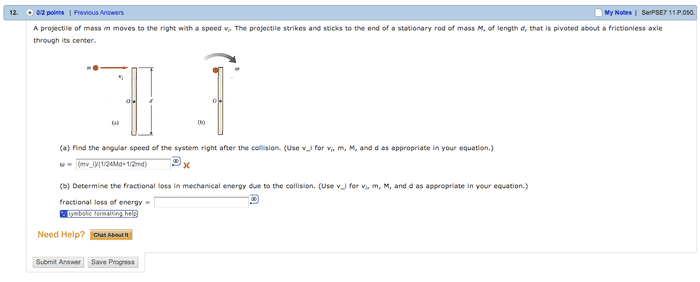
Angular speed of rod after projectile collides into it
Click For Summary

Homework Help Overview

The discussion revolves around the angular speed of a rod after a projectile collides with it, involving concepts from rotational dynamics and moment of inertia.

Discussion Character

  • Mixed

Approaches and Questions Raised

  • Participants explore the moment of inertia of a thin rod and question the appropriate radius to use in calculations. There are attempts to derive expressions for angular speed and kinetic energy ratios.

Discussion Status

Some participants have provided guidance on the moment of inertia and the interpretation of variables, while others are clarifying their understanding of the problem setup. Multiple interpretations of the radius and its implications are being discussed.

Contextual Notes

There are indications of confusion regarding the definitions of variables and the algebraic manipulation of expressions. Participants express concerns about the submission system's ability to recognize different algebraic forms.

StrawHat
Messages
33
Reaction score
0
[SOVLED] Angular speed of rod after projectile collides into it

Homework Statement


dcnzX.png


Homework Equations


L = r x p
Iparallel = ICM + md2


The Attempt at a Solution


L = r x p = mvir = mvid/2
mvi(d/2) = (Iparallel + md2
mvi(d/2) = (1/12M(d/2)^2 + m(d/2)^2)ω

Plugging and solving eventually leads me to...
ω = (mvi)/(1/24Md+1/2md)
...Which is apparently incorrect.
 
Last edited:
Physics news on Phys.org
What's the moment of inertia of a thin rod about its center?
 
1/12mr2
 
And what should r be in this problem? Hint: I don't think it's d/2.

As a matter of interest, how good is the submission system at algebra? Will it understand that a/(1/24b+1/2c)=24a/(b+12c), or will it only recognise expressions that your prof entered? The only one I've ever used could only do exact string comparison, so if the answer was 0.3 and you typed .3, that was marked wrong...
 
Why wouldn't it be d/2? If the diameter of the circular motion is d, then wouldn't the radius be d/2?
 
You have the correct functional form for the second moment of inertia of the rod, but are misinterpreting the thing you called r. It's the length of the rod (d, in this case). You can easily look it up, or derive it from first principles by integrating \mu r^2dr (where \mu is the mass per unit length of the rod) over the range -d/2 to d/2.
 
Oh okay, I thought r was supposed to be the distance between the rotation point and the end of the rod.

I got the right answer of ω = (mvi)/(1/6Md+1/2md)

Thanks for your help!
 
Okay, I've tried part B of the question and this is what I've done so far.

Kfinal = 1/2Iω2
Kinitial = 1/2mv2

I divided both of those to get (Iω2)/(mvinitial)

Calculating that further, and I get this:
D2LsZ.png


I'm guessing that it's not Kfinal/Kinitial, but (Kinitial - Kfinal)/Kfinal?

EDIT: Okay, I got the answer. Thank you all!
 
Last edited:
StrawHat said:
I'm guessing that it's not Kfinal/Kinitial, but (Kinitial - Kfinal)/Kfinal?

Almost. After subtracting, divide by Kinitial rather than Kfinal. (It's like one of those percent decrease problems in algebra.)
 

Similar threads

  • · Replies 4 ·
Replies
4
Views
2K
  • · Replies 17 ·
Replies
17
Views
1K
  • · Replies 11 ·
Replies
11
Views
2K
  • · Replies 18 ·
Replies
18
Views
4K
Replies
21
Views
3K
Replies
10
Views
3K
  • · Replies 12 ·
Replies
12
Views
2K
  • · Replies 8 ·
Replies
8
Views
4K
Replies
38
Views
4K
  • · Replies 2 ·
Replies
2
Views
2K