MHB Another Question on Upper and Lower Limits .... Denlinger, Theorem 2.9.6 (a)

  • Thread starter Thread starter Math Amateur
  • Start date Start date
  • Tags Tags
    Limits Theorem
Click For Summary
The discussion centers on understanding the implications of the inequalities in Theorem 2.9.6 (a) from Denlinger's "Elements of Real Analysis." The key point is that the inequality $$ \underline{x_n} \leq \overline{x_m} $$ for all natural numbers m and n indicates that the supremum of the lower limits, $$ \sup\{ \underline{x_n} \} $$, is less than or equal to the infimum of the upper limits, $$ \inf\{ \overline{x_m} \} $$. By fixing m and allowing n to vary, it is established that $$ \overline{x_m} $$ serves as an upper bound for the sequence of lower limits. Consequently, varying m shows that the supremum of the lower limits is a lower bound for the sequence of upper limits, leading to the conclusion that $$ \sup\{ \underline{x_n} \} \leq \inf\{ \overline{x_m} \} $$. This logical progression clarifies the relationship between the upper and lower limits in the context of the theorem.
Math Amateur
Gold Member
MHB
Messages
3,920
Reaction score
48
I am reading Charles G. Denlinger's book: "Elements of Real Analysis".

I am focused on Chapter 2: Sequences ... ...

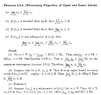
I need help with the proof of Theorem 2.9.6 (a)Theorem 2.9.6 reads as follows:
View attachment 9250
View attachment 9251
In the above proof of part (a) we read the following:

" ... $$ \forall \ m, n \in \mathbb{N}, \ \underline{x_n} \leq \underline{ x_{n + m} } \leq \overline{ x_{n + m} } \leq \overline{ x_m }$$. Thus, $$\text{sup} \{ \underline{x_n} \ : \ n \in \mathbb{N} \} \leq \text{inf} \{ \overline{x_n} \ : \ n \in \mathbb{N} \}$$... ... "
My question is as follows:Can someone explain exactly why $$ \ \underline{x_n} \leq \underline{ x_{n + m} } \leq \overline{ x_{n + m} } \leq \overline{ x_m } \ $$ implies that $$ \ \text{sup} \{ \underline{x_n} \ : \ n \in \mathbb{N} \} \leq \text{inf} \{ \overline{x_n} \ : \ n \in \mathbb{N} \}$$ ... ... Hope that someone can help ...

Peter
===============================================================================

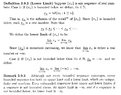
It may help MHB readers to have access to Denlinger's definitions and notation regarding upper and lower limits ... so I am providing access to the same ... as follows:
View attachment 9252
View attachment 9253
Hope that helps ...

Peter
 

Attachments
  • Denlinger - 1 - Theorem 2.9.6 - PART 1 ... .png
    Denlinger - 1 - Theorem 2.9.6 - PART 1 ... .png
    23.8 KB · Views: 147
  • Denlinger - 2 - Theorem 2.9.6 - PART 2 ... .png
    Denlinger - 2 - Theorem 2.9.6 - PART 2 ... .png
    6.2 KB · Views: 139
  • Denlinger - 1 - Start of Section 2.9  - PART 1 ... .png
    Denlinger - 1 - Start of Section 2.9 - PART 1 ... .png
    23.2 KB · Views: 145
  • Denlinger - 2 - Start of Section 2.9  - PART 2 .png
    Denlinger - 2 - Start of Section 2.9 - PART 2 .png
    22.5 KB · Views: 143
Last edited:
Physics news on Phys.org
Peter said:
Can someone explain exactly why $$ \ \underline{x_n} \leq \underline{ x_{n + m} } \leq \overline{ x_{n + m} } \leq \overline{ x_m } \ $$ implies that $$ \ \text{sup} \{ \underline{x_n} \ : \ n \in \mathbb{N} \} \leq \text{inf} \{ \overline{x_n} \ : \ n \in \mathbb{N} \}$$ ... ...
Leaving out the two intermediate parts in that string of inequalities, you see that $\underline{x_n} \leqslant \overline{ x_m }$ (for all $m$ and $n$ in $\Bbb{N}$). Keeping $m$ fixed and letting $n$ vary, it follows that $\overline{ x_m }$ is an upper bound for the sequence $\{ \underline{x_n}\}$. Therefore $\sup\{ \underline{x_n}\} \leqslant \overline{ x_m }$.

Now let $m$ vary. That last inequality shows that $\sup\{ \underline{x_n}\}$ is a lower bound for the sequence $\{\overline{ x_m }\}$, and therefore $\sup\{ \underline{x_n}\} \leqslant \inf \{\overline{ x_m }\}$.
 
Last edited:
Opalg said:
Leaving out the two intermediate parts in that string of inequalities, you see that $\underline{x_n} \leqslant \overline{ x_m }$ (for all $m$ and $n$ in $\Bbb{N}$). Keeping $m$ fixed and letting $n$ vary, it follows that $\overline{ x_m }$ is an upper bound for the sequence $\{ \underline{x_n}\}$. Therefore $\sup\{ \underline{x_n}\} \leqslant \overline{ x_m }$.

Now let $m$ vary. That last inequality shows that $\sup\{ \underline{x_n}\}$ is a lower bound for the sequence $\{\overline{ x_m }\}$, and therefore $\sup\{ \underline{x_n}\} \leqslant \inf \{\overline{ x_m }\}$.

Thanks Opalg ...

Appreciate your help ...

Peter
 
We all know the definition of n-dimensional topological manifold uses open sets and homeomorphisms onto the image as open set in ##\mathbb R^n##. It should be possible to reformulate the definition of n-dimensional topological manifold using closed sets on the manifold's topology and on ##\mathbb R^n## ? I'm positive for this. Perhaps the definition of smooth manifold would be problematic, though.

Similar threads

Replies
4
Views
2K
  • · Replies 2 ·
Replies
2
Views
3K
  • · Replies 5 ·
Replies
5
Views
3K
  • · Replies 2 ·
Replies
2
Views
2K
  • · Replies 2 ·
Replies
2
Views
2K
  • · Replies 2 ·
Replies
2
Views
2K
  • · Replies 1 ·
Replies
1
Views
2K
Replies
4
Views
2K
  • · Replies 2 ·
Replies
2
Views
3K
Replies
2
Views
1K