ANSYS Workbench contact problem

Click For Summary

Discussion Overview

The discussion revolves around a contact problem encountered in a finite element method (FEM) analysis of a sump lid for sewage as part of a bachelor's thesis in mechanical engineering. Participants explore issues related to meshing, load application, and material behavior under stress.

Discussion Character

  • Technical explanation
  • Debate/contested
  • Mathematical reasoning

Main Points Raised

  • One participant describes experiencing a problem where the upper layer of the sump lid appears to be pushed through the lower layer under load.
  • Another participant questions the meshing technique and suggests that the deformation might be due to compression rather than penetration, asking for clarification on the load application.
  • A participant mentions trying different mesh configurations but still encounters issues with the program not recognizing the connection between the top and bottom surfaces under load.
  • Concerns are raised about the stresses in the protruded region exceeding the elastic stress limit of the material, prompting questions about the extent of this excess and the material properties used.
  • One participant suggests varying load, plate thickness, and material strength to understand their effects on the results, while another notes that they are limited by the need to simulate a real-world scenario.
  • There is a discussion about the geometry of the elements connecting the top and bottom layers and whether they are appropriately designed to transfer loads effectively.
  • A participant confirms plans to distribute the load over a contact patch but indicates that this has not yet been implemented in the analysis.
  • Another participant inquires about the representation of the cover and whether there are intermediate supporting structures between the top and bottom layers.

Areas of Agreement / Disagreement

Participants express differing views on the nature of the deformation observed in the model, with some suggesting compression and others asserting penetration. The discussion remains unresolved regarding the best approach to address the contact problem and the implications of material properties.

Contextual Notes

Limitations include the reliance on automeshing, the potential inaccuracies in load representation, and the absence of intermediate structures in the model, which may affect the analysis outcomes.

Anders Johnsen
Messages
4
Reaction score
0
I'm currently working on my bachelor's thesis in mechanical engineering.

A part of my thesis is conducting a FEM-analysis on a sump for sewage.

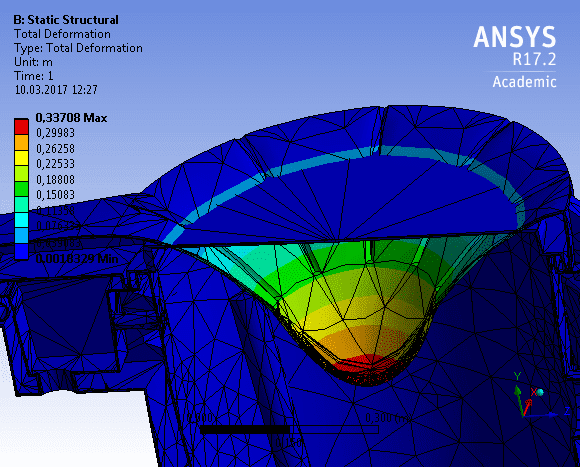
I've applied a load on the upper face of the lid for the sump. As a result, the upper layer of the lid has been "pushed through" the lower layer of the lid.

How can this be prevented?
5D - trykket igjennom.png
 
Engineering news on Phys.org
From the diagram it is not possible to see how you have meshed the cover to represent a disc with thickness and interlacing elements between the upper and lower faces.

At the same time, are you sure that the top face is pushed through rather than compressed into the lower face and both faces stretched and deformed downward as seen in this diagram.

The configuration of the deflected disc would imply you have used a load that is concentrated in the center region of the cover. Is that correct?
 
The entire model was automeshed. I've also tried several different meshes.

Yes, I'm quite sure the top surface was pushed through. I've played around with several different contacts, but I can't seem to make the program understand that the top surface should "connect" to the bottom surface as loads are applied.

Yes, in this configuration, the load is a remote load applied to the center of the lid of the container. This is not a correct representation of the real load, but I decided to try to solve the contact problem first.

Any tips?
 
How much of the displayed center section is protruded through the bottom layer and are the stresses in the protruded region all below the elastic stress limit for your selected material strength?

Have you tried varying your load, plate thickness, and material strengths to see what effects those have on your results?
 
I've tried varying the loads, but as I'm trying to simulate a car running over, it limits the loads that can be applied.

I'm sure plate thickness and material strength would alter the results, bit I'm running simulations on a already designed product.

I don't have access to the results at this time, but I seem to recall that the stresses in the portruded region exceeded the linear-elastic yield limit of the material.

I've also tried to choose both the top of the top layer and the top of the bottom layer when applying the load, and this prevents any portrusion, but this won't be representative for the real load-situation.

I think my problem is in the connections bar, where I'm able to "connect" the elements through contacts, but whatever combination I try, I can't seem to get the results I want.
 
Sometimes the answer you want is just not the one that is correct considering that your analyses are showing that the existing plate is exceeding its specified yield strength.

By how much is it exceeding its specified yield strength. Published "min yield" values are generally the suppliers guaranteed minimum for a material and the actual average yield strength of that material can be up to 10% to 15% above the certified minimum value.

Is the top layer exceeding specified tensile strength as well?

Anders Johnsen said:
I can't seem to make the program understand that the top surface should "connect" to the bottom surface as loads are applied.

What type of geometry is being used for the element structures connecting the top and bottom layers this internal structure should transfer the load between the two surfaces regardless of the amount of applied loading. Have you structured this as a short round cylinder?

Just for my information, are you applying your load as a distributed load over a tire contact patch area?
 
As shown on the attached picture, the lid of the container is automeshed, but refined on the surfaces of the top and the bottom parts.

Yes, I'm planning to distribute the load over a contact patch, but this has not been done at this stage in the process.
lokk - pumpkum.png
 
I the above a true representation of your cover where the top and the bottom of the cover are separated by a space between them with no intermediate supporting web plates between them?
 

Similar threads

  • · Replies 1 ·
Replies
1
Views
7K
  • · Replies 5 ·
Replies
5
Views
6K
  • · Replies 1 ·
Replies
1
Views
6K
  • · Replies 1 ·
Replies
1
Views
10K
Replies
2
Views
5K
  • · Replies 5 ·
Replies
5
Views
5K
  • · Replies 3 ·
Replies
3
Views
4K
  • · Replies 1 ·
Replies
1
Views
4K
Replies
3
Views
3K
  • · Replies 8 ·
Replies
8
Views
50K