Antenna inductance calculation (RFID applications, inductive coupling)

Click For Summary
SUMMARY

The forum discussion centers on estimating the inductance of various antenna coil shapes for RFID applications, specifically at a frequency of 134.2 kHz. Participants discuss different coil designs, including circular, multilayer, spiral, and square loop coils, referencing Microchip's application note for planar designs. The conversation highlights the challenges of calculating inductance for 3D shaped coils and the importance of maintaining specific inductance values for effective inductive coupling. Key insights include the necessity of avoiding random winding to ensure effective inductance and the potential for using analytical rules to estimate inductance based on coil geometry.

PREREQUISITES
  • Understanding of inductance and its role in RLC circuits
  • Familiarity with RFID technology and inductive coupling principles
  • Knowledge of coil design, including planar and 3D geometries
  • Experience with electromagnetic theory and magnetic field patterns
NEXT STEPS
  • Research "Microchip Application Note AN710" for detailed coil design equations
  • Explore "Inductance Calculation for 3D Coils" to find analytical methods for complex geometries
  • Study "Ferrite Rod Antenna Design" for low-frequency applications
  • Investigate "Magnetic Field Pattern Analysis" to understand field distribution in different coil shapes
USEFUL FOR

Engineers and designers working on RFID systems, particularly those focused on antenna design and inductive coupling at low frequencies. This discussion is beneficial for anyone looking to optimize antenna performance through precise inductance calculations.

ethanRR
Messages
3
Reaction score
0
Inductance of antenna coils of different shapes can be estimated. Some examples are:
  • A circular coil with single turn.
  • N turn multilayer circular coil.
  • Spiral coil.
  • N turn squae loop coil.
  • etc.
For plannar design (spiral, rectangular, etc) I have used this reference (from pag. 9 onwards): https://ww1.microchip.com/downloads/en/AppNotes/00710c.pdf

However, is it possible to estimate the inductance cooil of a 3D shaped coil? i.e, imagine a loop wire that runs along some of the edges of a cube doing several turns. I could not find any reference regarding this. I am trying to build different shape antennas for RFID low frequency devices (inductive coupling, 135 kHz). Any hint/starting point is appreciated.
 
Physics news on Phys.org
Not exactly sure of the winding detail you are suggesting as it sounds like a random winding which would tend to be non inductive. A solenoid on a square former should be possible to find, not very different to a circular solenoid of the same area.
 
Hi @tech99,

Thank you for your answer. This is actually my question. I want to match a specific inductance value for the design of an inductive coupling antenna. A solenoid of square form is actually in the reference I mentioned (equation 26). The shape I meant is something like the attached picture, i.e., the loop wire would run along the shown framework. If I had just the upper face the geometry would be a plannar and eq. 26 could be applied to estimate the inductance.

Regarding your answer "... random winding which would tend to be non inductive", could you please elaborate more? My understanding is that this shape is also inductive, but I would like to obtain some analitical rules to estimate the inductance, i.e., number of turns needed to obtain a specific inductance value.
 

Attachments

  • testExample.PNG
    testExample.PNG
    42.4 KB · Views: 147
It looks similar to the saddle shape use for scan coils on a TV tube. Maybe find inductance of a flat coil, then bend it into the saddle shape, which will reduce the inductance slightly.
 
ethanRR said:
Regarding your answer "... random winding which would tend to be non inductive", could you please elaborate more?
Randomly wound coils with on-average half of the coils effectively clockwise and half counterclockwise will generate no net induced voltage for a changing magnetic flux through that volume.
 
Last edited:
ethanRR said:
For plannar design (spiral, rectangular, etc) I have used this reference (from pag. 9 onwards): https://ww1.microchip.com/downloads/en/AppNotes/00710c.pdf

However, is it possible to estimate the inductance cooil of a 3D shaped coil? i.e, imagine a loop wire that runs along some of the edges of a cube doing several turns. I could not find any reference regarding this. I am trying to build different shape antennas for RFID low frequency devices (inductive coupling, 135 kHz). Any hint/starting point is appreciated.
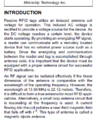
There is a pretty big discrepancy between your 135kHz and the frequencies discussed in that paper:

1654040511302.png


Can you consider using a version of a thin ferrite rod antenna for your low operating frequency?
 

Attachments

  • 1654040268181.png
    1654040268181.png
    15.4 KB · Views: 140
Dear @berkeman,

Thank you for taking the time in reading the reference. In that same reference, some examples also mention the 125 kHz range. The principle is the same, inductive coupling. I said 135 kHz because my reader works specifically at 134.2 kHz. For example, one compatible tag is this .

Can you consider using a version of a thin ferrite rod antenna for your low operating frequency?
No, if I could I had not posted this question. I have used the formulas in the reference for building rectangular antennas at 134.2 kHz to match a specific inductance needed, and it worked.

I have to match a specific inductance value to achieve high voltages since the antenna circuit is basically an RLC circuit whose resonant frequency is 134.2 kHz. This makes me wonder if I could probably think about plotting just plotting the magnetic field pattern.

Randomly wound coils with on-average half of the coils effectively clockwise and half counterclockwise will generate no net induced voltage for a changing magnetic flux through that volume.
Yes, and I have read some geometries used in resistors, "Non-Inductive Wire wound resistor". But that is not a random winding, nor my 3d-shape (I did not say random), although I should have stated this more clearly.

As I said, this conversation makes me wonder new questions:
1- Why the antenna circuit is a resonant circuit? I think because the winding geometry of a coil with several turns increases the magnetic field, but implicitly has an inductance associated, i.e., for the same intensity value, the loop geometry provides higher magnetic field strength. Thus, the point is to increase as much as possible the intensity (resonant point), of course up to a certain limit.

2- Since my point is to analyze the reading pattern, I probably could try to obtain the magnetic field pattern given a specific geometry.
 

Similar threads

  • · Replies 1 ·
Replies
1
Views
8K