(Apparently) simple question rearding module homomorphisms

  • Context: Graduate 
  • Thread starter Thread starter Math Amateur
  • Start date Start date
  • Tags Tags
    Homomorphisms module
Join the discussion
Registration is free. Ask a follow-up in this thread, or start your own.
7 replies · 3K views
Math Amateur
Gold Member
MHB
Messages
3,920
Reaction score
48
I am reading Dummit and Foote Chapter 10: Introduction to Module Theory.

I am having difficulty seeing exactly why a conclusion to Proposition 27 that D&F claim is "immediate":

I hope someone can help.

Proposition 27 and its proof read as follows:
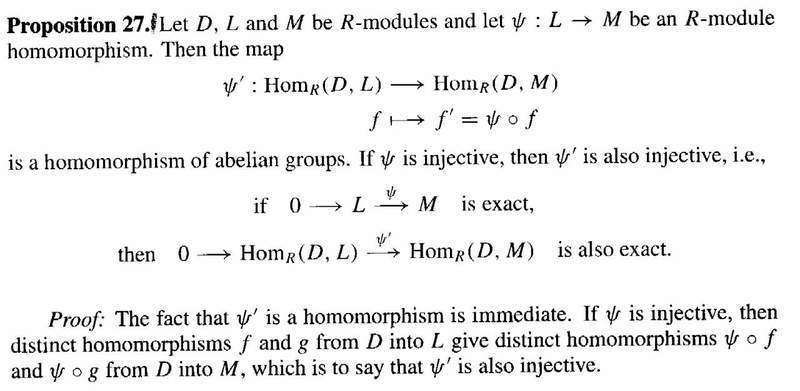
attachment.php?attachmentid=69619&stc=1&d=1399695567.jpg


In the first line of the proof (see above) D&F state the following:

"The fact that [itex]\psi[/itex] is a homomorphism is immediate."

Can someone please explain exactly why [itex]\psi[/itex] is a homomorphism?

Would appreciate some help.

Peter
 

Attachments

  • Dummit and Foote - Ch 10 - Proposition 27.jpg
    Dummit and Foote - Ch 10 - Proposition 27.jpg
    36.2 KB · Views: 805
Physics news on Phys.org
Tried to resize image - new image is displayed below.

attachment.php?attachmentid=69655&stc=1&d=1399778625.png


Peter
 

Attachments

  • Resized image.png
    Resized image.png
    31 KB · Views: 603
Another size option would be as follows:

attachment.php?attachmentid=69656&stc=1&d=1399778901.png


Peter
 

Attachments

  • Resize - second option.png
    Resize - second option.png
    26.6 KB · Views: 560
I'd recommend you try to figure it out for yourself, using the definition of phi' they give at the top.
 
Thanks.

Problem is now solved.

Peter
 
Math Amateur said:
Thanks.

Problem is now solved.

Peter
If you don't mind,can you show us your answer?
 
I received help on the MHB forum.

The solution was as follows:

"We have to verify that for:

[itex][/itex]

[itex]\psi'(f+g) = \psi'(f) + \psi'(g)[/itex] in [itex]\text{Hom}_R(D,M)[/itex].

To do this, let's take an arbitrary element [itex]d \in D[/itex].

Then:

[itex](\psi'(f+g))(d) = (\psi \circ (f+g))(d) = \psi((f+g)(d)) = \psi(f(d)+g(d)) = \psi(f(d)) + \psi(g(d))[/itex] (since [itex]\psi[/itex] is a module homomorphism)

[itex]= (\psi \circ f)(d) + (\psi \circ g)(d) = (\psi'(f))(d) + (\psi'(g))(d) = (\psi'(f) + \psi'(g))(d)[/itex].

Since these two functions are equal for every [itex]d \in D[/itex] they are the same element of [itex]\text{Hom}_R(D,M)[/itex]."

The solution is due to Deveno on the Math Help Boards, Linear and Abstract Algebra forum.

Peter
 
Last edited: