Exact Sequences - Lifting Homomorphisms - D&F Ch 10 - Theorem 28

Click For Summary

Discussion Overview

The discussion revolves around a specific step in the proof of Theorem 28 from Dummit and Foote's Chapter 10 on exact sequences, particularly focusing on the lifting of homomorphisms. Participants are examining the implications of certain equalities and substitutions in the context of module homomorphisms.

Discussion Character

  • Technical explanation
  • Conceptual clarification
  • Debate/contested

Main Points Raised

  • One participant questions the validity of the statement that if \( F = \psi' (F') \), then it follows that \( \phi ( F (d) ) = \phi ( \psi ( F' (d))) \), suggesting that it should instead imply \( \phi ( F (d) ) = \phi ( \psi' ( F' (d))) \).
  • Another participant argues that since \( F' \in \text{Hom}(D,L) \), the expression \( \psi' (F' (d)) \) is problematic because \( F' (d) \) is not in the domain of \( \psi' \).
  • A participant expresses confusion about the legality of substituting \( F \) with \( \psi' (F') \) and seeks clarification on the error made during this substitution.
  • Further clarification is provided that substituting directly leads to a misunderstanding of how \( \psi' \) operates on \( F' \), emphasizing that \( \psi' (F') \) acts on \( d \) rather than \( F' (d) \).

Areas of Agreement / Disagreement

Participants express differing views on the implications of the equality \( F = \psi' (F') \) and the subsequent substitutions. The discussion remains unresolved as participants continue to explore the implications of their claims.

Contextual Notes

Participants highlight potential misunderstandings regarding the domains of the homomorphisms involved and the nature of substitutions in the proof, indicating that certain assumptions may not hold without further clarification.

Math Amateur
Gold Member
MHB
Messages
3,920
Reaction score
48
I am reading Dummit and Foote, Chapter 10, Section 10.5, Exact Sequences - Projective, Injective and Flat Modules.

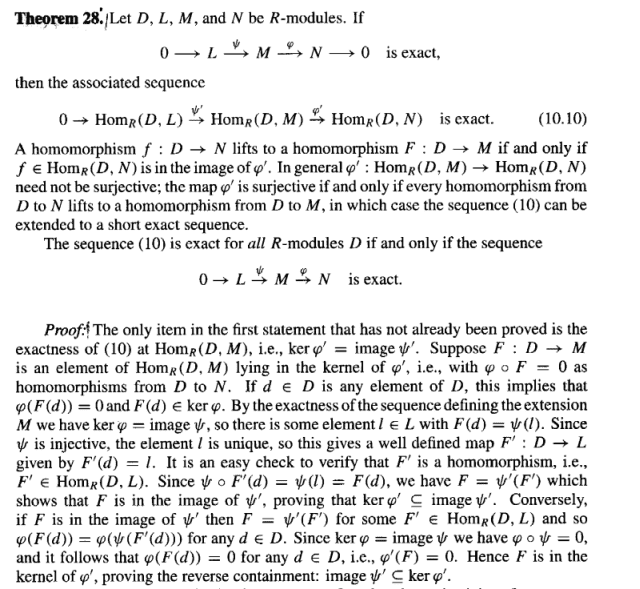
I need help with a minor step of D&F, Chapter 10, Theorem 28 on liftings of homomorphisms.

In the proof of the first part of the theorem (see image below) D&F make the following statement:

-------------------------------------------------------------------------------

Conversely, if F is in the image of \psi' then F = \psi' (F') for some F' \in Hom_R (D, L) and so \phi ( F (d) )) = \phi ( \psi ( F' (d))) for any d \in D. ...

----------------------------------------------------------------------------

My problem is that surely F = \psi' (F') implies that \phi ( F (d) )) = \phi ( \psi' ( F' (d))) and NOT \phi ( F (d) )) = \phi ( \psi ( F' (d)))?

Hoping someone can help>

Theorem 28 and the first part of the proof read as follows:
attachment.php?attachmentid=69697&stc=1&d=1399873986.png


Peter
 

Attachments

  • Dummit and Foote - Chapter 10 - Theorem 28 - RESIZED.png
    Dummit and Foote - Chapter 10 - Theorem 28 - RESIZED.png
    60.9 KB · Views: 590
Last edited:
Physics news on Phys.org
Math Amateur said:
My problem is that surely F = \psi' (F') implies that \phi ( F (d) )) = \phi ( \psi' ( F' (d)))

This cannot be true. We know that ##F^\prime\in \textrm{Hom}(D,L)##, and thus ##F^\prime(d)\in L##. But the domain of ##\psi^\prime## is not ##L##, but rather ##\textrm{Hom}(D,L)##. So ##\psi^\prime(F^\prime(d))## makes no sense since ##F^\prime(d)## is not in the domain of ##\psi^\prime##.
 
  • Like
Likes   Reactions: 1 person
Thanks ...

Yes, you are right ...

BUT, now I have two problems ...

Problem 1 ... to get \phi ( F (d) )) = \phi ( \psi' ( F' (d))) I simply replaced the F with \psi' (F') since we have that F = \psi' (F') ... but presumably I did something 'illegal' ... can you explain my error?

Problem 2 ... How then does it follow that \phi ( F (d) )) = \phi ( \psi ( F' (d))) for any d \in D (given that F = \psi' (F')? Can you help?

Peter
 
Math Amateur said:
Thanks ...

Yes, you are right ...

BUT, now I have two problems ...

Problem 1 ... to get \phi ( F (d) )) = \phi ( \psi' ( F' (d))) I simply replaced the F with \psi' (F') since we have that F = \psi' (F') ... but presumably I did something 'illegal' ... can you explain my error?

If you simply substituted, then you would have gotten

F(d) = \psi^\prime(F^\prime)(d)

Thus ##\psi^\prime(F^\prime)## acts on ##d##. You would not get F(d) = \psi^\prime(F^\prime(d))

Now, by definition, we have ##\psi^\prime(F^\prime) = \psi\circ F^\prime##. Thus

F(d) = \psi^\prime(F^\prime)(d) = (\psi\circ F^\prime)(d) = \psi(F^\prime(d))
 
  • Like
Likes   Reactions: 1 person
Thanks ... appreciate your help ... given me the confidence to go forward from there in my attempt to understand projective modules

Thanks again,

Peter
 

Similar threads

  • · Replies 3 ·
Replies
3
Views
2K
  • · Replies 2 ·
Replies
2
Views
2K
  • · Replies 3 ·
Replies
3
Views
2K
  • · Replies 4 ·
Replies
4
Views
4K
  • · Replies 6 ·
Replies
6
Views
2K
  • · Replies 1 ·
Replies
1
Views
2K
  • · Replies 7 ·
Replies
7
Views
3K
  • · Replies 3 ·
Replies
3
Views
3K
  • · Replies 1 ·
Replies
1
Views
2K
  • · Replies 10 ·
Replies
10
Views
3K