Creating a Contour System: Results

  • Thread starter Thread starter abvg
  • Start date Start date
  • Tags Tags
    Physics System
Click For Summary
SUMMARY

The discussion centers on analyzing a circuit with two closed loops, specifically focusing on the voltage drops across resistors and the impact of current sources E1 and E2. The participants explore Kirchhoff's second rule, concluding that when E1 is turned off, the remaining circuit's behavior is governed by E2, R, and R2, leading to the equation E2 = I2(R + R2). The correctness of the initial solution presented in the discussion is affirmed, despite confusion regarding the contributions of the current sources.

PREREQUISITES
  • Understanding of Kirchhoff's laws, particularly Kirchhoff's second rule.
  • Familiarity with basic circuit analysis concepts, including voltage drops and current sources.
  • Knowledge of Ohm's Law (V = IR) and its application in circuit calculations.
  • Ability to interpret and manipulate circuit diagrams and equations.
NEXT STEPS
  • Study advanced circuit analysis techniques using Kirchhoff's laws.
  • Learn about the impact of multiple current sources in circuit design.
  • Explore practical applications of Ohm's Law in real-world circuits.
  • Investigate common mistakes in circuit analysis and how to avoid them.
USEFUL FOR

Electrical engineering students, circuit designers, and anyone involved in analyzing and troubleshooting electrical circuits will benefit from this discussion.
abvg
Messages
4
Reaction score
0
Homework Statement
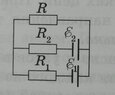
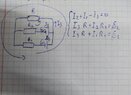
I probably have the right solution, but I don't understand it. the problem with my solution, it seems to me, is that on each selected circuit, the sum of voltage drops includes an extra voltage drop
Relevant Equations
find the current through the resistor R in the circuit (attached to the question) if E1 = 1.5V , E2= 3.7V, R1 = 10 ohms , R2= 20 ohms , R = 5 ohms. the internal resistance of the current source is not taken into account
выбранный контур контура и получившаяся система также показана на фото.
 

Attachments

  • IMG_20230316_080328.jpg
    IMG_20230316_080328.jpg
    37 KB · Views: 114
  • IMG_20230316_081828.jpg
    IMG_20230316_081828.jpg
    48.3 KB · Views: 106
Physics news on Phys.org
abvg said:
on each selected circuit, the sum of voltage drops includes an extra voltage drop
I'm not understanding your difficulty. Can you expand on that?
 
  • Like
Likes   Reactions: MatinSAR
Rules Violation - Member warned that per forum rules, posts must be in English.
haruspex said:
Я не понимаю ваших затруднений. Можете ли вы расширить это?

haruspex said:
Я взял 2 замкнутых контура. рассмотрим небольшой, где есть источник тока с Е2, в этой цепи через резистор R проходит ток I3, а падение напряжения там RI3. мне непонятно, что источник тока Е2 создает ток I2 и он "соединяется" с I1 проходит через R почему мы думаем что падение напряжения на R+I2R2 полностью равно Е2, ведь вклад Е2 в падение напряжения на R должно быть I2R. Я также представил, что было бы, если бы не было источника тока с Е1, в данном случае Е2 = RI2+R2I2. это, как мне кажется, опровергает якобы "правильное" решение. мне бы очень помогло, если бы у меня было действительно правильное решение и объяснение для него.
 
abvg said:
I took 2 closed circuits. Let's consider a small one where there is a current source with E2, in this circuit the current I3 passes through the resistor R, and the voltage drop there RI3. I do not understand that the E2 current source creates a current I2 and it "connects" to I1 passes through R why do we think that the voltage I also imagined what would have happened if there had not been a current source with E1, in this case E2 = RI2+R2I2. it seems to me that refutes the allegedly "right" solution. It would help me a lot if I had the right decision and explanation for it.

Well, you can take it in smaller steps. Assign a voltage variable to the left hand side and write the V=IR equation for each resistor.
I do not see how the no E1 case shows your method to be wrong.
 
  • Like
Likes   Reactions: MatinSAR
haruspex said:
Я не понимаю, как случай без E1 показывает, что ваш метод неверен.
если выключить участок цепи с Е1, то останется только цепь, где есть Е2, R, R2 и ток в этой цепи будет силой I2, что следует из второго правила Кирхгофа, что Е2 = I2(R + Р2). Мне интересно ваше мнение, как вы считаете решение, изложенное на фото, правильно?
haruspex said:
Ну, вы можете сделать это небольшими шагами. Назначьте переменную напряжения в левой части и запишите уравнение V = IR для каждого резистора.
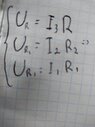
IMG_20230316_102032.jpg вот так? А что дальше?
 
abvg said:
если выключить участок цепи с Е1, то останется только цепь, где есть Е2, R, R2 и ток в этой цепи будет силой I2, что следует из второго правила Кирхгофа, что Е2 = I2(R + Р2). Мне интересно ваше мнение, как вы считаете решение, изложенное на фото, правильно?

View attachment 323669 вот так? А что дальше?
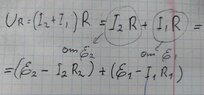
IMG_20230316_102650.jpg думаю это верно
 
abvg said:
If you turn off the section of the circuit with E1, there will only be a chain where there is E2, R, R2 and the current in this circuit will be force I2, which follows from Kirchhoff's second rule that E2 = I2(R + P2).
Yes, but that does not tell me why you think that contradicts your equations in post #1.
Note that you cannot just set ##E_1## to zero. You have to set ##I_1=0, R_1=\infty##.
I believe your post #1 solution is correct.
 
Thread closed for Moderation...
 
After a Mentor discussion, this version of the thread will remain closed.

@abvg -- Please always take care to post in English on PF, and not rely on others to do the translations to try to understand you and help you. Also, please take care with the Reply/Quote function -- in a number of the posts above you've represented your reply as a quote from @haruspex which is very confusing.
 

Similar threads

  • · Replies 4 ·
Replies
4
Views
4K
  • · Replies 9 ·
Replies
9
Views
1K
  • · Replies 1 ·
Replies
1
Views
5K
  • · Replies 8 ·
Replies
8
Views
2K
  • · Replies 15 ·
Replies
15
Views
2K
  • · Replies 2 ·
Replies
2
Views
2K
  • · Replies 6 ·
Replies
6
Views
3K
  • · Replies 1 ·
Replies
1
Views
2K
Replies
5
Views
2K
  • · Replies 28 ·
Replies
28
Views
1K