Arc length of a stadium billiard

  • Context: Undergrad 
  • Thread starter Thread starter carlosbgois
  • Start date Start date
  • Tags Tags
    Arc Arc length Length
Click For Summary
SUMMARY

The discussion focuses on calculating the arc length of a stadium billiard, which consists of two semicircles connected by tangent lines. The primary challenge is determining the arc length from a given angle θ to the collision angle. The solution involves using trigonometric functions and the relationship between the radius of the semicircles and the tangent lines, leading to the formula for arc length as s(φ) = a(φ + arcsin(W/a * sin(φ))) for the first quadrant, where W is half the width between the tangent lines and a is the radius of the semicircle.

PREREQUISITES
  • Understanding of semicircles and tangent lines
  • Basic trigonometry, including sine and arcsine functions
  • Familiarity with the concept of arc length in geometry
  • Knowledge of angles in radians and their applications in circular motion
NEXT STEPS
  • Study the derivation of arc length formulas in circular geometry
  • Learn about the properties of tangents to circles and their applications
  • Explore advanced trigonometric identities and their uses in geometry
  • Investigate the implications of different angles on arc length calculations
USEFUL FOR

Mathematicians, physics students, and anyone interested in geometric calculations involving circular arcs and tangents, particularly in the context of stadium billiards.

carlosbgois
Messages
66
Reaction score
0
I've been trying to figure out the most straightforward way of doing this for a while, and would like to get some advice on new approaches, as the one I was using didn't work out at all. So here it is:

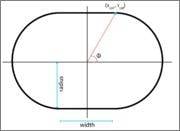
The stadium billiard is defined as two semicircles joined by two tangent lines, as shown in the figure attached. Given the angle of a point in the boundary, my goal is to determine the arc length of the boundary, from theta=0 to the collision angle. To do that, I have the parameters of the length of the tangent lines, and the radius of the semicircles (figure.) What approach would fit best here?

Thank you all for your time.
Screen_Shot_2015_01_24_at_20_45_18.jpg
 
Physics news on Phys.org
I'm not following what it is that you want to figure out. Can you add to your figure the "arc length" you are talking about?
 
Sorry about that. Here is an image showing what is the arc length I'm referring to:

Screen_Shot_2015_01_24_at_20_45_18.jpg
 
carlosbgois said:
Sorry about that. Here is an image showing what is the arc length I'm referring to:

Screen_Shot_2015_01_24_at_20_45_18.jpg
Since the circle is tangent to the parallel lines, then the arc length from the start point to the tangent point, as indicated on your diagram is (π/2) * radius of the circle.
 
SteamKing said:
Since the circle is tangent to the parallel lines, then the arc length from the start point to the tangent point, as indicated on your diagram is (π/2) * radius of the circle.
But that's not true for the general case, only for when the angle is such that the point is at the exact meeting of the semicircle and the tangent. I'm reading this as his calling "arc" the amount you specified plus some amount of the tangent line.

I haven't worked on it yet but it appears to be trivial.
 
Yes I'm looking for a general solution: given θ, what is the arc length?
 
carlosbgois said:
Yes I'm looking for a general solution: given θ, what is the arc length?
Well, you know what the circle-arc part of it is. Can you use trivial trig to get the rest?
 
phinds said:
But that's not true for the general case, only for when the angle is such that the point is at the exact meeting of the semicircle and the tangent. I'm reading this as his calling "arc" the amount you specified plus some amount of the tangent line.

I haven't worked on it yet but it appears to be trivial.

Since the parallel lines are tangent to the circular arcs (as specified by the OP), and the parallel lines are exactly 2*radius apart, then the arc length as shown in the figure will be (π/2)*radius. The angle θ shown on the diagram is not referenced from the center of the circular arcs, so it does not have a direct relationship with the arc length.
 
SteamKing said:
Since the parallel lines are tangent to the circular arcs (as specified by the OP), and the parallel lines are exactly 2*radius apart, then the arc length as shown in the figure will be (π/2)*radius. The angle θ shown on the diagram is not referenced from the center of the circular arcs, so it does not have a direct relationship with the arc length.
Again, he is using "arc" to mean "the circular part plus some of the horizontal line". I questioned him on that in post #5 and his response in post #6 is that I am interpreting it the way he intends.

This whole thing seems like a trivial problem and I don't see what all the fuss is about.
 
  • #10
For a student, it doesn't look completely trivial to me. Using the angle ##\phi## labeled in the picture and calling ##W = \frac 1 2\text{width}## where width is as labeled, and the radius of the circle ##a##, I get the arc length as$$
s(\phi) = a(\phi + \arcsin\left(\frac W a\sin\phi\right)),~~0\le \phi \le \arctan\frac a W$$for just the first quadrant arc, which is the hard part.
 

Similar threads

  • · Replies 4 ·
Replies
4
Views
2K
  • · Replies 7 ·
Replies
7
Views
3K
  • · Replies 2 ·
Replies
2
Views
2K
  • · Replies 4 ·
Replies
4
Views
2K
  • · Replies 2 ·
Replies
2
Views
3K
Replies
2
Views
2K
  • · Replies 2 ·
Replies
2
Views
2K
  • · Replies 6 ·
Replies
6
Views
2K
  • · Replies 18 ·
Replies
18
Views
2K
  • · Replies 24 ·
Replies
24
Views
4K