Are Mu and Lambda the Key to Solving this Line Intersection Problem?

  • Thread starter Thread starter lionely
  • Start date Start date
  • Tags Tags
    Lambda Parameters
Click For Summary

Homework Help Overview

The discussion revolves around a geometry problem involving the intersection of lines in three-dimensional space, specifically focusing on points A, B, and C, and their relationships. The original poster presents equations for lines l1, l2, and l3, along with coordinates for points A, B, and C, and seeks to demonstrate that the lengths of segments AC and BC are equal.

Discussion Character

  • Exploratory, Assumption checking, Problem interpretation

Approaches and Questions Raised

  • Participants discuss the calculation of vectors AC and BC, questioning their magnitudes and whether they are equal. There is also a focus on correcting the coordinates of point B. Additionally, a new part of the problem is introduced regarding finding point D on line AB such that segment CD is perpendicular to AB, prompting questions about the use of the dot product.

Discussion Status

The discussion is active, with participants correcting each other's calculations and exploring the implications of the problem. Some guidance has been offered regarding the use of the dot product to check for perpendicularity, and there is a suggestion that point D could be the midpoint of segment AB.

Contextual Notes

There is some ambiguity regarding the full problem statement, as participants note missing information. The original poster's calculations and assumptions are being examined, particularly concerning the coordinates of points B and C and the relationship between the segments.

lionely
Messages
574
Reaction score
2
the lines l2[/SUB and l3
are given by

l1 : r = 10i + j + 9k + μ(3i+j+4k)

l2: x= (y+9)/2= (z-13)/-3

l3 r= -3i-5j-4k + λ(4i+3j+k)

where mu and lambda are parameters.

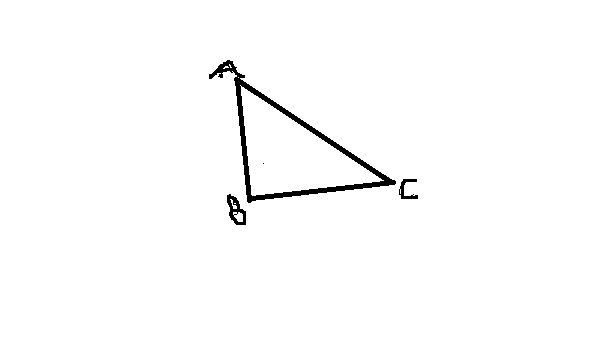
d) Show that AC=BC

A(4,-1,1) this was given, I calculated and got B as (5,-1,-2) and C (1,-2,-3)

This I what I did so far
2502qvs.png


I found AC ( -3,-1,-4)

BC(-4,-1,-1)

I also found the mods of AC and BC to see if they were equal but, they're not.
 
Last edited by a moderator:
Physics news on Phys.org


lionely said:
the lines l2[/SUB and l3
are given by

l1 : r = 10i + j + 9k + μ(3i+j+4k)

l2: x= (y+9)/2= (z-13)/-3

l3 r= -3i-5j-4k + λ(4i+3j+k)

where μ and λ are parameters.

d) Show that AC=BC

A(4,-1,1) this was given, I calculated and got B as (5,-1,-2) and C (1,-2,-3)

This I what I did so far

2502qvs.png


I found AC ( -3,-1,-4)

BC(-4,-1,-1)

I also found the mods of AC and BC to see if they were equal but, they're not.

It looks like you haven't given us the whole problem, although we can read between the lines to figure out most of what's missing:
Two of the lines intersect at point A, which is at (4,-1,1).

Two of the lines intersect at point B.

Two of the lines intersect at point C.​
...

Now,

Calculate vector AC and see if its magnitude matches the magnitude of either of the other two vectors.

Added in Edit:

B is at (5,1,-2) not (5,-1,-2)
 
Last edited:


it doesn't Magnitude of AC is root 26

while magnitude of B is root 30 and C is root 14.

sorry!
I found BC and the magnitude of it is root 26! Thank you for pointing out the mistake in the coordinates of B!


lionely said:
it doesn't Magnitude of AC is root 26

while magnitude of B is root 30 and C is root 14.

sorry!
I found BC and the magnitude of it is root 26! Thank you for pointing out the mistake in the coordinates of B!
Good deal !


Ummm there's is one more part to the question , It says write down the coordinates of the point D on AB such that CB is perpendicular to AB.

I'm not sure what to do... do I do something with the dot product?


lionely said:
Ummm there's is one more part to the question , It says write down the coordinates of the point D on AB such that CB is perpendicular to AB.

I'm not sure what to do... do I do something with the dot product?
Well, using the dot product will be a good way to check your answer, but think about the overall situation.

Triangle ABC has
length AC = length BC .​
Where should point D be on AB so that ... looks like a typo ?


write down the coordinates of the point D on AB such that CD is perpendicular to AB.


lionely said:
write down the coordinates of the point D on AB such that CD is perpendicular to AB.
OK! That makes sense.


Now,

Triangle ABC has
length AC = length BC .​
Where should point D be on AB so that CD is perpendicular to AB.


In the middle of AB?
 
  • #10


lionely said:
In the middle of AB?
Yes. D is the midpoint of AB .
 
  • #11


LOL so wait I can find find AD then just get D and that's it?
 
  • #12


lionely said:
LOL so wait I can find find AD then just get D and that's it?
Yes. That's it.

You can check your result by seeing if the appropriate dot product is zero.
 
  • #13


Thank you again for the help. Homework is now finished!
 

Similar threads

Replies
18
Views
2K
  • · Replies 14 ·
Replies
14
Views
4K
  • · Replies 2 ·
Replies
2
Views
2K
  • · Replies 4 ·
Replies
4
Views
3K
  • · Replies 2 ·
Replies
2
Views
4K
  • · Replies 4 ·
Replies
4
Views
1K
  • · Replies 1 ·
Replies
1
Views
976
Replies
2
Views
2K
  • · Replies 10 ·
Replies
10
Views
2K
Replies
2
Views
4K