Area between Curves: Calculus Solution

  • Context: Undergrad 
  • Thread starter Thread starter Sirsh
  • Start date Start date
  • Tags Tags
    Area Curves
Click For Summary

Discussion Overview

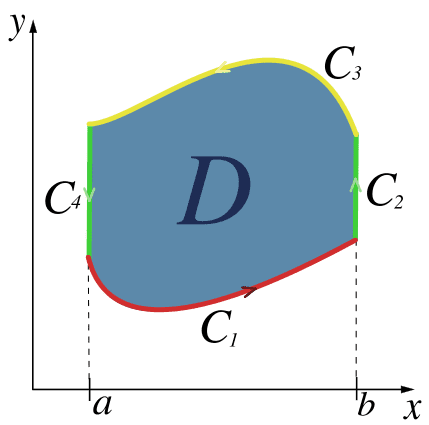
The discussion revolves around finding the area between curves using calculus, specifically in the context of a physics-related problem. Participants explore both mathematical and experimental approaches to determine the area of a specific region depicted in a picture, without having the equations of the bounding lines.

Discussion Character

  • Exploratory
  • Technical explanation
  • Debate/contested

Main Points Raised

  • One participant suggests a practical method of determining the area by cutting out the shape and weighing it, referencing a technique learned in undergraduate physics.
  • Another participant inquires about a mathematical approach to calculate the area of region D, proposing the use of integration to subtract the area of curve C1 from the area of curve C3.
  • A participant questions whether the curves represent a path integral, recalling that line integrals along closed paths in conservative fields are zero.
  • There is a reference to Green's theorem, indicating a potential connection to the mathematical concepts being discussed.

Areas of Agreement / Disagreement

Participants express various methods for determining the area, including both experimental and mathematical approaches. However, there is no consensus on the specific mathematical techniques to be employed, and some questions remain about the context and details of the curves involved.

Contextual Notes

Participants lack specific equations for the curves, which limits the mathematical discussion. The context of the curves and their properties is also not fully established, leading to uncertainty in the proposed methods.

Sirsh
Messages
262
Reaction score
10
Hello all.

This is not homework, i stumbled upon it looking for information for my physics.. I have some background in calculus and am just wondering if anyone would have any idea on how you'd solve this area problem.. all i have is a picture of it and not any equations of the lines.

Thanks.
429px-Green%27s-theorem-simple-region.svg.png
 
Physics news on Phys.org
Sirsh said:
Hello all.

This is not homework, i stumbled upon it looking for information for my physics.. I have some background in calculus and am just wondering if anyone would have any idea on how you'd solve this area problem.. all i have is a picture of it and not any equations of the lines.

Thanks.

429px-Green%27s-theorem-simple-region.svg.png

Sure. Print it, cut out the area, weigh the paper cutout (and weigh a full piece of paper with known dimensions). I still remember my undergrad Physics TA telling me about this technique...
 
Oh, and what is the context of the question?
 
Wow that's a very smart idea haha. Um, it was just finding out the way to calculate the area of the region D. Is there anyway mathmatically?

My thoughts are to take away the area of C1 from a-b from the area of C3 from a-b with integration.
 
Sirsh said:
Wow that's a very smart idea haha. Um, it was just finding out the way to calculate the area of the region D. Is there anyway mathmatically?

My thoughts are to take away the area of C1 from a-b from the area of C3 from a-b with integration.

You said you had no equations. What do you plan to integrate?
 
I notice that the curves that bound the region are marked with arrows. Is this some kind of a path integral? I seem to remember that the line integral along a closed path in a conservative field is zero.
 

Similar threads

  • · Replies 2 ·
Replies
2
Views
3K
  • · Replies 2 ·
Replies
2
Views
3K
  • · Replies 2 ·
Replies
2
Views
2K
  • · Replies 3 ·
Replies
3
Views
3K
  • · Replies 3 ·
Replies
3
Views
2K
  • · Replies 11 ·
Replies
11
Views
3K
  • · Replies 4 ·
Replies
4
Views
3K
  • · Replies 24 ·
Replies
24
Views
4K
  • · Replies 5 ·
Replies
5
Views
4K
  • · Replies 2 ·
Replies
2
Views
2K