Area of lune (Geometry problem)

  • Thread starter Thread starter Nebuchadnezza
  • Start date Start date
  • Tags Tags
    Area
Click For Summary
SUMMARY

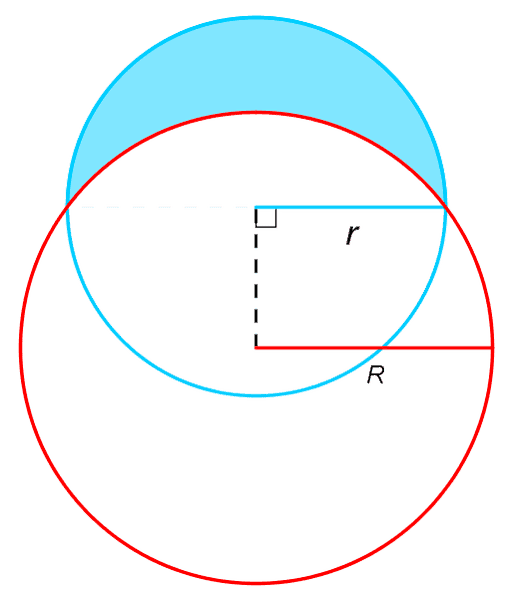
The discussion focuses on calculating the area of a lune, a crescent-shaped region bounded by two circular arcs with radii r and R. The area is expressed with the formula A(r) = (r²π/2) + r√(R² - r²) - R²sin⁻¹(r/R). To find the maximum area of the lune, calculus is required, although the explicit solution for r is complex and not provided. The problem assumes the red circle's radius is fixed while the blue circle's radius can vary, with specific geometric constraints on their placement.

PREREQUISITES
  • Understanding of geometric shapes, specifically circles and circular segments.
  • Familiarity with calculus concepts, particularly optimization techniques.
  • Knowledge of trigonometric functions, including the inverse sine function.
  • Basic algebra for manipulating and solving equations.
NEXT STEPS
  • Study calculus techniques for finding maxima and minima of functions.
  • Explore geometric properties of circular segments and their areas.
  • Learn about the application of trigonometric functions in geometry.
  • Investigate advanced topics in optimization problems involving multiple variables.
USEFUL FOR

Mathematicians, geometry enthusiasts, students studying calculus, and anyone interested in solving geometric optimization problems.

Nebuchadnezza
Messages
78
Reaction score
2
Here is an interesting brainteaser I found. Looking at the earlier post with the circle and the tangent, I thought people here might be interested. I do have the answer to this riddle so this is not homework by any means.

The problem goes as follows

1) Find the area of the crescent-shaped region (called a lune)
bounded by arcs of circles with radii r and R.

2) What is the maximum area of the lune ?
ZiGS4.png
 
Mathematics news on Phys.org
For this problem I am assuming the following:

1) The radius of the red circle is fixed and the radius of the blue circle can vary
2) 0 <= r <= R
3) The blue and red circle are always placed such that the diameter of the blue circle is some chord of the red circle

With these three assumptions, the area of the lune must be half of the area of the blue circle minus the area of the circular segment formed by the diameter of the blue circle treated as a chord of the red circle. With a little bit of magic I get the following formula for the area of the lune in terms of the radius of the blue circle:
A(r) = \frac{r^2\pi}{2}+r\sqrt{R^2-r^2}-R^2Sin^{-1}(\frac{r}{R})
Finding the maximum area of the lune requires some calculus. The expression I get is really messy and am too lazy to solve for r explicitly.
 
Last edited:
  • Like
Likes Emmanuel_Euler

Similar threads

  • · Replies 1 ·
Replies
1
Views
3K
  • · Replies 2 ·
Replies
2
Views
4K
  • · Replies 10 ·
Replies
10
Views
2K
  • · Replies 2 ·
Replies
2
Views
1K
  • · Replies 59 ·
2
Replies
59
Views
66K
  • · Replies 4 ·
Replies
4
Views
2K
  • · Replies 2 ·
Replies
2
Views
6K
  • · Replies 2 ·
Replies
2
Views
3K
  • · Replies 13 ·
Replies
13
Views
4K
  • · Replies 13 ·
Replies
13
Views
4K