JD_PM
- 1,125
- 156
I am writing about the nature of force in classical mechanics and what does really imply, in terms of change in motion. I am using as an example a circuit, on which we exert a force.
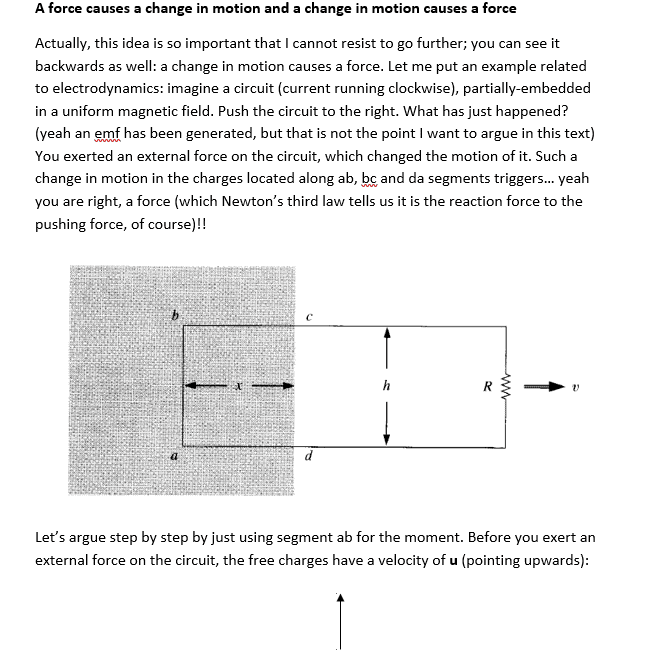
I am trying to justify the following scheme (concretely, ##f_{mag}##):
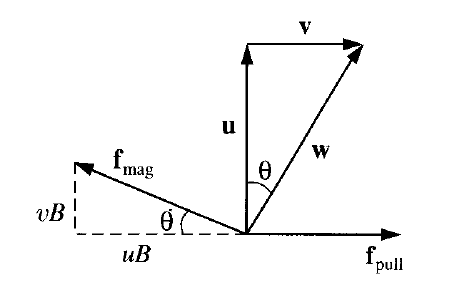
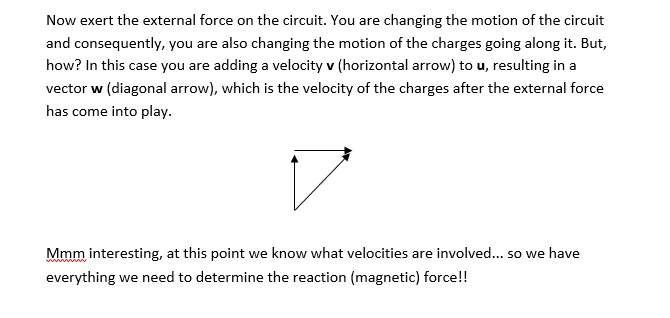
The thing is that I am wondering how can I justify ##f_{mag}## by using vector addition, based on Newton's Second Law (as neat as possible). I know that it can be justified by Lorentz Force Law (force has to be perpendicular to the displacement, as magnetic forces do not work) but that is not what I am looking for.
My idea is that, based on Newton's Second Law:
$$\vec F = m \frac{d \vec v}{dt}$$
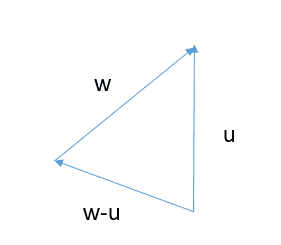
We can argue that ##\frac{d \vec v}{dt}## is the change in velocity (final velocity - initial velocity) ##w - u##, which yields the desired result for the direction of the force:
Do you see this as a valid argument?
Besides I am wondering how can I justify the constant m. I have been thinking about writing that once we subtract both vectors the constant m determines the force on each charge, but this sounds vague...
When I use this method (addition of vectors) with momentum instead of just velocities it's easy because I can justify the force vector by just subtracting two momentum vectors, as ##\vec F = \frac{d \vec p}{dt}## (I do not have to bother about any constant).
PS: Writing about Physics has recently become a hobby of mine. Actually this is a piece of a longer 'work' (I do it basically for fun) on explaining how optical tweezers work. As you can see I try to be kind of funny while writing XD. Any kind of advice will be really appreciated.
Thanks
I am trying to justify the following scheme (concretely, ##f_{mag}##):
The thing is that I am wondering how can I justify ##f_{mag}## by using vector addition, based on Newton's Second Law (as neat as possible). I know that it can be justified by Lorentz Force Law (force has to be perpendicular to the displacement, as magnetic forces do not work) but that is not what I am looking for.
My idea is that, based on Newton's Second Law:
$$\vec F = m \frac{d \vec v}{dt}$$
We can argue that ##\frac{d \vec v}{dt}## is the change in velocity (final velocity - initial velocity) ##w - u##, which yields the desired result for the direction of the force:
Do you see this as a valid argument?
Besides I am wondering how can I justify the constant m. I have been thinking about writing that once we subtract both vectors the constant m determines the force on each charge, but this sounds vague...
When I use this method (addition of vectors) with momentum instead of just velocities it's easy because I can justify the force vector by just subtracting two momentum vectors, as ##\vec F = \frac{d \vec p}{dt}## (I do not have to bother about any constant).
PS: Writing about Physics has recently become a hobby of mine. Actually this is a piece of a longer 'work' (I do it basically for fun) on explaining how optical tweezers work. As you can see I try to be kind of funny while writing XD. Any kind of advice will be really appreciated.
Thanks
