Assistance with a rock identification (found in the Southwestern US)

Click For Summary
SUMMARY

The discussion centers on the identification of a rock found in southwestern New Mexico, which exhibits magnetic properties and a dark gray/greenish color. Participants suggest that the rock may be a mix of gneiss and dacite, with possible chlorite content contributing to its green appearance. The presence of quartz banding and the rock's magnetic characteristics lead to speculation about its composition, including considerations of magnetite and maghemite. Ultimately, the consensus leans towards a volcanic origin influenced by local geological conditions.

PREREQUISITES
  • Understanding of mineral identification techniques, including scratch tests and magnetic properties.
  • Familiarity with geological terms such as gneiss, dacite, and chlorite.
  • Knowledge of the geological history of the Southwestern United States, particularly volcanic activity.
  • Basic comprehension of iron oxide minerals, including magnetite and maghemite.
NEXT STEPS
  • Research the characteristics and identification methods for gneiss and dacite.
  • Study the properties of iron oxide minerals, focusing on magnetite and maghemite.
  • Explore the geological history of the Southwestern U.S. to understand volcanic formations.
  • Learn about mineral testing techniques, including magnetic and scratch tests for rock identification.
USEFUL FOR

Geologists, mineral enthusiasts, and anyone interested in rock identification and the geological features of the Southwestern United States will benefit from this discussion.

C Mac
Messages
6
Reaction score
2
Hello,
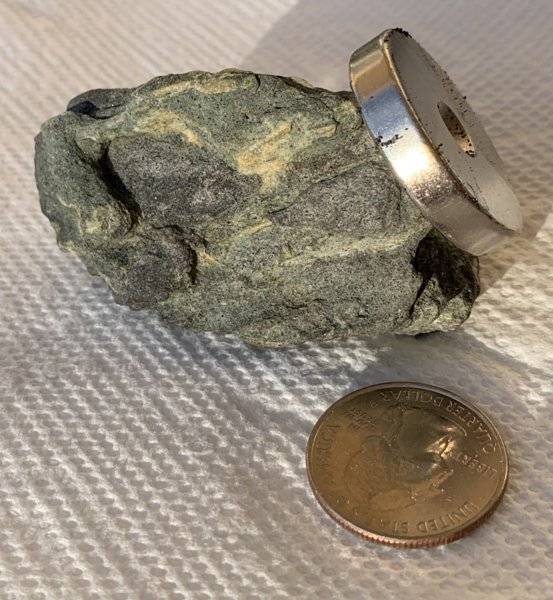
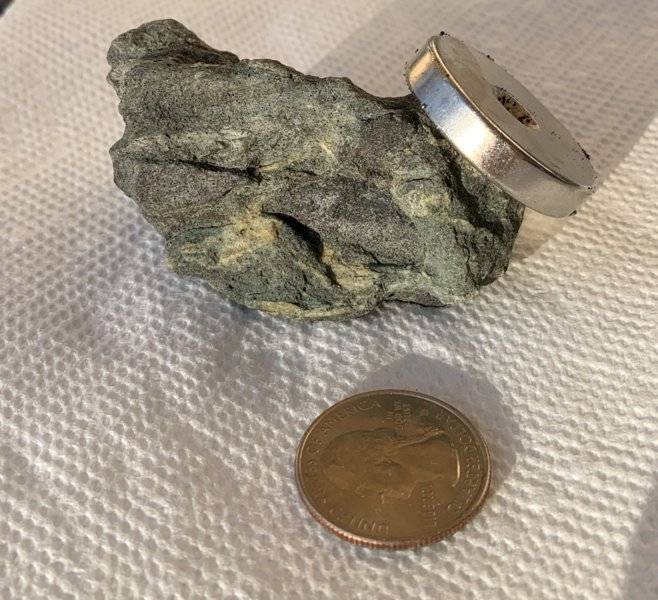
Thanks for providing a forum where people can share their education/passion and help others. Speaking of helping out, could I please get some feedback on this rock I came across in the southwestern part of the U.S.? I picked it up because it didn't match anything else in the area. It sat around my place and I eventually put a magnet to it and it was magnetic. I also did a scratch test on ceramic and it didn't leave a mark. In my not very scientific way, I thought it was magnetized sandstone. Maybe it's weathered magnetite? Attached are a few photos. Please let me know what you think when you have a moment.
Hopefully you can see the images.
IMG_8153.jpg
IMG_8151.jpg
IMG_8152.jpg
 

Attachments

  • IMG_8153.jpg
    IMG_8153.jpg
    63.6 KB · Views: 893
  • IMG_8151.jpg
    IMG_8151.jpg
    75.1 KB · Views: 920
  • IMG_8152.jpg
    IMG_8152.jpg
    61.5 KB · Views: 915
Last edited by a moderator:
Earth sciences news on Phys.org
C Mac said:
Maybe it's weathered magnetite?

I don't think so ... magnetite will weather/corrode to a reddish colour aka rust ( as with most iron minerals)

Many rocks will stick to a magnet because of their iron content, even basaltic lava

1) is it really green in colour or is it the camera/lighting ?
2) the darker areas, do they really look like they are clumps of material in that green/white matrix ?
3) where in the SW be more specific ... state, area in the state ?
4) in that last photo with the white patches, it (well that area) looks much like dacite ( volcanic)
5) the overall appearance looks like a conglomerate of several different rock typesVariations of dacite ...

SuperRocks3b.jpg
Dave
 

Attachments

  • SuperRocks3b.jpg
    SuperRocks3b.jpg
    95.8 KB · Views: 907
  • Like
Likes   Reactions: C Mac
Thank you for the replies. The rock came from southwestern New Mexico. I do historical research. While not looking for rocks, I'll pickup odd rocks that don't match the terrain. To answer additional questions, it's a dark gray/greenish. The photos, including the first one in this photo, were taken with direct sunlight since I was trying to pullout the various colors and features. The second photo in this posts shows the rock with no direct light.

Thanks again and please let me know if you have additional questions.

IMG_8044.jpg


IMG_8052.jpg
 

Attachments

  • IMG_8044.jpg
    IMG_8044.jpg
    92.1 KB · Views: 813
  • IMG_8052.jpg
    IMG_8052.jpg
    81.5 KB · Views: 849
  • Like
Likes   Reactions: davenn
Could it be maghemite?
 
  • Like
Likes   Reactions: C Mac
C Mac said:
Thank you for the replies. The rock came from southwestern New Mexico. I do historical research. While not looking for rocks, I'll pickup odd rocks that don't match the terrain. To answer additional questions, it's a dark gray/greenish. The photos, including the first one in this photo, were taken with direct sunlight since I was trying to pullout the various colors and features. The second photo in this posts shows the rock with no direct light.

thanks for the additional info
Well, New Mexico - Arizona area has a lot of old volcanics so that could explain the dacite
the green stuff with streaks / almost banding of quartz ( white material) through it gives the appearance of gneiss - schist

one gneiss variation ...

diorite-gneiss-ted-kinsman.jpg


The green is usually because of chlorite content.
Gneiss and schist are old metamorphic bedrock rocks. the presence of what looks like those darker lumps of dacite,
hints at the possibility that volcanics came up through the gneiss bedrock and tore bits off resulting in this mix of
two very different rocks.
Because the "gneiss" is more prominent than the darker patches, this hints that the sample was from the edge of the
magma duct that came to the surface through the bedrock... hence more bedrock than magma in the sample

This is my best educated guess without seeing the sample(s) up close for myself. I remember seeing a similar thing
(different rock types) but still volcanic and country rock mix when I was studying the "Dunedin Volcano" ( New Zealand)
back in my university days.
Dave
 

Attachments

  • diorite-gneiss-ted-kinsman.jpg
    diorite-gneiss-ted-kinsman.jpg
    81.4 KB · Views: 816
  • Like
Likes   Reactions: C Mac
Vanadium 50 said:
Could it be maghemite?

I had to google that one :wink:
not one I was familiar with
Maghemite - Wikipedia
https://en.wikipedia.org/wiki/Maghemite
168159a3.png
f9bbbf72.png

Overview
Maghemite (Fe2O3, γ-Fe2O3) is a member of the family of iron oxides. It has the same spinel ferrite structure as magnetite and is also ferrimagnetic.
Maghemite can be considered as an Fe(II)-deficient magnetite with formula where represents a vacancy, A indicates tetrahedral and B octahedral positioning.
I don't think so, I think it unlikely that you would see streaks of what looks like quartz through it as in the OP's sampleD
 

Attachments

  • 168159a3.png
    168159a3.png
    146 bytes · Views: 647
  • f9bbbf72.png
    f9bbbf72.png
    158 bytes · Views: 642
  • Like
Likes   Reactions: C Mac
Thank you for the feedback and great leads. (Yes, I had to google maghemite as well.) In addition, it really looks like gneiss (pictured above) with quartz banding. Of course, it also looks similar to the photo of magnetite, minus the crystals. Thanks for narrowing it down.

Hope the forum doesn't mind if I post a few more rocks that I've come across.
 
  • Like
Likes   Reactions: davenn
  • #10
C Mac said:
Hope the forum doesn't mind if I post a few more rocks that I've come across.
All good :smile: use a different thread for each sample just to keep comments/replies together for a particular sample
 
  • Like
Likes   Reactions: C Mac

Similar threads

Replies
6
Views
4K
  • · Replies 8 ·
Replies
8
Views
970
  • · Replies 21 ·
Replies
21
Views
5K
  • · Replies 54 ·
2
Replies
54
Views
8K
Replies
3
Views
10K
Replies
10
Views
5K
Replies
5
Views
3K
  • · Replies 2 ·
Replies
2
Views
3K
  • · Replies 26 ·
Replies
26
Views
10K
  • · Replies 5 ·
Replies
5
Views
11K