Astrophysics question about a binary star system (AQA exam)

Click For Summary
The discussion centers on the interpretation of wavelength change in a binary star system as presented in an AQA exam mark scheme. The confusion arises from the mark scheme considering the amplitude of the wave rather than the peak-to-peak value when calculating the change in wavelength. The correct reference point for measuring this change is the unshifted wavelength of 656.28 nm, with a maximum shift of ± 0.24 nm. Participants seek clarification on why the mark scheme's approach is valid in this context. Understanding this distinction is crucial for accurately answering related astrophysics questions.
bonbon22
Messages
92
Reaction score
5
https://pmt.physicsandmathstutor.co...e 2015 MS - Unit 5-2A AQA Physics A-level.pdfmark scheme
question 2
244254

244255

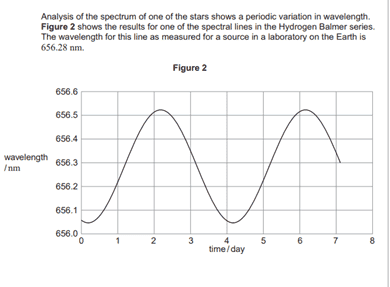
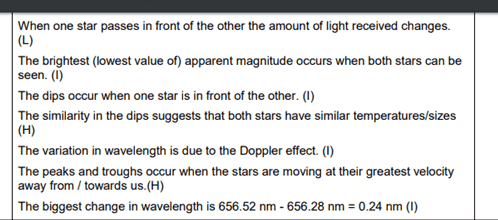
very simple question why is the change in wavlength not 656.05 - 656.52? instead.
The difference being in the mark scheme they have taken the greatest change in wavelength to be the amplitude of the wave not the peak to peak value. How does that make sense exactly.
 
Last edited by a moderator:
Physics news on Phys.org
Because change in wavelength is measured relative to the unshifted wavelength of 656.28 nm. That is what we see when the velocity of the star relative to Earth is zero. The maximum shift is ± 0.24 nm.
 
  • Like
Likes bonbon22
The book claims the answer is that all the magnitudes are the same because "the gravitational force on the penguin is the same". I'm having trouble understanding this. I thought the buoyant force was equal to the weight of the fluid displaced. Weight depends on mass which depends on density. Therefore, due to the differing densities the buoyant force will be different in each case? Is this incorrect?

Similar threads

  • · Replies 7 ·
Replies
7
Views
2K
  • · Replies 12 ·
Replies
12
Views
4K
Replies
5
Views
2K