Astrophysics question about a binary star system (AQA exam)

Click For Summary
SUMMARY

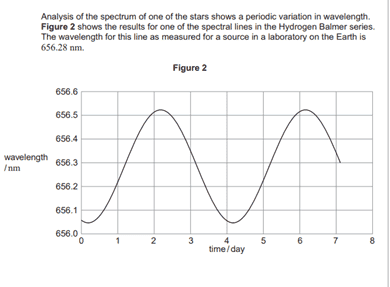
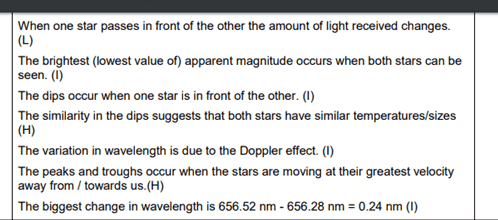
The forum discussion centers on a question from the AQA Physics A-level exam regarding the interpretation of wavelength changes in a binary star system. The mark scheme indicates that the change in wavelength is calculated using the amplitude of the wave rather than the peak-to-peak value. This approach is justified by noting that the change in wavelength is measured relative to the unshifted wavelength of 656.28 nm, with a maximum shift of ± 0.24 nm. This clarification resolves confusion about the calculation method used in the exam context.

PREREQUISITES
  • Understanding of wave properties, specifically amplitude and wavelength
  • Familiarity with the concept of redshift and blueshift in astrophysics
  • Knowledge of binary star systems and their dynamics
  • Basic grasp of the AQA Physics A-level curriculum and exam format
NEXT STEPS
  • Research the principles of redshift and blueshift in astrophysics
  • Study the properties of waves, focusing on amplitude and wavelength relationships
  • Examine the dynamics of binary star systems and their observational effects
  • Review past AQA Physics A-level exam papers for similar questions
USEFUL FOR

Students preparing for the AQA Physics A-level exam, educators teaching astrophysics concepts, and anyone interested in understanding wavelength changes in astronomical contexts.

bonbon22
Messages
92
Reaction score
5
https://pmt.physicsandmathstutor.co...e 2015 MS - Unit 5-2A AQA Physics A-level.pdfmark scheme
question 2
244254

244255

very simple question why is the change in wavlength not 656.05 - 656.52? instead.
The difference being in the mark scheme they have taken the greatest change in wavelength to be the amplitude of the wave not the peak to peak value. How does that make sense exactly.
 
Last edited by a moderator:
Physics news on Phys.org
Because change in wavelength is measured relative to the unshifted wavelength of 656.28 nm. That is what we see when the velocity of the star relative to Earth is zero. The maximum shift is ± 0.24 nm.
 
  • Like
Likes   Reactions: bonbon22

Similar threads

  • · Replies 7 ·
Replies
7
Views
2K
  • · Replies 12 ·
Replies
12
Views
5K
  • · Replies 5 ·
Replies
5
Views
2K