Average Force on Wall from Ice Cubes' Impact

Click For Summary

Homework Help Overview

The problem involves ice cubes sliding down a ski-jump track and impacting a wall, with the goal of determining the average force exerted on the wall from the impact of the cubes. The context includes concepts from kinematics and energy conservation.

Discussion Character

  • Exploratory, Conceptual clarification, Mathematical reasoning

Approaches and Questions Raised

  • Participants discuss calculating the speed of the ice cubes at the moment of impact, with some using conservation of energy to find initial velocities. Questions arise regarding the accuracy of calculated velocities and the components of motion at the highest point of the trajectory.

Discussion Status

The discussion is ongoing, with participants offering hints and corrections regarding the calculations of velocity components. There is an exploration of different interpretations of the motion involved, particularly concerning the horizontal and vertical components of velocity.

Contextual Notes

Participants are working under the constraints of a homework problem, which may limit the information available for discussion. Assumptions about the motion and energy conservation principles are being questioned.

SamTsui86
Messages
30
Reaction score
0
Small ice cubes, each of mass 5.30 g, slide down a frictionless ski-jump track in a steady stream, as shown in Figure P6.71. Starting from rest, each cube moves down through a net vertical distance of y = 1.40 m and leaves the bottom end of the track at an angle of 40.0° above the horizontal. At the highest point of its subsequent trajectory, the cube stikes a vertical wall and rebounds with half the speed it had upon impact. If 10.0 cubes strike the wall per second, what average force is exerted on the wall?
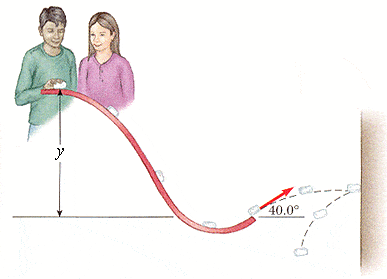
p6-71.gif


I don't even know how to begin, can anyone give me some hints?
 

Attachments

  • p6-71.gif
    p6-71.gif
    14.1 KB · Views: 384
Physics news on Phys.org
Start by figuring out how fast an ice cube is going when it hits the wall. I think you can do that part.
 
Last edited:
ok, the ice hits the wall at Vf = 6.84 m/s Vfx = 5.24 m/s and Vfy = 4.4 m/s
 
SamTsui86 said:
ok, the ice hits the wall at Vf = 6.84 m/s Vfx = 5.24 m/s and Vfy = 4.4 m/s
If the ice hits the wall at the highest point of its trajectory, it must be moving horizontally.
6.84m/s looks too big for the final velocity. How did you get that?
 
Last edited:
I use the conservation of energy to figure out the initial velocity as it leave the track so

KE + PE top = KE + PE final
0 + mgh = 1/2mv^2 + 0
v= 5.24 m/s

then since the angle is 40 degree i did 5.24/cos40 to get 6.84 m/s
 
SamTsui86 said:
I use the conservation of energy to figure out the initial velocity as it leave the track so

KE + PE top = KE + PE final
0 + mgh = 1/2mv^2 + 0
v= 5.24 m/s

then since the angle is 40 degree i did 5.24/cos40 to get 6.84 m/s
The first part is good. That is the total velocity. The horizontal component will be less than the total, and the vertical component will be less than the total. You have the right trig term for the problem, but in the wrong place. Fix that and find the velocity at the highest point of the trajectory.
 

Similar threads

Replies
5
Views
2K
Replies
2
Views
3K
  • · Replies 3 ·
Replies
3
Views
5K
Replies
2
Views
8K
  • · Replies 5 ·
Replies
5
Views
6K
Replies
4
Views
2K
Replies
4
Views
3K
  • · Replies 1 ·
Replies
1
Views
2K
  • · Replies 3 ·
Replies
3
Views
5K
  • · Replies 4 ·
Replies
4
Views
6K