Average Speed and Average Power confusion

Click For Summary
Understanding average speed and average power involves recognizing that average speed is calculated as total distance divided by total time, while average power is defined over a specific time interval. The discussion highlights the mathematical foundation of these concepts, emphasizing the importance of time-weighted averages. Integrals are presented as a method to calculate these averages, illustrating how they can be interpreted in discrete terms. The relationship between average speed and velocity is clarified through integrals, showing that average speed is a time-weighted average of speed. Overall, the thread seeks to demystify the mathematical principles underlying average speed and power calculations.
LLT71
Messages
73
Reaction score
5
I found it somehow tricky to understand average speed and average power in mathematical fashion.
I suppose general idea of taking average of some quantity is: sum of all values/number of values.
how that idea fit's into idea of average speed=distance traveled/time traveled

similarly, average signal power:
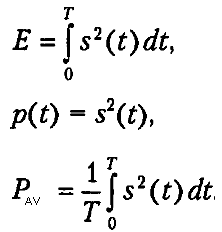
signal_power.PNG

why is it over T?
 
Physics news on Phys.org
LLT71 said:
I found it somehow tricky to understand average speed and average power in mathematical fashion.
I suppose general idea of taking average of some quantity is: sum of all values/number of values.
how that idea fit's into idea of average speed=distance traveled/time traveled

similarly, average signal power:
signal_power.PNG

why is it over T?

Do you understand integrals in discrete terms?

https://betterexplained.com/articles/a-calculus-analogy-integrals-as-multiplication/
 
  • Like
Likes LLT71
time-weighted average of Q(t)=##\displaystyle\frac{\int_0^T Q(t)\ dt}{ \int_0^T \ dt }=\frac{\int_0^T Q(t)\ dt}{ T } ##
(For example, the average-velocity is a time-weighted average of velocity:
##\displaystyle\frac{\int_{t_1}^{t_2} v(t) \ dt}{ \int_{t_1}^{t_2} \ dt }=\frac{\int_{t_1}^{t_2} \frac{dx(t)}{dt} \ dt}{ \int_{t_1}^{t_2} \ dt }=\frac{x(t_2)-x(t_1)}{ t_2-t_1}=\frac{\Delta x}{ \Delta t} ##.

the average-speed is a time-weighted average of speed:
##\displaystyle\frac{\int_{t_1}^{t_2} |v(t)| \ dt}{ \int_{t_1}^{t_2} \ dt }=\frac{\int_{t_1}^{t_2} |\frac{dx(t)}{dt}| \ dt}{ \int_{t_1}^{t_2} \ dt }=\frac{d}{ t_2-t_1}=\frac{d}{ \Delta t} ##.
)z-weighted average of Q(z)=##\displaystyle\frac{\int_0^Z Q(z)\ dz}{ \int_0^Z \ dz }=\frac{\int_0^Z Q(z)\ dz}{ Z }##
(For example, the center of mass is a mass-weighted average of position:
##\displaystyle\frac{m_1x_1+m_2x_2+m_3x_3 }{m_1+m_2+m_3}=\frac{m_1x_1+m_2x_2+m_3x_3 }{M}##.
If all of the "masses" are equal (so each item has equal "weight" in the average),
then the mass-weighted average reduces to
the count-weighted (ordinary, "straight") average:
##\displaystyle\frac{(1)x_1+(1)x_2+(1)x_3 }{(1)+(1)+(1)}=\frac{x_1+x_2+x_3 }{3}##.
)
 
  • Like
Likes LLT71
thanks guys!
 
I built a device designed to brake angular velocity which seems to work based on below, i used a flexible shaft that could bow up and down so i could visually see what was happening for the prototypes. If you spin two wheels in opposite directions each with a magnitude of angular momentum L on a rigid shaft (equal magnitude opposite directions), then rotate the shaft at 90 degrees to the momentum vectors at constant angular velocity omega, then the resulting torques oppose each other...

Similar threads

Replies
16
Views
6K
  • · Replies 10 ·
Replies
10
Views
2K
  • · Replies 9 ·
Replies
9
Views
1K
  • · Replies 5 ·
Replies
5
Views
3K
Replies
2
Views
2K
  • · Replies 18 ·
Replies
18
Views
2K
Replies
3
Views
2K
  • · Replies 6 ·
Replies
6
Views
4K
  • · Replies 10 ·
Replies
10
Views
2K
  • · Replies 10 ·
Replies
10
Views
2K