Avg Power in a Rotational Energy/Work Problem

Click For Summary
SUMMARY

The forum discussion centers on calculating average power delivered by a motor in a rotational energy problem. The motor does 1885 J of work on the platform, resulting in a rotational kinetic energy of 1885 J and an angular velocity of 8.68 rad/s. The average power (Pavg) is derived from the formula Pavg = W/Δt, where Δt is 17.4 s. The correct calculation for average power, using unrounded values, yields approximately 109 W.

PREREQUISITES
  • Understanding of rotational dynamics and energy concepts
  • Familiarity with the formula Pavg = W/Δt
  • Knowledge of angular velocity and its calculation
  • Basic integration concepts for time averages
NEXT STEPS
  • Study the relationship between work and power in rotational systems
  • Learn about the calculation of average angular velocity in rotational motion
  • Explore the concept of time averages in physics
  • Review torque and its effects on rotational motion
USEFUL FOR

Students studying physics, particularly those focusing on rotational dynamics, engineers working with motors and mechanical systems, and educators seeking to clarify concepts of work and power in rotational contexts.

dcmf
Messages
16
Reaction score
5
Homework Statement
Consider a motor that exerts a constant torque of 25.0 N⋅m to a horizontal platform whose moment of inertia is 50.0 kg⋅m^2. Assume that the platform is initially at rest and the torque is applied for 12.0 rotations. Neglect friction.

What is the average power Pavg delivered by the motor in the situation above? Enter your answer in watts to three significant figures.
Relevant Equations
K = (1/2)Iw^2
W = τΔθ
P = W/Δt
This question has multiple parts and according to all the work done up to this point...

How much work W does the motor do on the platform during this process?​
1885 J​
What is the rotational kinetic energy of the platform Krot,f at the end of the process described above?​
1885 J​
What is the angular velocity ωf of the platform at the end of this process?​
8.68 rad/s​
How long Δt does it take for the motor to do the work done on the platform calculated in Part A?​
17.4 s​

Now I'm being asked...

What is the average power Pavg delivered by the motor in the situation above?​
???​

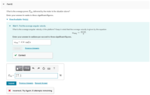
I assumed to find average power I would need average work, especially because the question's hint prompted me to find the average angular velocity, which it confirmed to be 4.34 rad/s. So I did the following calculations:

1711247294014.png

27.1 W was not accepted as the answer. Any advice on adjustments to make to my equation? Is there a rounding error?
 
Physics news on Phys.org
dcmf said:
I would need average work
How would you define that?
What is the definition of average power? You wrote ##P_{avg}=W/\Delta t##, which is correct if you define that W appropriately.
 
  • Like
Likes MatinSAR and dcmf
haruspex said:
How would you define that?
What is the definition of average power?

In class, we actually did not address work or power in the context of problems involving rotation. This homework question seems to to be presented like a way to self-learn the material, but we were not provided with an equation to work with, so I assumed I should use the P=W/Δt equation.

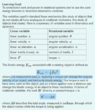
I'm not sure how P differs from Pavg. According to one website I just found, "average power as the total energy consumed divided by the total time taken". Would this be accurate?

If so, would doing the calculation as...
Pavg = W tot/Δttot = 1884.95559 J / 17.36646 s = 108.54 W​
(using unrounded versions of earlier values) and then rounding to 3 sig figs (109 W) be the right way to set up and solve the equation according to the above definition?
 

Attachments

  • 1711247973595.png
    1711247973595.png
    62.9 KB · Views: 110
  • 1711248085686.png
    1711248085686.png
    13.4 KB · Views: 114
haruspex said:
How would you define that?
What is the definition of average power? You wrote ##P_{avg}=W/\Delta t##, which is correct if you define that W appropriately.
I just noticed that you may have updated your reply. Would it be appropriate to use the work as defined in the first part of the question that asks "How much work W does the motor do on the platform during this process?"
 
I would set the work aside. You are asked to find the average power over time. The time average of a function ##f(t)## over an interval ##T## is $$f_{\text{avg.}}=\frac{\int_0^T f(t)~dt}{\int_0^T dt}.$$ Think of the equivalent linear situation when you have a constant force acting on an object and the velocity is not constant. In that case, the power delivered to the object is given by $$P(t)=Fv(t)$$where ##v## is the instantaneous linear velocity. In this case you have a constant torque. What do you think the equivalent equation would be for rotations?

Put it together and you will discover why the problem asked you to find the average angular velocity first.
 
  • Like
Likes MatinSAR and dcmf
kuruman said:
I would set the work aside.
Why?
kuruman said:
The time average of a function ##f(t)## over an interval ##T## is $$f_{\text{avg.}}=\frac{\int_0^T f(t)~dt}{\int_0^T dt}.$$
And in the present case, the numerator is the work done, no?
 
haruspex said:
Why?
Please see PM on this.
haruspex said:
And in the present case, the numerator is the work done, no?
Yes.
 

Similar threads

Replies
9
Views
3K
  • · Replies 5 ·
Replies
5
Views
4K
  • · Replies 26 ·
Replies
26
Views
3K
Replies
15
Views
2K
Replies
4
Views
1K
  • · Replies 8 ·
Replies
8
Views
3K
  • · Replies 7 ·
Replies
7
Views
5K
  • · Replies 7 ·
Replies
7
Views
3K
  • · Replies 5 ·
Replies
5
Views
11K
  • · Replies 13 ·
Replies
13
Views
4K