Ax+by=c is a straight line. When b=0 then it is // to y-axis

Click For Summary

Homework Help Overview

The discussion revolves around the interpretation of the linear equation ax + by = c in the context of geometry, specifically regarding the conditions when b = 0 and its implications for the line's orientation in the Cartesian plane.

Discussion Character

  • Conceptual clarification, Assumption checking

Approaches and Questions Raised

  • Participants explore the implications of setting b = 0 in the equation, questioning why this results in a line parallel to the y-axis. They discuss the nature of the line when b = 0 and consider the roles of constants a, b, and c in the equation.

Discussion Status

There is an active exploration of the definitions and implications of the equation, with participants questioning the textbook's assertions and their own understanding of the concepts. Some have expressed uncertainty about the relationship between the line's equation and its graphical representation.

Contextual Notes

Participants mention a lack of clarity regarding the conditions under which the equation behaves differently, particularly when varying the constants a, b, and c. There is also an acknowledgment of personal gaps in foundational knowledge that may affect their understanding.

CynicusRex
Gold Member
Messages
98
Reaction score
68
Am I forgetting some critical basic knowledge?
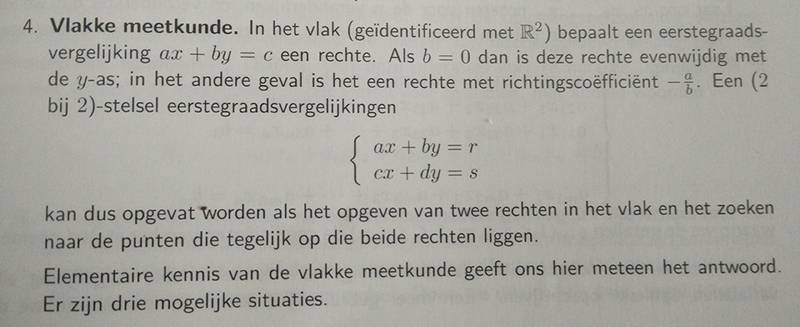
It says: In the plane (identified by R^2) a linear equation ax+by=c is a straight line. If b=0 then this straight line is parallel with the y-axis; in the other case it is a straight line with slope -a/b. A (2 by 2)-system linear equation.

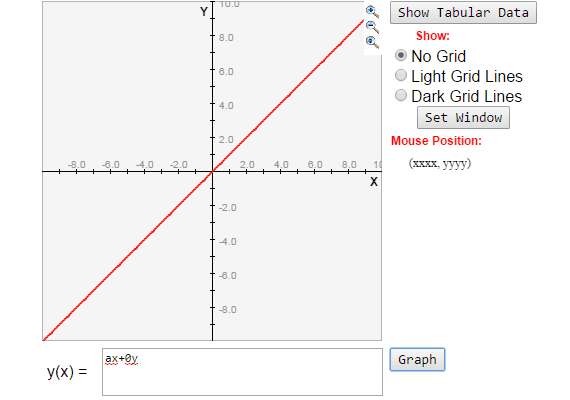
Why is it parallel? If you make b=0 in ax+by=c you still get a straight line. Or should I see it as: b y = -ax + c
hNGwASW.jpg


5R9ORRJ.png
 
Last edited:
Physics news on Phys.org
TheBlackAdder said:
Is this a mistake in the textbook or am I forgetting some critical basic knowledge?
It says: In the plane (identified by R^2) a linear equation ax+by=c is a straight line. If b=0 then this straight line is parallel with the y-axis; in the other case it is a straight line with slope -a/b.
Take the equation for the line and set b = 0. Solve for x. What do you get?

Since there are three constants here, namely a, b, and c, the 'other case' is not clear, since we have discussed what happens when b = 0. In any event, take the original equation for the line and set a = 0 or c = 0 and see what remains.
 
  • Like
Likes   Reactions: CynicusRex
TheBlackAdder said:
Is this a mistake in the textbook or am I forgetting some critical basic knowledge?
In the plane (identified by R^2) a linear equation ax+by=c is a straight line. If b=0 then this straight line is parallel with the y-axis;
Why is it parallel? If you make b=0 in ax+by=c you still get a straight line.
If a line is parallel with a straight line, is not it a straight line?
If b=0 ax=-c, this is a straight line, but where? Does it intercept the y axis? So is this line parallel with the y-axis (or coincide with it) ?
 
  • Like
Likes   Reactions: CynicusRex
I'm literally speechless on how I missed that. I'm incredibly rusty in the basics of math. I thought ax = c was the same as ax + 0 = y.
I didn't figure c as a constant.
 
a, b, c are all constants.
 
I'm used to seeing y on the other side of the equation symbol (as slope intercept form). That's why I thought on c being just another solution variable.
Anyway, thank you. Can't wait for feeling bad on the next blunder.
 
TheBlackAdder said:
I'm used to seeing y on the other side of the equation symbol (as slope intercept form). That's why I thought on c being just another solution variable.
Anyway, thank you. Can't wait for feeling bad on the next blunder.
By the way:

Welcome to PF !
 
  • Like
Likes   Reactions: CrazyNinja, CynicusRex and gracy

Similar threads

Replies
17
Views
3K
  • · Replies 3 ·
Replies
3
Views
2K
Replies
2
Views
2K
  • · Replies 3 ·
Replies
3
Views
3K
  • · Replies 6 ·
Replies
6
Views
4K
Replies
24
Views
3K
  • · Replies 7 ·
Replies
7
Views
3K
Replies
11
Views
3K
  • · Replies 2 ·
Replies
2
Views
2K
Replies
2
Views
2K