MHB How Do Boundary Conditions Affect Differential Equations?

Click For Summary
Boundary conditions play a crucial role in solving differential equations, as they help determine arbitrary constants in the general solution. The discussion centers on the differential equation dy/dt = 2y - 5, which is rewritten and solved using an integrating factor. The integration process reveals that the solution can be expressed in terms of the initial condition y(0) = y_0, leading to the final form of the solution. Participants emphasize the importance of verifying solutions against the original differential equation to ensure accuracy. Understanding how boundary conditions influence the constants in solutions is essential for grasping the overall behavior of the system described by the differential equation.
karush
Gold Member
MHB
Messages
3,240
Reaction score
5
$\displaystyle \frac{dy}{dt}=2y-5, \quad y(0)=y_0$
rewrite
$$y'-2y=-5$$
obtain u(x)
$$u(x)=\exp\int-2\, dx = e^{-2t}$$
then
$$(e^{-2t}y')=5e^{-2t}$$
just reviewing but kinda
? transparentcup.png

 
Last edited:
Physics news on Phys.org
In your last line, on the LHS, you want:

$$\left(e^{-2t}y\right)'$$

Or what I would write:

$$\frac{d}{dt}\left(e^{-2t}y\right)$$

And on the RHS, you want:

$$-5e^{-2t}$$
 
$\quad\displaystyle \frac{dy}{dt}=2y-5, \quad y(0)=y_0$
rewrite
$\quad y'-2y=-5$
obtain u(x)
$\quad u(x)=\exp\int-2\, dx = e^{-2t}$
then
$\quad (e^{-2t}y)'=-5e^{-2t}$
integrate both sides
$\quad\displaystyle e^{-2t}y=-5\int e^{-2t} dt=-5e^{-2t}+c_1$
finally
$\quad\displaystyle y
=-5\frac{e^{-2t}}{e^{-2t}}+\frac{c_1}{e^{-2t}}=c_1e^{2t}-5$
so at $\quad y(0)=y_0$

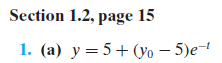
ok I don't see how they got this answer

View attachment 8700
 

Attachments

  • 2.1.PNG
    2.1.PNG
    2.1 KB · Views: 143
Last edited:
karush said:
$\quad\displaystyle \frac{dy}{dt}=2y-5, \quad y(0)=y_0$
rewrite
$\quad y'-2y=-5$
obtain u(x)
$\quad u(x)=\exp\int-2\, dx = e^{-2t}$
then
$\quad (e^{-2t}y)'=-5e^{-2t}$
integrate both sides
$\quad\displaystyle e^{-2t}y=-5\int e^{-2t} dt=-5e^{-2t}+c_1$
finally
$\quad\displaystyle y
=-5\frac{e^{-2t}}{e^{-2t}}+\frac{c_1}{e^{-2t}}=c_1e^{2t}-5$
so at $\quad y(0)=y_0$

ok I don't see how they got this answer
First, what is your c1 in terms of [math]y_0[/math]? You never finished that part.

Also take a look at this:
[math]y = 5 +(y_0 - 5)e^{-t}[/math]

[math]y' = -(y_0 - 5)e^{-t}[/math]

Thus
[math]y' - 2y = -(y_0 - 5)e^{-t} - 2(5 + (y_0 - 5)e^{-t}) = -10 - 3(y_0 - 5)e^{-t} \neq -5[/math]

So the given solution does not match the differential equation. You have the skill to do this check. (And you should always check your own solutions anyway.)

-Dan
 
We have:

$$\frac{d}{dt}\left(e^{-2t}y\right)=-5e^{-2t}$$

Integrate using the boundaries:

$$\int_{y_0}^{e^{-2t}y}\,du=-5\int_{0}^{t}e^{-2v}\,dv$$

$$e^{-2t}y-y_0=\frac{5}{2}\left(e^{-2t}-1\right)$$

$$y-y_0e^{2t}=\frac{5}{2}\left(1-e^{2t}\right)$$

$$y=\left(y_0-\frac{5}{2}\right)e^{2t}+\frac{5}{2}$$
 
$\quad\displaystyle \frac{dy}{dt}=2y-5, \quad y(0)=y_0$
rewrite
$\quad y'-2y=-5$
obtain u(x)
$\quad u(x)=\exp\int-2\, dx = e^{-2t}$
then
$\quad (e^{-2t}y)'=-5e^{-2t}$
integrate both sides
$\quad\displaystyle e^{-2t}y=-5\int e^{-2t} dt=-5e^{-2t}+c_1$
finally
$\quad\displaystyle y
=-5\frac{e^{-2t}}{e^{-2t}}+\frac{c_1}{e^{-2t}}=c_1e^{2t}-5$
so at $\quad y(0)=y_0$
$\quad\displaystyle y(0)=-5+c_1=y_0 $
then
$\quad\displaystyle c_1=y_0+5$
 
MarkFL said:
We have:

$$\frac{d}{dt}\left(e^{-2t}y\right)=-5e^{-2t}$$

Integrate using the boundaries:

$$\int_{y_0}^{e^{-2t}y}\,du=-5\int_{0}^{t}e^{-2v}\,dv$$

$$e^{-2t}y-y_0=\frac{5}{2}\left(e^{-2t}-1\right)$$

$$y-y_0e^{2t}=\frac{5}{2}\left(1-e^{2t}\right)$$

$$y=\left(y_0-\frac{5}{2}\right)e^{2t}+\frac{5}{2}$$
well that is pretty cool ... better than the book process
but I still don't think the boundary thing has registered with me
 
karush said:
well that is pretty cool ... better than the book process
but I still don't think the boundary thing has registered with me
When solving differential equations you see a lot of arbitrary constants. (ie. there are many solutions to the same differential equation.) The boundary conditions simply give you information about those constants. In this case you had c1 as a constant after solving the differential equation. The boundary condition [math]y(0) = y_0[/math] tells you what c1 is in terms of [math]y_0[/math]. Perhaps it would be more meaningful to you if we specified y(0) = 3 or something like that.

-Dan
 

Similar threads

  • · Replies 5 ·
Replies
5
Views
2K
Replies
2
Views
2K
  • · Replies 7 ·
Replies
7
Views
3K
  • · Replies 6 ·
Replies
6
Views
2K
  • · Replies 2 ·
Replies
2
Views
1K
  • · Replies 2 ·
Replies
2
Views
1K
  • · Replies 3 ·
Replies
3
Views
1K
  • · Replies 4 ·
Replies
4
Views
4K
  • · Replies 9 ·
Replies
9
Views
5K
Replies
3
Views
1K