Band Bending at SiO2 Interface

Click For Summary
SUMMARY

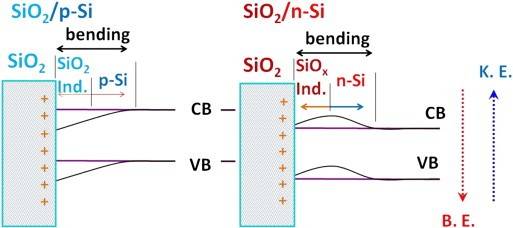
The discussion centers on the phenomenon of band bending at the SiO2 interface with p-Si and n-Si semiconductors. Participants clarify that binding energy (B.E.) and kinetic energy (K.E.) are crucial in understanding how charge carriers behave at these interfaces. The inquiry specifically addresses the transition of energy states for electrons and holes as influenced by band bending. The schematic representation provided illustrates these energy changes, emphasizing the relationship between B.E. and K.E.

PREREQUISITES
  • Understanding of semiconductor physics
  • Familiarity with band theory and energy bands
  • Knowledge of charge carrier dynamics in p-Si and n-Si
  • Basic concepts of binding energy and kinetic energy
NEXT STEPS
  • Study the principles of band bending in semiconductor interfaces
  • Explore the effects of electric fields on charge carrier energy states
  • Investigate the role of SiO2 as a dielectric in semiconductor devices
  • Learn about energy band diagrams and their applications in semiconductor technology
USEFUL FOR

Students and professionals in semiconductor physics, electrical engineers, and researchers focusing on interface phenomena in electronic materials.

1msm
Messages
6
Reaction score
0
Hello everyone !

In below picture we can see band bending in semiconductor at SiO2 interface,
as show in picture how charge's BE(binding energy) and KE(kinetic energy) are changing..??
Or what happens to charges total energy in band bending ..??

BE-KE.jpg


\\
 
Physics news on Phys.org
1msm said:
Hello everyone !

In below picture we can see band bending in semiconductor at SiO2 interface,
as show in picture how charge's BE(binding energy) and KE(kinetic energy) are changing..??
Or what happens to charges total energy in band bending ..??

Please re-read what you wrote. These appear to be statements that just happen to end with "?". What EXACTLY are you asking for here?

Zz.
 
Sorry for the inconvenience,

the above picture is a Schematic representation of band-bending in SiO2/p-Si and SiO2/n-Si interfaces.
B.E. and K.E. refer to binding and kinetic energies respectively.

this is the only small information available from it.

Now my question is,
How exactly the band-bending causes the electrons/holes energy to change from B.E to K.E or from K.E to B.E ?
 

Similar threads

  • · Replies 11 ·
Replies
11
Views
4K
  • · Replies 13 ·
Replies
13
Views
4K
  • · Replies 1 ·
Replies
1
Views
2K
  • · Replies 3 ·
Replies
3
Views
2K
  • · Replies 1 ·
Replies
1
Views
2K
  • · Replies 2 ·
Replies
2
Views
4K
  • · Replies 3 ·
Replies
3
Views
1K
  • · Replies 4 ·
Replies
4
Views
3K
  • · Replies 7 ·
Replies
7
Views
12K
  • · Replies 4 ·
Replies
4
Views
3K