Basic commutator of angular momentum

Join the discussion
Ask a follow-up here, or get your own question answered by working scientists, mathematicians and engineers — people, not an autocomplete.
Real named experts · corrections over time · the nuance an AI answer skips
3 replies · 2K views
catsarebad
Messages
69
Reaction score
0
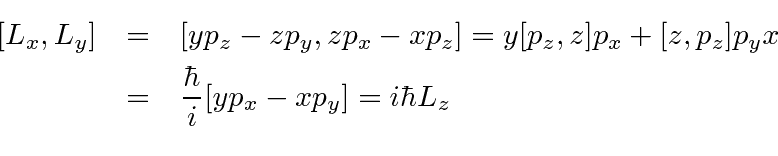
Could someone explain to me how the author goes from 2nd to 3rd step
img1750.png

I think the intermediate step between 2 and 3 is basically to split up the commutator as

[y p_z, z p_x] - [y p_z,x p_z] - [z p_y,z p_x] + [z p_y, x p_z]

2nd term = 0
3rd term = 0

so leftover is
[L_x, L_y] = [y p_z, z p_x] + [z p_y, x p_z]

but how does this turn into what he has on 3rd step?
 
Physics news on Phys.org
catsarebad said:
[...]
so leftover is
[L_x, L_y] = [y p_z, z p_x] + [z p_y, x p_z]

but how does this turn into what he has on 3rd step?
Multiple applications of the Leibniz product rule: ##[AB,C] = A[B,C] + [A,C]B##
 
really? I thought it would be much simpler than that. I thought i was missing a trivial trick.
 
catsarebad said:
really? I thought it would be much simpler than that. I thought i was missing a trivial trick.
Once you become proficient with the Leibniz rule, you'll be able to skip steps. E.g., the ##y## in the 1st commutator commutes with ##zp_x##, so it can just be taken out the front, and so on. You could call that a "trivial" trick, but it's wise to carefully practice the Leibniz rule a few times initially, since it's essential when simplifying more difficult commutators.