Basic geometry question in a physics book

Click For Summary

Homework Help Overview

The discussion revolves around a geometry problem related to calculating the surface area of a frustum or a cone, with references to the Pappus-Guldinus theorem and various approaches to derive the formula for the surface area. Participants are exploring the relationships between the dimensions involved and the implications of different formulas presented in the problem.

Discussion Character

  • Exploratory, Conceptual clarification, Mathematical reasoning, Assumption checking

Approaches and Questions Raised

  • Participants discuss the surface area formula in terms of pi, radius, and slant height, questioning how to derive it. Some suggest using integrals and the Pappus-Guldinus theorem, while others explore the implications of dimensions in the answer choices. There are also considerations of limiting behaviors and assumptions about the relationships between height and radius.

Discussion Status

The discussion is active, with various participants offering insights and questioning the validity of different approaches. Some have provided guidance on how to think about the problem, while others are still exploring different interpretations of the formulas and their implications.

Contextual Notes

Participants note that some answer choices do not have the correct dimensions for area and question the assumptions underlying the problem setup. There is an acknowledgment of the complexity involved in deriving the correct formula and the need for careful consideration of the relationships between the variables.

aspodkfpo
Messages
148
Reaction score
5
Homework Statement
geometry
Relevant Equations
literally geometry
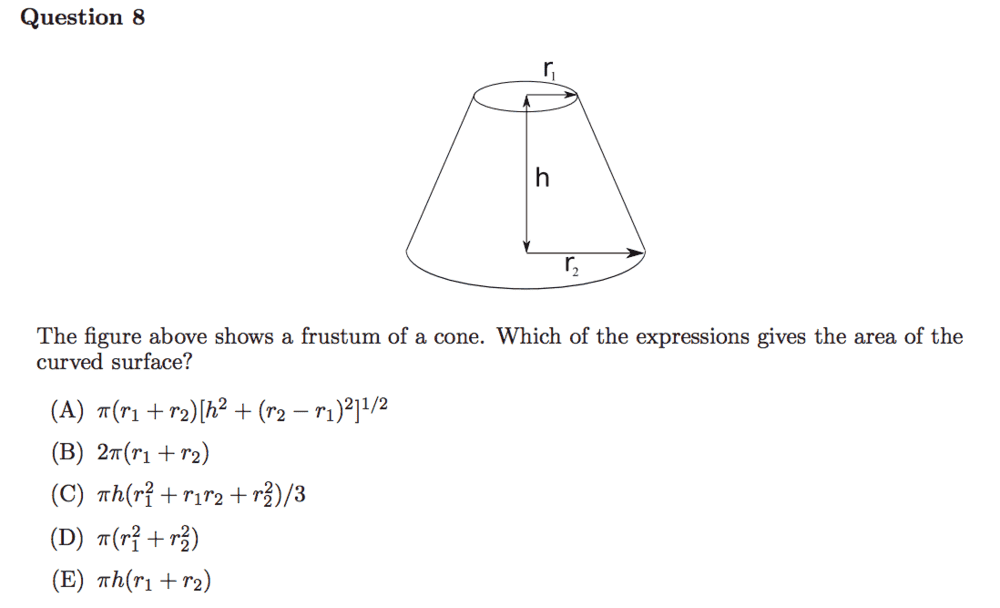
I can guess this question, by seeing that the surface area of the curved part must be in the form pi r l.

Don't know how to get to this formula though.

Answer is A
Screen Shot 2020-08-09 at 1.46.06 am.png
 
Physics news on Phys.org
Look up the Pappus-Guldinus theorem:
The first theorem states that the surface area A of a surface of revolution generated by rotating a plane curve C about an axis external to C and on the same plane is equal to the product of the arc length s of C and the distance d traveled by the geometric centroid of C:$$A = sd$$

This animation uses ##c## instead of ##s##, and ##2\pi a## instead of ##d##:

Pappus_centroid_theorem_areas.gif
 
  • Like
Likes   Reactions: Lnewqban
aspodkfpo said:
Homework Statement:: geometry
Relevant Equations:: literally geometry

I can guess this question, by seeing that the surface area of the curved part must be in the form pi r l.

Don't know how to get to this formula though.

Answer is AView attachment 267476

You have a choice of strategies. You could, of course, calculate the area of the given frustrum. Or, you could be lazy (or clever) and calculate the area of a cone and think about what happens when ...
 
`Everyone here is working too hard. Only two of the 5 choices have dimensions of area. Only one of the remaining choices has the area depending on h: i.e. the wrong choice says no matter how close or far apart the faces are, the area of the surface connecting them is the same. Sounds dubious.

And there you go.
 
  • Like
Likes   Reactions: epenguin
Vanadium 50 said:
`Everyone here is working too hard. Only two of the 5 choices have dimensions of area. Only one of the remaining choices has the area depending on h: i.e. the wrong choice says no matter how close or far apart the faces are, the area of the surface connecting them is the same. Sounds dubious.

Doesn't option E, ##\pi h (r_1 + r_2)##, also have dimensions of area and depend on ##h##?
 
Oops. You're right. I thought it was squared. However, it is possible to show this has the wrong limiting behavior.
 
  • Like
Likes   Reactions: etotheipi
Vanadium 50 said:
However, it is possible to show this has the wrong limiting behavior.

Yeah, if we take ##h\rightarrow 0## without varying either of the radii, E would give that the curved surface goes to zero, whilst we know full well it will be an annulus :smile:
 
aspodkfpo said:
...
I can guess this question, by seeing that the surface area of the curved part must be in the form pi r l.
...
Another way to look at it:
How would you compute the slant height l, applying Pythagorean theorem?

main-qimg-01a251b45821425b3758e3ab9a0d1c1b.png
 
  • Like
Likes   Reactions: PeroK and 256bits
## \int_{0}^{h} 2\pi y dx ## with ##y=r_1+\frac{r_2-r_1}{h}x##
 
  • #10
neilparker62 said:
## \int_{0}^{h} 2\pi y dx ## with ##y=r_1+\frac{r_2-r_1}{h}x##

To calculate the curved surface area, you will need to use $$\int_0^h 2\pi y \sqrt{1+y'^2} dx$$i.e. cylindrical strips don't work for surface area (they give the wrong limiting behaviour), but thin frustrums do*. The issue with this is that, if we do not yet know the surface area of a frustrum (that is what we are trying to find out), then we cannot write down the differential area in the first place! :wink:

*the differential area will be ##dA = \pi (y + [y + dy]) ds = \pi(2y + dy)\sqrt{1+y'^2} dx \rightarrow 2\pi y \sqrt{1+y'^2} dx##
 
Last edited by a moderator:
  • Like
Likes   Reactions: neilparker62
  • #11
Ok -how about: ##2\pi \sqrt{1+{\left(\frac{r_1+r_2}{h}\right)}^2}\int_{0}^{h} y dx ## with ##y=r_1+\frac{r_2-r_1}{h}x##

'Cribbed' from here: https://ocw.mit.edu/courses/mathematics/18-01sc-single-variable-calculus-fall-2010/unit-4-techniques-of-integration/part-b-partial-fractions-integration-by-parts-arc-length-and-surface-area/session-78-computing-the-length-of-a-curve/MIT18_01SCF10_Ses78a.pdf
 
  • #12
Lnewqban said:
Another way to look at it:
How would you compute the slant height l, applying Pythagorean theorem?

View attachment 267483
So I presume if I do some long algebra with similarity proofs, I would end up cancelling terms and get it in the expression as they state?
 
  • #13
aa.jpg
Imagine that that is a pyramid with ##n## faces of lateral height ##L=\sqrt{R^2+H^2}## (from radius and height). The area of a face, which is a triangle, is given by ##\frac12(2R\sin\frac{\theta}{2})L##.
To get the total lateral surface area of the whole pyramid, which is an approximation of the lateral surface area of a cone, we multiply the previous result by ##n## (because we have ##n## faces).
Since we have divided the circle into ##n## parts, we have ##\theta=2\pi/n##. We then get to the cone by taking ##n## to infinity.
$$S=\lim_{n\to\infty}nR\sin\left(\frac{\pi}{n}\right)L=\lim_{n\to\infty}nR\frac{\pi}{n}L=\pi RL$$
I have used the fact that ##\sin x## can be approximated by ##x## when ##x\to0##.
Just use subtraction to find the lateral surface area of a frustum.
 
  • #14
Integrals! That's what this problem needs! More integrals!

Seriously, you are all working too hard. As John Wheeler told me in my youth, "never start a calculation until you know the answer".

Two of the answers are not areas. One of the remaining answers says a cylinder twice as tall has the same area - clearly nonsense and can be eliminated. One of the remaining answers says that a circle (h and one of the radii equal to zero) has zero area - clearly nonsense and can be eliminated. That leaves just one.

An hour of calculation can save you a minute of thinking.
 
  • Like
Likes   Reactions: etotheipi and hutchphd
  • #15
aspodkfpo said:
So I presume if I do some long algebra with similarity proofs, I would end up cancelling terms and get it in the expression as they state?
Do you understand the analysis that leads to the answer being A or E?

Note that ##B## has dimensions of length, not area, so it can't be that. And ##C## has dimensions of volume, so that's out. I wonder if ##C## actually gives the volume of the frustrum?

Option ##D## depends on ##r_1, r_2## but not on ##h##. You could have a very small ##h## (with a small area) or a large ##h## (with a large area), so the area must depend on ##h##. That's ##D## ruled out as well.

##E## looks good. You take the average circumference of the frustrum: ##2\pi(\frac{r_1 + r_2}{2})## and multiply it by the height.

##A## looks fairly complicated. It's not as nice as ##E##. But, how to decide between them? It would be much simpler if we had a cone!
 
  • #16
Conical Frustum Area..png

Here's yet another integral - I hope much simpler. I hear the post(s) re finding answer by elimination but the OP did indicate the answer was A and wanted to know how to get the formula.
 
  • Like
Likes   Reactions: etotheipi
  • #17
Vanadium 50 said:
Integrals! That's what this problem needs! More integrals!

I reckon you would love this book: Mathematics Made Difficult.

But in all seriousness, you are right. I think I am amongst those guilty of often sledgehammering things unnecessarily, whilst it is always insightful to see how the more experienced PF members can samurai slash through the weeds and pluck out an answer almost effortlessly 😁

neilparker62 said:
Here's yet another integral - I hope much simpler. I hear the post(s) re finding answer by elimination but the OP did indicate the answer was A and wanted to know how to get the formula.

This is essentially the theorem of Pappus 😁
 
Last edited by a moderator:
  • Like
Likes   Reactions: Vanadium 50
  • #18
etotheipi said:
I reckon you would love this book: Mathematics Made Difficult.

But in all seriousness, you are right. I think I am amongst those guilty of often sledgehammering things unnecessarily, whilst it is always insightful to see how the more experienced PF members can samurai slash through the weeds and pluck out an answer almost effortlessly 😁
This is essentially the theorem of Pappus 😁
From my (admittedly modest) perspective your posts were instructive and helped to clear up (for me anyway) why A and not E. So thanks for that.
 
  • #19
aspodkfpo said:
So I presume if I do some long algebra with similarity proofs, I would end up cancelling terms and get it in the expression as they state?
Not too long algebra. :smile:

Please, refer to figure of post #8 above.
As you could see if you unfold that surface over a flat plane, what really determines the area of the curved surface of that figure are the height ##l## and the two lengths (##2\pi~r_1##) and (##2\pi~r_2##).

Since answer (A) is in terms of given ##h## and not ##l##, applying the Pythagorean theorem to the formed right triangle, you can see that ##l## is the hypotenuse, that ##(r_2-r_1)## is one of the sides and that ##h## is the other side.

Because of that, we have:
##l=\sqrt{h^2+(r_2-r_1)^2}##

If we could consider the flat form as a "curved rectangle", we could say that:
Area of flat surface = Average length x ##l##

Being that average length a middle circular arc running equidistant from the external and internal arcs.
The equation for that middle circular arc would be:
##Average~length = (2\pi~r_1+2\pi~r_2)/2 = \pi~(r_1+r_2)##

Do those two terms have some resemblance to answer (A)?
 
  • #20
Here's my tuppence ha'penny worth:

Consider the limit ##r_1 \rightarrow 0## and ##h \rightarrow 0##. We should get the area of a circle of radius ##r_2##. That must be ##A##.
 
  • Like
Likes   Reactions: Lnewqban and etotheipi
  • #21
PeroK said:
Here's my tuppence ha'penny worth:

Consider the limit ##r_1 \rightarrow 0## and ##h \rightarrow 0##. We should get the area of a circle of radius ##r_2##. That must be ##A##.

Good lord, save some swag for the rest of us PeroK 😁

1596996291137.png
 
  • Like
Likes   Reactions: PeroK
  • #22
etotheipi said:
I think I am amongst those guilty of often sledgehammering things unnecessarily

When your only tool is a sledgehapper everything looks like a...um...sledgenail.
 
Last edited:
  • Like
Likes   Reactions: hutchphd and etotheipi

Similar threads

  • · Replies 14 ·
Replies
14
Views
4K
  • · Replies 5 ·
Replies
5
Views
1K
  • · Replies 8 ·
Replies
8
Views
2K
  • · Replies 2 ·
Replies
2
Views
2K
  • · Replies 4 ·
Replies
4
Views
3K
Replies
15
Views
4K
Replies
2
Views
3K
  • · Replies 8 ·
Replies
8
Views
2K
Replies
7
Views
3K
  • · Replies 19 ·
Replies
19
Views
3K