aspodkfpo said:
So I presume if I do some long algebra with similarity proofs, I would end up cancelling terms and get it in the expression as they state?
Not too long algebra.

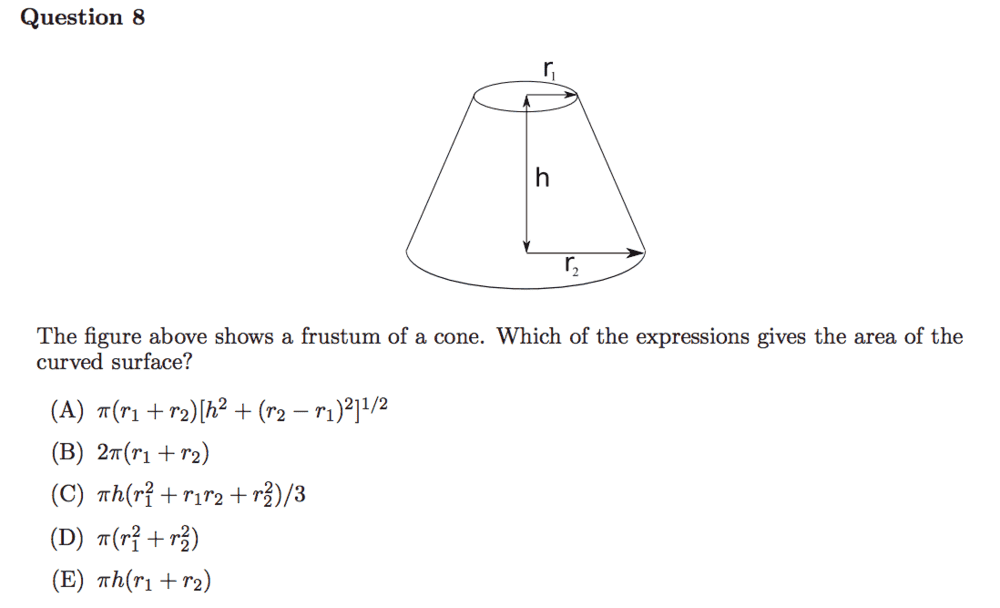
Please, refer to figure of post #8 above.
As you could see if you unfold that surface over a flat plane, what really determines the area of the curved surface of that figure are the height ##l## and the two lengths (##2\pi~r_1##) and (##2\pi~r_2##).
Since answer (A) is in terms of given ##h## and not ##l##, applying the Pythagorean theorem to the formed right triangle, you can see that ##l## is the hypotenuse, that ##(r_2-r_1)## is one of the sides and that ##h## is the other side.
Because of that, we have:
##l=\sqrt{h^2+(r_2-r_1)^2}##
If we could consider the flat form as a "curved rectangle", we could say that:
Area of flat surface = Average length x ##l##
Being that average length a middle circular arc running equidistant from the external and internal arcs.
The equation for that middle circular arc would be:
##Average~length = (2\pi~r_1+2\pi~r_2)/2 = \pi~(r_1+r_2)##
Do those two terms have some resemblance to answer (A)?