Why Is Light Not Refracted at the Planar Edge of a Planoconvex Lens?

  • Thread starter Thread starter slakedlime
  • Start date Start date
  • Tags Tags
    Optics
Click For Summary
SUMMARY

The discussion centers on the behavior of light at the planar edge of a planoconvex lens, specifically why light is not refracted when it strikes this edge at a 90-degree angle. Participants clarify that while light refracts at the curved edge due to varying speeds in different media, it does not bend at the planar edge because the incident rays are perpendicular to the surface. The conversation references a tutorial from the University of Neuchâtel and emphasizes the importance of understanding the normal line in optics. Misinterpretations of diagrams and explanations regarding refraction at different surfaces are also addressed.

PREREQUISITES
  • Understanding of basic optics principles, including refraction and the normal line.
  • Familiarity with planoconvex lens design and its optical properties.
  • Knowledge of light behavior at interfaces between different media.
  • Ability to interpret optical diagrams and applets.
NEXT STEPS
  • Study the principles of refraction using Snell's Law.
  • Explore the effects of chromatic aberration in optical systems.
  • Learn about the design and applications of planoconvex lenses in optics.
  • Investigate the role of the normal line in determining light behavior at interfaces.
USEFUL FOR

Students preparing for GCSE physics exams, secondary science teachers, and anyone interested in the fundamentals of optics and light behavior in lenses.

slakedlime
Messages
74
Reaction score
2
[SOLVED] Basic optics (GCSEs in 3 days, please help)

Homework Statement


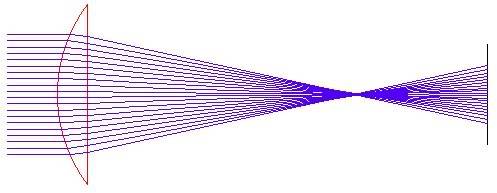
Here is a diagram of light passing through the curved edge of a planoconvex lens.
plano.jpg


When a light ray strikes the planar edge, it is not refracted. Why?

2. The attempt at a solution
The website the diagram came from: http://www-optics.unine.ch/education/optics_tutorials/plano_convex_lens_aberration.html

Light is refracted when it strikes the curved edge of the lens. I know that when light it is not refracted if it passes at 90 degrees to the border between the media. In the diagram, this isn't the case.

I've studied refraction with semicircular glass plates, but light is refracted when it passes out of the straight edge.

Any hints would be really useful.
 
Last edited by a moderator:
Physics news on Phys.org
It's to do with light traveling slower when it enters a denser medium.
If it strikes the curved edge then one end of the light ray will travel slower through the glass while the other is traveling at the original velocity through the air. This causes the light to turn towards the normal of the curve.
If the light ray hits the planar edge, it still enters into a denser medium and will have a lower velocity, but it will travel in a straight line. Imagine a car being the light ray and the glass being sand. When the car drives into the sand at an angle, one wheel will get onto it first, because the sand has more friction, the wheel will travel slower than the other wheel still on the road. This creates a turning effect. If you imagine a car driving into the sand at 90 degress it will not change direction.
Hope this helped.
 
slakedlime, as you have correctly pointed out, the light is refracted by the planar interface. I'm not really sure what they are trying to say... perhaps someone else has seen this before and can enlighten us.
Unless they mean reversing the lens so that the normally incident rays arrive at the planar surface first?
 
Last edited:
mda said:
Unless they mean reversing the lens so that the normally incident rays arrive at the planar surface first?

I know that incident rays arriving first at the planar surface aren't refracted because they strike the glass at 90 degrees (along the normal). I found that diagram as an applet on this site (which is about chromatic aberrations):

http://www-optics.unine.ch/education/optics_tutorials/plano_convex_lens_aberration.html

I pasted one of the diagrams here. It seems that light isn't bent after coming out of the planar surface. Maybe I'm mistaken? :redface:
 
Last edited by a moderator:
In the diagram you give (first post) it is refracted, you just cannot see it clearly, because it's not by a lot.
 
Maybe if you ignore whatever is happening first on the right (assuming the light is going right->left), and imagine the light is just a 'horizontal' beam, like the one in the centre.

Are they not just asking you to talk about the 'normal', as you did above?
 
timothy123 said:
Maybe if you ignore whatever is happening first on the right (assuming the light is going right->left), and imagine the light is just a 'horizontal' beam, like the one in the centre.

Would it be logical to assume that all the light rays are horizontal?

bsimmo said:
In the diagram you give (first post) it is refracted, you just cannot see it clearly, because it's not by a lot.
That's what I first thought, but the website said otherwise. It said that light striking the planar surface wasn't refracted. Maybe the writer was simplifying because the difference is so little?
 
slakedlime said:
When a light ray strikes the planar edge, it is not refracted. Why?
I'd say it was just a sloppy diagram. Light is refracted at both surfaces.
 
I'm a beginning secondary science teacher (admittedly with a biology specialism), and if I had to second guess a GCSE paper, I'd say it was simply asking why there is no refraction at A, whilst there is at B, in the diagram below:

http://img151.imageshack.us/img151/3686/flowroot5110jd8.png

Which you can do, no problem I think! I'm sure you're on track for a good mark.

Obviously, it's hard to say without seeing the paper.. :-)
 
Last edited by a moderator:
  • #10
slakedlime said:
That's what I first thought, but the website said otherwise. It said that light striking the planar surface wasn't refracted. Maybe the writer was simplifying because the difference is so little?
I think you are misreading what the website said. The only mention I saw was this:
"As you can see in the previous applet, if the light falls upon the planar interface, it is not bent, and the whole effect will be done by the curved interface. On the other way, the whole lens effect is shared between the two interfaces. Their "effort" is smaller for each interface, so the aberrations are smaller."​
In the first sentence, they are talking about parallel rays striking the plane surface first; since the rays are perpendicular to the plane surface, there is no refraction. But the second sentence correctly states that when parallel rays strike the curved surface first, refraction occurs at both interfaces.
 
Last edited:
  • #11
Oh, thank-you for pointing that out! :redface: I understand it now. Thanks for your help and time everyone!
 

Similar threads

  • · Replies 15 ·
Replies
15
Views
2K
  • · Replies 1 ·
Replies
1
Views
9K
  • · Replies 2 ·
Replies
2
Views
2K
  • · Replies 1 ·
Replies
1
Views
9K
  • · Replies 9 ·
Replies
9
Views
4K
  • · Replies 3 ·
Replies
3
Views
2K
  • · Replies 2 ·
Replies
2
Views
2K
  • · Replies 1 ·
Replies
1
Views
2K
Replies
1
Views
2K
  • · Replies 1 ·
Replies
1
Views
8K