Basic Question about a Ring Homomorphisms

  • Context: Undergrad 
  • Thread starter Thread starter Math Amateur
  • Start date Start date
  • Tags Tags
    Homomorphisms Ring
Click For Summary
SUMMARY

The discussion centers on the clarification of ring homomorphisms, specifically regarding the mapping from the zero ring to any arbitrary ring R as described in "An Introduction to Rings and Modules With K-Theory in View" by A.J. Berrick and M.E. Keating. Participants highlight that the mapping is not a ring homomorphism unless R is also the zero ring, due to the absence of a multiplicative identity in the zero ring. The critical point is that while the mapping f(0_T) = 0_R holds, the requirement for f(1_R) = 1_S cannot be satisfied, violating the definition of a ring homomorphism.

PREREQUISITES
  • Understanding of ring theory and definitions of ring homomorphisms.
  • Familiarity with the properties of the zero ring and its implications in algebra.
  • Knowledge of the concepts of multiplicative identity and additive identity in rings.
  • Basic understanding of algebraic structures and morphisms in mathematics.
NEXT STEPS
  • Study the definitions and properties of ring homomorphisms in detail.
  • Explore the implications of the zero ring in various algebraic contexts.
  • Investigate examples of mappings that do not satisfy the homomorphism properties.
  • Learn about the Hilbert Nullstellensatz and its relevance to ideals and rings.
USEFUL FOR

This discussion is beneficial for mathematicians, algebraists, and students studying abstract algebra, particularly those focusing on ring theory and homomorphisms.

Math Amateur
Gold Member
MHB
Messages
3,920
Reaction score
48
I am reading An Introduction to Rings and Modules With K-Theory in View by A.J. Berrick and M.E. Keating (B&K).

I need help to clarify a remark of B&K regarding ring homomorphisms from the zero or trivial ring ...

The relevant text from B&K reads as follows:

?temp_hash=93b8052059b87992d1f7fd12348dde3e.png

?temp_hash=93b8052059b87992d1f7fd12348dde3e.png

In the above text from B&K's book we read ...

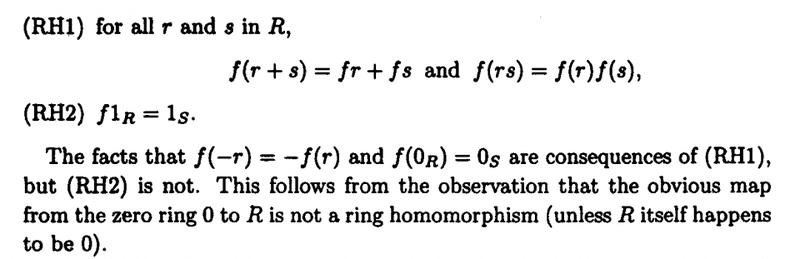
"... ... This follows from the observation that the obvious map from the zero ring to ##R## is not a ring homomorphism (unless ##R## itself happens to be ##0##). ... ... "
I do not understand the above statement that the obvious map from the zero ring to ##R## is not a ring homomorphism (unless ##R## itself happens to be ##0##) ... ...What, indeed do B&K mean by the obvious map from the zero ring to ##R## ... ... ?It seems to me that the obvious map is a homomorphism ... ..Consider the rings ##T, R## where ##T## is the zero ring and ##R## is any arbitrary ring ... so ##T = \{ 0 \}## where ##0 = 1## ...

Then to me it seems that the "obvious" map is ##f( 0_T) = 0_R## ... ... which seems to me to be a ring homomorphism ...

... BUT ... this must be wrong ... but why ... ?

Can someone please clarify the above for me ...

Some help will be very much appreciated ...

Peter
 

Attachments

  • B&K -1 - Section 1.1.6 Ring Homomorphisms - PART 1 ... ....png
    B&K -1 - Section 1.1.6 Ring Homomorphisms - PART 1 ... ....png
    17.6 KB · Views: 958
  • B&K -2 - Section 1.1.6 Ring Homomorphisms - PART 2 ... ....png
    B&K -2 - Section 1.1.6 Ring Homomorphisms - PART 2 ... ....png
    27 KB · Views: 894
Physics news on Phys.org
Math Amateur said:
I am reading An Introduction to Rings and Modules With K-Theory in View by A.J. Berrick and M.E. Keating (B&K).

I need help to clarify a remark of B&K regarding ring homomorphisms from the zero or trivial ring ...

The relevant text from B&K reads as follows:
?temp_hash=93b8052059b87992d1f7fd12348dde3e.png

?temp_hash=93b8052059b87992d1f7fd12348dde3e.png

In the above text from B&K's book we read ...

"... ... This follows from the observation that the obvious map from the zero ring to ##R## is not a ring homomorphism (unless ##R## itself happens to be ##0##). ... ... "
I do not understand the above statement that the obvious map from the zero ring to ##R## is not a ring homomorphism (unless ##R## itself happens to be ##0##) ... ...
If you require (RH2) to hold, then you need a ##1_0## which ##\{0\}## doesn't have.
What, indeed do B&K mean by the obvious map from the zero ring to ##R## ... ... ?It seems to me that the obvious map is a homomorphism ... ..Consider the rings ##T, R## where ##T## is the zero ring and ##R## is any arbitrary ring ... so ##T = \{ 0 \}## where ##0 = 1## ...

Then to me it seems that the "obvious" map is ##f( 0_T) = 0_R## ... ... which seems to me to be a ring homomorphism ...
You cannot say ##0=1##. There is no ##1## in ##T=\{0\}##. But your definition of ##f : T \rightarrow R## is correct.
... BUT ... this must be wrong ... but why ... ?
The only wrong here is ##1 \notin \{0\}## and thus (RH2) is violated. (In strict logic, the definition doesn't apply to ##\{0\}## at all, because it is not a ring with unity.)

What can be done with the usage of (RH1) is the following:
##f(r') = f(1_R \cdot r') = f(1_R) \cdot f(r')## so ##f(1_R) = 1_{f(R)}##.

Now this is the crucial point. We cannot conclude ##1_{f(R)} = 1_S## as we do in fields and groups.

E.g. in ##\mathbb{Z_9}## the ring of remainders of division by nine, there is ##1\,\cdot\,3 = 3 = 4 \,\cdot\, 3## but ##1 \neq 4##.
Therefore we need the additional property (RH2) to guarantee ##f(1) = 1##.
 
  • Like
Likes   Reactions: Math Amateur
fresh_42 said:
If you require (RH2) to hold, then you need a ##1_0## which ##\{0\}## doesn't have.

It does have one. The zero ring ##\{0\}## has ##0## as ##1_0##, hence ##1=0##. In the definition of a ring with unit, there is usually never the requirement that ##1\neq 0##. That requirement usually is present in fields though.
 
  • Like
Likes   Reactions: Math Amateur
micromass said:
It does have one. The zero ring ##\{0\}## has ##0## as ##1_0##, hence ##1=0##. In the definition of a ring with unit, there is usually never the requirement that ##1\neq 0##. That requirement usually is present in fields though.
Thanks. I'm still thinking of an example of a mapping ##f : R \rightarrow S## with ##f(r + s) =f(r)+f(s)## and ##f(rs)=f(r)f(s)## but ##f(1) \neq 1## which is not as simple as ##R=\{0\}##.
 
##f:\mathbb{R}\rightarrow \mathbb{R}[X]/(X^2-X):\alpha\rightarrow \alpha X##
 
  • Like
Likes   Reactions: Math Amateur and fresh_42
micromass said:
##f:\mathbb{R}\rightarrow \mathbb{R}[X]/(X^2-X):\alpha\rightarrow \alpha X##
Yes. ##r \rightarrow \alpha r## came to my mind, but to get rid of the square this way didn't come to my mind. Silly me, now I feel riled.
 
  • Like
Likes   Reactions: Math Amateur
Interesting ring R[X]/(X2 - X). Let's see — if there is a term [c Xn] (c ∈ R, n ≥ 2) in R[X]/(X2 - X) then we can add

[0] ≡ [-c Xn + c Xn-1] ≡ [-c (Xn - Xn-1)] ≡ [-cXn-2(X2 - X)] ≡ [-cXn-2]⋅[X2 - X]​

without changing it, to get (the equivalence class of) a monomial of lower degree. Since any element of R[X] contains only finitely many powers of X in the first place, we can reduce any term to a linear polynomial aX + b with a finite number of such operations.

So the elements of R[X]/(X2 - X) may be thought of by those coefficients (a, b), i.e., as elements of the plane R2. It looks provable that any element of R[X]/(X2 - X) has a unique representation in this form. Then addition is just what you might expect, i.e.,

(a, b) + (c, d) = (a+c, b+d).​

But what is the multiplication rule? I get that (using this representation):

(a, b) ⋅ (c, d) = (ad + bc + ac, bd),
which may be thought of as a map

mult: R2R2.​

Cool!

Question: Is it just a coincidence that (in this representation)

the sum of (the coefficients of the product) = (ad + bc + ac) + bd​

equals

the product of (the sums of coefficients) = (a + b) ⋅ (c + d) ?​
 
Last edited:
Thanks to fresh_42, micromass and zinq for the guidance and help ...

BUT ... I am still puzzling over my original question ...

Can you help with the original issue ...

Thanks again for your posts so far ...

Peter
 
-----
In the above text from B&K's book we read ...

"... ... This follows from the observation that the obvious map from the zero ring to R is not a ring homomorphism (unless R itself happens to be 0). ... ... "

I do not understand the above statement that the obvious map from the zero ring to R is not a ring homomorphism (unless R itself happens to be 0)
-----

Hint: There are two parts to the book's definition of a ring homomorphism. What happens when you try to prove each one of them to a map from the zero ring to an arbitrary ring? (I did not know where this went wrong until I tried it.) Remember that in the zero ring 0 = 1.
 
  • #10
Math Amateur said:
Thanks to fresh_42, micromass and zinq for the guidance and help ...

BUT ... I am still puzzling over my original question ...

Can you help with the original issue ...

Thanks again for your posts so far ...

Peter
In short: You cannot conclude ##f(1_R) = 1_S## by only the condition (RH1) given.

Homomorphisms of any kind means basically: preserving the structure. Here we have rings.
Thus ##f(r_1+r_2) = f(r_1)+f(r_2)## and ##f(r_1\,\cdot\, r_2) = f(r_1)\,\cdot\,f(r_2)## has to hold.

But what to do with the two neutral elements?
The ##0_R## is no problem, since ##f(0_R)=0_S## already follows from the above.
However, this can't be said about ##1_R##.
But to preserve / respect the whole structure from one ring ##R## to the other ring ##S##, one would expect to have ##f(1_R) = 1_S## as well. As it cannot be proven by (RH1), it is required for ##f## being a ring homomorphism: (RH2).

The examples above (I think all, but I didn't check) map ##1_R \longmapsto 0_S##.
This is something we would not like to be called a ring homomorphism as soon as ##S## has a ##1_S##, too.

But remember post #3. Therefore ##T= \{0\}## counts as an example, where ##1_T = 0_T##. In this case, ##f(1_R)=1_T=0_T## is allowed. There is a unit in both rings and (RH1) and (RH2) hold, even if it happens that in one ring the neutral elements coincide.

Edit: Homomorphism = homo (equal) morph (structure)
That's why, e.g. linear maps - ##L(\alpha x + \beta y) = \alpha L(x) + \beta L(y)## - are also called homomorphisms, or monomorphisms (injective), or epimorphisms (surjective), or isomorphisms (bijective), or automorphisms (bijective within the same underlying set). The same is true for groups, fields, algebras and rings and modules, although they all carry a different structure and therefore a different definition. But the structure itself is preserved by morphisms (name for it if categories are involved).
 
Last edited:
  • #11
one suggestion i have is to just forget about the zero ring as it essentially never arises in practice. At least I have spent my whole 40 year career without encountering it significantly. i.e. in my experience, when it arises it is uninteresting and can be ignored. actual math is usually not about such trivial things. at most you might be troubled now and then to check that your ring you are dealing with is not the zero ring, e.g. that the ideal you are dealing with in a quotient is not the whole ring. i.e. there is a reason it is called the trivial ring.

But this somewhat frivolous comment is just a late night throwaway. If you are enjoying solving the logical puzzle here, go ahead, it may be fun, and even enlightening. But don't lose a lot of sleep over it. It would be more useful to learn the Hilbert nullstellensatz, i.e. a criterion for when an ideal is the unit ideal, (so that if so, then the quotient is the zero ring).
 
Last edited:

Similar threads

  • · Replies 1 ·
Replies
1
Views
2K
  • · Replies 5 ·
Replies
5
Views
1K
  • · Replies 3 ·
Replies
3
Views
1K
  • · Replies 5 ·
Replies
5
Views
1K
  • · Replies 13 ·
Replies
13
Views
3K
  • · Replies 4 ·
Replies
4
Views
1K
  • · Replies 4 ·
Replies
4
Views
2K
Replies
2
Views
2K
  • · Replies 3 ·
Replies
3
Views
1K
  • · Replies 55 ·
2
Replies
55
Views
7K