Beam splitter, one photon, one detector?

Click For Summary

Discussion Overview

The discussion revolves around the behavior of photons in various scenarios involving beam splitters and detectors, exploring concepts related to quantum mechanics, wavefunctions, and time reversal. Participants examine specific cases with different configurations of detectors and the implications of these setups on measurement outcomes.

Discussion Character

  • Exploratory
  • Debate/contested
  • Technical explanation

Main Points Raised

  • One participant queries the probability of a single detector registering a photon when a beam splitter is used with one detector and empty space on the other side, suggesting possibilities of 100% or 50% chance.
  • Another participant asserts that the probability for the single detector in the first scenario is 50% and extends this claim to the second scenario involving a laser beam.
  • A different perspective is introduced regarding the second scenario, where it is suggested that both detectors would be continuously triggered if they are illuminated by the laser beam.
  • A follow-up question is posed about the effects of rotating the detector screen in a double slit experiment, raising concerns about wavefunction collapse and the implications of different configurations on measurement outcomes.
  • One participant suggests that the question of collapse is more manageable without invoking a collapse interpretation, proposing a calculation of amplitude at each point on the screen instead.
  • Another participant raises a question about the asymmetry in photon paths when considering time reversal, particularly in relation to the absence of a detector and the implications of photon emission events in a closed system.
  • Further discussion includes a challenge regarding the understanding of time-reversal invariance in quantum mechanics, with one participant correcting a previous assertion about the symmetry properties of the Hamiltonian.
  • Some participants express uncertainty about the utility of time reversal thought experiments in this context, indicating a lack of clarity on the implications of such considerations.

Areas of Agreement / Disagreement

Participants express differing views on the outcomes of the scenarios presented, particularly regarding probabilities and the implications of detector configurations. There is no consensus on the effects of time reversal or the interpretation of wavefunction collapse.

Contextual Notes

Participants note the complexity of the scenarios, including the dependence on definitions of measurement and the implications of detector placement. There are unresolved questions regarding the mathematical treatment of time reversal and its relevance to the discussed setups.

Idunno
Messages
42
Reaction score
1
I would like to know the results of a few scenarios with a beam splitter.
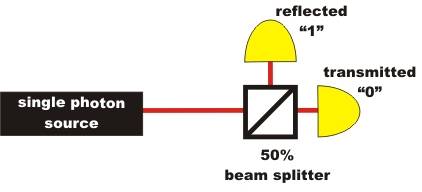
Quantenzufallsgenerator.jpg


(1) You send a single photon through a half silvered mirror with a reflector at either side, as above, but instead of having two detectors, and a 50% chance of either going off, you just have one detector, and where the other detector should be, there is just empty space for a long distance. What is the chance of the one detector going off? 100%? 50%?

(2) Same as before, but with a laser beam, not just one photon at a time, any difference?

(3) Two detectors, one photon at a time, but detectors are not equidistant, one further than the other.

Thanks, I am curious as to the results of this, but can't find an easy source.
 

Attachments

  • Quantenzufallsgenerator.jpg
    Quantenzufallsgenerator.jpg
    7.9 KB · Views: 1,254
Physics news on Phys.org
Well:

1) 50 percent
2) 50 percent
3) 50 percent

any objections ?
 
  • Like
Likes   Reactions: vanhees71
As I understand the problem, in case #2 both detectors will be continuously triggered (if their construction allows it) as they're both continuously illuminated.
 
Thanks for the reply(s).

Follow up question if you don't mind: What if, in a double slit experiment, you rotate the detector screen by 45 degrees or so? Usually the detector screen is parallel to the wall with the slits in it, but now it's at an angle. This make a difference? More intense signal at the edge closest to the slits perhaps?

The issue in my mind is: what if some of the wavefunction encounters a detector before the rest of the wavefunction encounters anything at all? In the case of the beamsplitter and one detector, "half" of the wavefunction encounters a detector, and the other half encounters nothing, can this make a difference to how collapse happens? Same deal with the rotated screen?
 
Last edited:
Idunno said:
can this make a difference to how collapse happens?
This question is much easier to handle if you don't use a collapse interpretation. You just calculate the amplitude at each point on the screen - it's the sum of the amplitudes through each slit, and the only difference is that the distance from the slits and hence the phase at any given point is different when the screen is tilted. Square the amplitude and you'll have your probability at each point.
 
Last edited:
  • Like
Likes   Reactions: vanhees71
Ah, Thank you. :)
 
Is there an asymmetry in the path without the detector when time reversed - the photon path apparently originating from "empty space for a long distance"?

Or, if the whole apparatus were enclosed within a box, that the path without the detector when time reversed has the photon path emission event located a little too conveniently at just the right place on the inner wall of the box?

These non-detector path time reverse emission events seem kind of fortuitously spontaneous... how are they understood?
 
bahamagreen said:
Is there an asymmetry in the path without the detector when time reversed - the photon path apparently originating from "empty space for a long distance"?

Or, if the whole apparatus were enclosed within a box, that the path without the detector when time reversed has the photon path emission event located a little too conveniently at just the right place on the inner wall of the box?

These non-detector path time reverse emission events seem kind of fortuitously spontaneous... how are they understood?
What is it you expect from bringing in time reversal ? (The wave equation is first order in time, there is no symmetry to be exploited)
 
That's of course wrong. As long as the Hamiltonian is time-reversal invariant (a symmetry is always a property of the Hamiltonian in QT), the Schrödinger equation is time-reversal invariant. You must not forget that time-reversal invariance is realized by an anti-unitary operator!
 
  • #10
Oops... my bad. I still have a hard time imagining what you can achieve with a time reversal thought experiment in this setup
 
  • #11
Well, I can't either...
 
  • Like
Likes   Reactions: BvU
  • #12
I can't tell if my question was answered or deflected, or if you think my question is wrong, or "not even wrong".
 

Similar threads

  • · Replies 1 ·
Replies
1
Views
1K
  • · Replies 4 ·
Replies
4
Views
1K
  • · Replies 8 ·
Replies
8
Views
2K
  • · Replies 1 ·
Replies
1
Views
2K
  • · Replies 7 ·
Replies
7
Views
2K
  • · Replies 20 ·
Replies
20
Views
2K
  • · Replies 1 ·
Replies
1
Views
2K
  • · Replies 5 ·
Replies
5
Views
2K
  • · Replies 13 ·
Replies
13
Views
2K
  • · Replies 3 ·
Replies
3
Views
3K