Bending Moment in two directions

Click For Summary
SUMMARY

The discussion centers on calculating the total bending moment at the midpoint of a beam subjected to forces acting in two directions. The user, Shaun, initially considers using the Pythagorean theorem to combine the moments, questioning whether to add them directly or use the square root method. A response clarifies that moments are vector quantities, emphasizing the importance of considering both magnitude and direction. The correct approach involves expressing the moments in their component form as M = Mx + My.

PREREQUISITES
  • Understanding of bending moments in structural engineering
  • Familiarity with vector addition and component analysis
  • Knowledge of moment diagrams and their significance
  • Basic principles of mechanics related to beams and forces
NEXT STEPS
  • Study the principles of vector mechanics in structural analysis
  • Learn how to construct and interpret moment diagrams
  • Explore the concept of moment equilibrium in beams
  • Investigate the effects of fixed and hinged supports on bending moments
USEFUL FOR

Structural engineers, civil engineering students, and anyone involved in analyzing beam mechanics and bending moments will benefit from this discussion.

shauntur
Messages
3
Reaction score
0
Not Really a homework question but it will help with how i go about the homework.

So i have a beam coming out of the wall and it has force acting on it like this:
Woops, that 20 on the side view should be a 10 :P
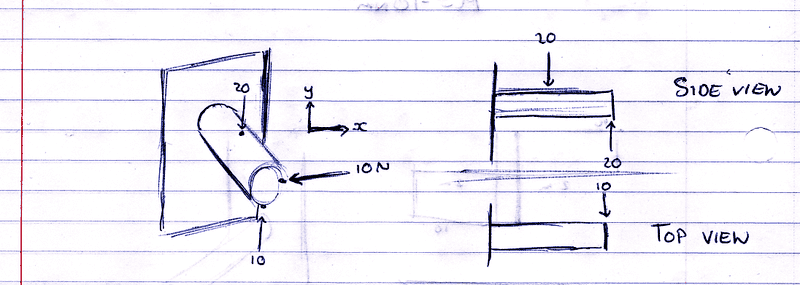
Untitled-1-4.png

What i want to find is the total moment at the mid point. I know how to find the moment in each direction but I am not sure if I am aloud to add them together or use pythag??
heres my solution for each direction:
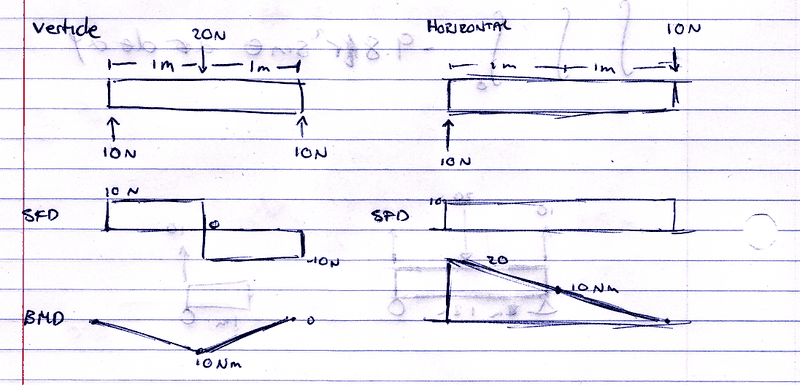
Untitled-2-1.png

Can i just go sqrt(10^2+10^2) to give me 10?
Thanks
Shaun
 
Physics news on Phys.org
shauntur said:
Can i just go sqrt(10^2+10^2) to give me 10?
Thanks
Shaun
Hi Shaun, welcome to PF!
Moments are vectors and as such, have both magnitude and direction. So aside from the fact that sqrt(10^2+10^2) = 10(sq root 2) :wink:, its magnitude, there is a direction associated with the moment also (what is it?). Sometimes it is best to leave the moment in its component form...M = Mx + My.
 
thanks heaps mate, probably shouldn't be doing engineering if i can't use pythag properly :-p
really appreciate ur help
 
In your M diagrams, the horizontal one shows an assumed hinge at the wall, whereas the vertical one assumes moment-fixity. This may not affect your answer to the moment at midpoint of the beam.
 

Similar threads

  • · Replies 4 ·
Replies
4
Views
3K
  • · Replies 9 ·
Replies
9
Views
4K
  • · Replies 2 ·
Replies
2
Views
3K
  • · Replies 11 ·
Replies
11
Views
3K
  • · Replies 2 ·
Replies
2
Views
3K
  • · Replies 2 ·
Replies
2
Views
3K
  • · Replies 16 ·
Replies
16
Views
4K
  • · Replies 9 ·
Replies
9
Views
2K
  • · Replies 4 ·
Replies
4
Views
3K
  • · Replies 1 ·
Replies
1
Views
2K