Bending moments about two different axes

Click For Summary
SUMMARY

This discussion focuses on the analysis of bending moments in a massless beam structure, specifically addressing the relationship between internal bending moments at different points along the beam. The participants clarify that while moments can be defined about different axes, the torque expressions must be consistent in their reference points. The key takeaway is that the internal bending moment at any point, denoted as ##M_x##, is influenced by the distribution of stress across the beam and must be understood in relation to the overall moment at the anchored end, ##M_A##. The conversation emphasizes the importance of recognizing the physical relationships between these moments for accurate structural analysis.

PREREQUISITES
  • Understanding of beam mechanics and internal forces
  • Familiarity with torque and moment calculations
  • Knowledge of stress distribution in structural elements
  • Basic principles of equilibrium in mechanical systems
NEXT STEPS
  • Study the principles of shear and bending moment diagrams
  • Learn about the relationship between internal forces and moments in beams
  • Explore the concept of couples and their effect on bending moments
  • Investigate the effects of different boundary conditions on beam behavior
USEFUL FOR

Mechanical engineers, structural analysts, and students studying beam theory and structural mechanics will benefit from this discussion, particularly those interested in the nuances of bending moment analysis.

etotheipi
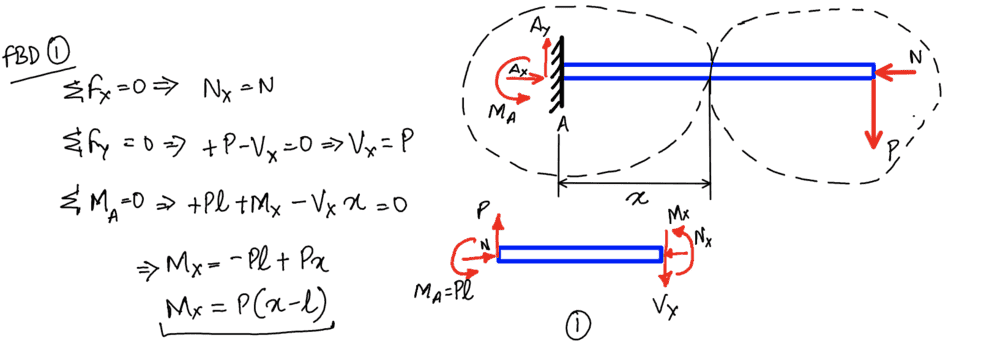
I was reading through a set of notes and found something a little odd. The aim is to solve the beam structure shown below, which is massless and of length ##l##.
1589116434300.png


By considering the beam as a whole, we obtain ##A_y = P##, ##A_x = N## and by taking moments about A we see ##M_A = Pl##.

However, now we consider a segment of the beam up to a distance ##x## along its length. We define the reaction forces and internal bending moments at this point to be ##N_x##, ##V_x## and ##M_x## as shown. The ##\sum F_x## and ##\sum F_y## parts are fine, but I wonder how they justify their third equation?

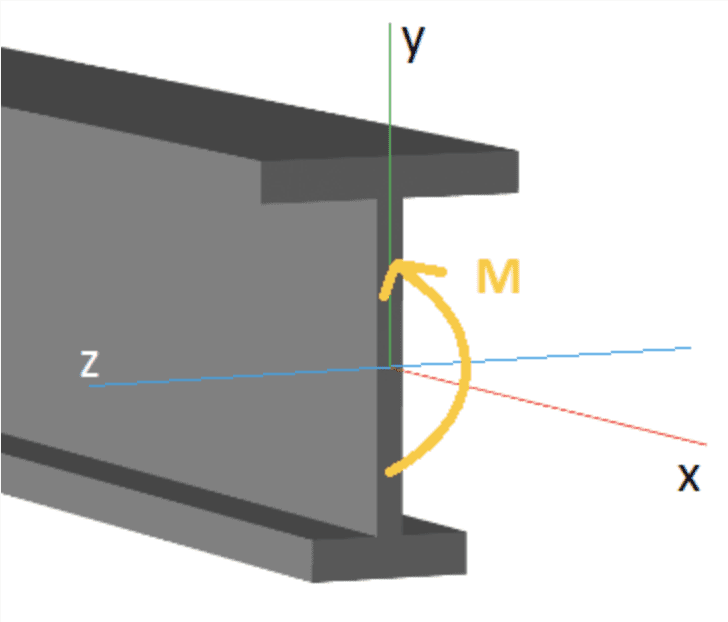
As far as I am aware, the internal bending moment at any point in the beam is taken about an axis passing through that point (N.B. we can really define 3 bending moments, but in this problem we only need the 1), like this:
1589116812882.png


##M_A## is taken about one axis, and ##M_x## is taken about another parallel axis displaced from the first axis by a distance ##x##. But when balancing torques, it only makes sense to add torques about the same axis!

I wondered then, why they used two torques about different axes in the same expression? Thanks!
 
Last edited by a moderator:
Engineering news on Phys.org
Imagine that the beam we have becomes only the x section and that a moment of magnitude P(L-x) is applied to that end, but not any force perpendicular to the beam, only the longitudinal N force.
We can achieve that by welding a lever to that end and applying two forces (which cancel each other) to it.
 
  • Like
Likes   Reactions: etotheipi
Lnewqban said:
Imagine that the beam we have becomes only the x section and that a moment of magnitude P(L-x) is applied to that end, but not any force perpendicular to the beam, only the longitudinal N force.
We can achieve that by welding a lever to that end and applying two forces (which cancel each other) to it.

I'm not sure I follow; I'm happy with considering a section of the beam and defining the internal forces at the cross section in the middle, I just don't see how the torque expression they give is valid. ##M_x## and ##M_A## are about different axes?

If we take moments about A, then the torque of the forces producing ##M_x## about an axis at ##x## will not be ##M_x## about an axis at A, since the lever arm of all of those forces have changed?
 
Last edited by a moderator:
I also don't know whether or not I am being of any help, perhaps I did not understand your question.
What I am trying to say is that the location and magnitude of Mx is real, in both my example and the original configuration.
One way or another, Mx is the reason for the existence of Ma at the anchored end of the beam.
 
  • Like
Likes   Reactions: etotheipi
Right, sure, but ##M_x## is the torque about an axis passing through ##x## caused by uneven distribution of stress across a cross section at ##x##, whilst ##M_A## is the torque about an axis through ##A##.

They take moments about ##A##, but include ##M_x## in their expression. I would argue that the torque produced by the uneven distribution of stress at ##x## is not ##M_x## when taken about ##A##.
 
It seems that you are back to the original idea. :smile:
If you don't mind, I would like to ask you to forget about the mathematical details for a minute.
Can you see the physical relationship between both moments?
 
  • Like
Likes   Reactions: etotheipi
I can see why there is a need for the bending moments on either side of the section of length ##x##. The ##M_x## arrow is really curling in the opposite direction.
 
  • Like
Likes   Reactions: Lnewqban
Exactly!
The beam must "smile" if equilibrium exists.
If we replace the anchoring of the left end of the beam with a hinge we eliminate the possibility of a reactive moment at that point.
Then, the beam would rotate around that point A, same with force P applied at the right end or with Mx applied at point x.
 
  • Like
Likes   Reactions: etotheipi
I wonder, are bending moments always caused by couples?

The moment of a couple is indeed invariant for all parallel axes, which would be a resolution.
 
  • Like
Likes   Reactions: Lnewqban
  • #10
etotheipi said:
I wonder, are bending moments always caused by couples?

The moment of a couple is indeed invariant for all parallel axes, which would be a resolution.
I would venture to respond yes to your question.
"Pure moments" do not exist in nature, we always have a force and a lever involved in such abstract concept.
But it is a very useful concept, nevertheless.

What makes bending or flexing of members the worse scenario in most cases of resistance of material and structural problems is the huge ratio of internal forces to available lever distances compared to the external forces and dimensions (in other words, how many times is a beam long compared to its sectional height).
 
  • Informative
Likes   Reactions: etotheipi
  • #11
Ah, awesome, thank you @Lnewqban!

In that case for a prismatic member in pure bending, with bending moments on each side ##\vec{M}_A## and ##\vec{M}_B##, the total moment about ##A## is also ##\vec{M}_A + \vec{M}_B## since the moment of the couple producing ##\vec{M}_{B}## about ##B## is the same as about ##A##. I have the feeling that on any cross-section, the effect of the internal forces can always be decomposed into a normal forces and two shear forces, and at the same time can be decomposed into a couple of moment ##\vec{M}##.

I have much respect for anyone who has understood all of the quirks of mechanical engineering, I thought I'd try my hand at it and have bee slightly taken aback at how many subtleties there are to it...
 
  • Like
Likes   Reactions: Lnewqban
  • #12
You are very welcome, etotheipi :smile:
I am glad that I could help you clarifying your question.
 
  • Like
Likes   Reactions: etotheipi

Similar threads

  • · Replies 9 ·
Replies
9
Views
3K
  • · Replies 3 ·
Replies
3
Views
2K
  • · Replies 2 ·
Replies
2
Views
3K
Replies
3
Views
1K
  • · Replies 11 ·
Replies
11
Views
3K
  • · Replies 4 ·
Replies
4
Views
2K
Replies
5
Views
37K
  • · Replies 3 ·
Replies
3
Views
7K
  • · Replies 9 ·
Replies
9
Views
2K
Replies
8
Views
7K