Between O- and F- which has higher electron affinity?

Click For Summary
SUMMARY

The discussion centers on the electron affinity of O- and F-, concluding that O- has a greater electron affinity than F-. This is due to O- requiring one more electron to achieve a stable configuration, while F- already possesses a stable electronic structure. Consequently, adding an electron to O- releases energy, whereas F- requires energy to accept an additional electron, making it less favorable. The key takeaway is that stability after electron addition is crucial in determining electron affinity.

PREREQUISITES
  • Understanding of electron configurations, specifically for O- and F-
  • Knowledge of electron gain enthalpy (EGE) concepts
  • Familiarity with stability principles in atomic structures
  • Basic grasp of energy changes during electron addition
NEXT STEPS
  • Research the concept of electron gain enthalpy (EGE) in detail
  • Study the stability of electronic configurations in various elements
  • Explore the differences in electron affinity across the periodic table
  • Investigate the implications of electron affinity in chemical reactions
USEFUL FOR

Chemistry students, educators, and professionals interested in atomic structure and electron behavior, particularly those focusing on electron affinity and stability in chemical species.

prakhargupta3301
Messages
58
Reaction score
1
Thread moved from the technical forums, so no Homework Template is shown
O-- 2s2 2p5
F-- 2s2 2p6 (Fully filled hence more stable.)
Since F- is fully filled as compared to O- wouldn't it require more positive electron gain enthalpy to gain one more electron than O-?
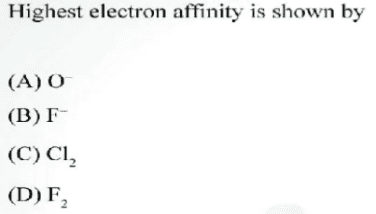
upload_2018-7-11_23-19-59.png

However, the correct answer is given (A)
Please tell me how.
Thank you for reading.
 

Attachments

  • upload_2018-7-11_23-19-59.png
    upload_2018-7-11_23-19-59.png
    7.9 KB · Views: 1,018
Physics news on Phys.org
prakhargupta3301 said:
Since F- is fully filled as compared to O- wouldn't it require more positive electron gain enthalpy to gain one more electron than O-?
Don't think in that way.

##O^{-}## requires one more electron to complete its stable configuration of [Ne]. On the other hand, ##F^{-}## already has the stable electronic configuration. So, it will not want to accept one more electron.

So, the electronic affinity of ##O^{-}## is greater than that of ##F^{-}##.

When thinking about electronics affinity, you will have to consider which species will become more stable after the addition of one more electron. The stability before the addition of electronic should not be considered.
 
  • Like
Likes prakhargupta3301
Wrichik Basu said:
Don't think in that way.

##O^{-}## requires one more electron to complete its stable configuration of [Ne]. On the other hand, ##F^{-}## already has the stable electronic configuration. So, it will not want to accept one more electron.

So, the electronic affinity of ##O^{-}## is greater than that of ##F^{-}##.
But isn't that the exact same reason why putting an electron in F- absorb higher amount of energy than O- will? Am I correct?
 
prakhargupta3301 said:
But isn't that the exact same reason why putting an electron in F- absorb higher amount of energy than O- will? Am I correct?
I've added a small explanation at the end:
Wrichik Basu said:
When thinking about electronics affinity, you will have to consider which species will become more stable after the addition of one more electron. The stability before the addition of electronic should not be considered.
Does that help?
 
Wrichik Basu said:
Don't think in that way.

When thinking about electronics affinity, you will have to consider which species will become more stable after the addition of one more electron. The stability before the addition of electronic should not be considered.
No one has ever told me that before. Can you also tell me why that is so?
 
prakhargupta3301 said:
No one has ever told me that before. Can you also tell me why that is so?
You're also forgetting that electronics gain enthalpy is the amount of energy released on addition of one electron to a species. Released, not absorbed. ##O^{-}## will release energy, whereas ##F^{-}## will require energy to take in one more electron.

If any species becomes unstable after taking in one more electron, it will try not to do that. ##F^{-}## already has stable configuration. Why would it disturb itself unnecessarily? ##O^{-}## requires one more electron to be stable, so it will readily do that.
 
  • Like
Likes prakhargupta3301
Wrichik Basu said:
You're also forgetting that electronics gain enthalpy is the amount of energy released on addition of one electron to a species. Released, not absorbed. ##O^{-}## will release energy, whereas ##F^{-}## will require energy to take in one more electron.

If any species becomes unstable after taking in one more electron, it will try not to do that. ##F^{-}## already has stable configuration. Why would it disturb itself unnecessarily? ##O^{-}## requires one more electron to be stable, so it will readily do that.
But isn't the second EGE always positive, so for O- and F- both will be positive. Hence energy is absorbed.
Also, since F- is more stable, it would require more energy to take one more electron. So..

Regarding this:
Wrichik Basu said:
If any species becomes unstable after taking in one more electron, it will try not to do that. ##F^{-}## already has stable configuration. Why would it disturb itself unnecessarily? ##O^{-}## requires one more electron to be stable, so it will readily do that.
Yes it will readily do that, but the energy (+ve hence absorbed) will be lesser. Isn't that the whole point?
Sorry if I'm bugging you, but I think there is something I still miss.
THank you for taking such great pains.
 
So higher positive EGE is actually lower negative EGE? Is that it?
THank you.
 
My mistake :headbang:

Yes, you're right. The second EGE of both Oxygen and Fluorine are positive. Both need more energy to take in one more electron. For oxygen, the size is small, and hence, another electron has to be pushed into the atom forcibly.

But fluorine has a higher second EGE than oxygen, making it more difficult (that is, more energy has to be supplied) to accommodate one more electron.
 

Similar threads

  • · Replies 0 ·
Replies
0
Views
2K
  • · Replies 4 ·
Replies
4
Views
15K
  • · Replies 3 ·
Replies
3
Views
2K
Replies
1
Views
18K
  • · Replies 7 ·
Replies
7
Views
7K
  • · Replies 1 ·
Replies
1
Views
3K
  • · Replies 6 ·
Replies
6
Views
3K
  • · Replies 9 ·
Replies
9
Views
9K
  • · Replies 15 ·
Replies
15
Views
2K
  • · Replies 4 ·
Replies
4
Views
3K