Binding energy of the electron in Hydrogen atom.

Click For Summary

Discussion Overview

The discussion revolves around the binding energy of the electron in a hydrogen atom, comparing different expressions and formulations derived from various sources. Participants explore discrepancies in the equations presented, which arise from differences in units, contexts, and assumptions related to the binding energy calculations.

Discussion Character

  • Debate/contested
  • Technical explanation
  • Mathematical reasoning

Main Points Raised

  • One participant notes discrepancies between three different expressions for binding energy, questioning why they differ despite all representing the energy of the electron bound to the nucleus.
  • Another participant asserts that all expressions essentially convey the same concept, specifically referencing the energy of the hydrogen atom in the nth state as En = -13.6 eV/n².
  • Concerns are raised about the use of different units in the first equation compared to the second and third, which may contribute to the discrepancies observed.
  • It is mentioned that the first equation uses Gaussian units, while the second and third are in SI units, which could explain the differences in results.
  • One participant expresses difficulty accessing the third source and suggests it approximates the binding energy of an electron in a solid as analogous to a hydrogen atom in a dielectric medium.
  • Another participant points out that the Ei in the third equation represents a different energy than En in the others, leading to further confusion regarding the relationships between the equations.
  • There is a suggestion that the differences may stem from typographical errors or variations in electromagnetic unit systems.
  • A later reply indicates that all three equations can be reconciled by considering the units and constants involved, although this approach is acknowledged as potentially flawed.

Areas of Agreement / Disagreement

Participants do not reach a consensus on the correctness of the equations, with multiple competing views remaining regarding their validity and the reasons for their discrepancies.

Contextual Notes

Limitations include the dependence on different unit systems (Gaussian vs. SI), potential typographical errors, and the specific contexts in which each equation is applied. The discussion remains unresolved regarding the absolute correctness of the equations.

otaKu
Messages
26
Reaction score
2
This website here says that the expression for binding energy for an electron is:
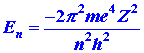
Image73.gif
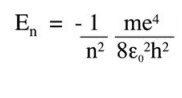
This http://ocw.mit.edu/high-school/chemistry/exam-prep/structure-of-matter/atomic-theory-and-atomic-structure/MITHFH_lecnotes05.pdfby MIT calculates it quantum mechanically to give:
Untitled.png
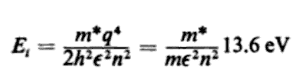
The book I was reading optoelectronics from says that the energy binding the electron to the impurity(ionic nucleus) is
Untitled.png
I am totally confused as to why there is a discrepancy between these results. Don't they mean the same(not talking about the inclusion of atomic number in first and effective mass in third)? Since all of these denote the energy of the electron bound to the core(nucleus) why do they differ?! Am I overlooking something and all three of these are correct? I would highly value any advice or explanation on this discrepancy. I've referred multiple sources and feel completely lost even though it is something very fundamental and basic. Thank you!
(Follow the links to see the sources for the equations)
 
Physics news on Phys.org
Essentially they are all saying the same thing, that the energy of the hydrogen atom with the electron in the nth state is given by

En= -13.6 eV/n2

The factor of Z2 refers to hydrogen-like atoms.

In the first or second formula the h should be h bar (h/2Pi). The last formula you presented is slightly more complicated because the lattice gives the electron an effective mass different from its isolated mass. I wouldn't worry about this until you take solid state physics.
 
DrSteve said:
In the first or second formula the h should be h bar (h/2Pi).

Even if I were to replace h by h/2π the formulas remain unequal. The 1st one has a π in it as well. I'd want to believe that the second one is correct but unfortunately the book I am reading seems to use the third one over and over which is essentially different from the second one even after I replace the h in second one with h/2π.
 
The first uses different units than the second and third.
 
The first equation uses Gaussian units. See this page of the lectures from which the first equation was taken, and notice how he writes Coulomb's law. Compare it to how the MIT notes write Coulomb's law.
 
  • Like
Likes   Reactions: otaKu
Google doesn't let me view the page from the third book, that you linked to, and I'm not familiar with that book, or with that field, so I'd better not try to guess what's happening here.
 
jtbell said:
Google doesn't let me view the page from the third book, that you linked to, and I'm not familiar with that book, or with that field, so I'd better not try to guess what's happening here.
The book's name is Optical Processes in Semiconductors by Pankove. He uses this equation to approximate the binding energy of an electron to it's parent impurity ion inside a solid by considering it as an hydrogen atom immersed in a dielectric medium. I'll post the image if it helps.
Untitled.png
 
Vanadium 50 said:
The first uses different units than the second and third.
what about the third one? It seems different than the rest of the two and I don't seem to figure out a way to link it to either of them.
 
jtbell said:
Google doesn't let me view the page from the third book, that you linked to, and I'm not familiar with that book, or with that field, so I'd better not try to guess what's happening here.
I substituted the corresponding values of the constants and the second one is definitely in the SI notation. The first one, as you say is in gaussian, though I need to validate it by putting in the values of the constants. I suppose the third one is wrong and we need to replace the 2 with 8 there to convert it to SI.
 
  • #10
The Ei in the third equation is a different energy from the En in the others. By letting En = - (13.6 eV)/n2 in the third equation, I get $$E_n = - \frac {mq^4} {2h^2 n^2}$$ which differs from the first equation by a factor of 1/(4π2), and from the second equation by a factor of ##4 \varepsilon_0^2##. It might be yet another system of electromagnetic units, or it might be simply the result of a typographical error somewhere else.
 
  • Like
Likes   Reactions: otaKu
  • #11
jtbell said:
The Ei in the third equation is a different energy from the En in the others. By letting En = - (13.6 eV)/n2 in the third equation, I get $$E_n = - \frac {mq^4} {2h^2 n^2}$$ which differs from the first equation by a factor of 1/(4π2), and from the second equation by a factor of ##4 \varepsilon_0^2##. It might be yet another system of electromagnetic units, or it might be simply the result of a typographical error somewhere else.
I get it now. All three are correct. Actually if we observe the coulomb law in SI and its counterpart in CGS we find that CGS units are such that the value of 1/4πε in CGS is 1. That is, ε(in CGS) = 1/4π. Substituting it in the third equations reduces it to 1st. *sigh* This might not be the best approach to do it but I guess it is correct. This thing consumed a hell lot of time. :/
Thank you everyone for their answers!
especially jtbell
 
  • Like
Likes   Reactions: DrSteve
  • #12
Those different systems of electromagnetic units can be a real pain in the <insert least favorite part of the anatomy here>. ?:)
 
  • Like
Likes   Reactions: DrSteve

Similar threads

  • · Replies 12 ·
Replies
12
Views
3K
  • Sticky
  • · Replies 2 ·
Replies
2
Views
11K
  • · Replies 10 ·
Replies
10
Views
3K
  • · Replies 11 ·
Replies
11
Views
5K
  • · Replies 14 ·
Replies
14
Views
2K
  • · Replies 2 ·
Replies
2
Views
3K
  • · Replies 1 ·
Replies
1
Views
3K
  • · Replies 5 ·
Replies
5
Views
2K
  • · Replies 5 ·
Replies
5
Views
2K
  • · Replies 4 ·
Replies
4
Views
2K